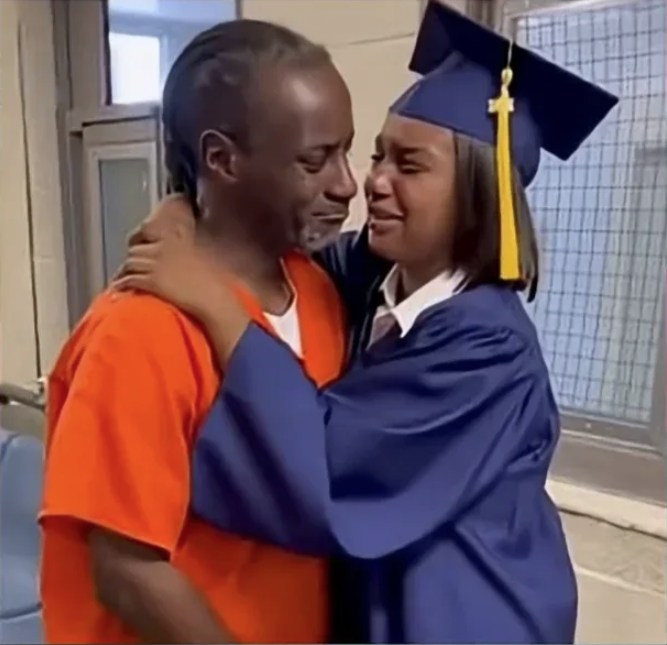
Mark had missed everything. Every birthday. Every milestone. Prom. The college acceptance letter. And now, graduation day. He sat in prison wearing his orange jumpsuit, shackled, carrying the weight of knowing that his choices had cost him the privilege of watching his daughter become the woman he’d always hoped she’d be.
When the guard told him he had a visitor, he assumed it was routine. Another brief conversation through barriers, another reminder of everything imprisonment takes away. He walked into the visiting room and froze.
There she stood. His daughter. Still in her cap and gown, tassel hanging, diploma in hand, tears streaming down her face. She’d skipped the parties. Skipped the celebrations with friends. Driven straight to the prison in her graduation regalia because she refused to let her father miss this moment.
“I did it, Daddy,” she whispered, moving into his arms as much as the shackles allowed. “I told you I’d make you proud.”
He held her as tightly as the cuffs permitted, sobbing into her shoulder. Pride and regret tangled together—pride in the remarkable woman she’d become despite his absence, regret for every moment he’d missed, for every way his incarceration had shaped her life.
“You didn’t miss it,” she said, her voice fierce through the tears. “I brought it to you.”
And she had. She’d driven to the prison in her graduation dress specifically so he could see her in it. So he could touch the diploma, see the tassel, witness the achievement even though he couldn’t sit in the audience and cheer. She refused to let prison walls completely separate them from this milestone. If he couldn’t come to graduation, she’d bring graduation to him.
That moment contained everything complicated about incarceration and family. The love that persists despite absence. The achievements that happen because of determination, not because circumstances were easy. The children who become remarkable adults while their parents watch from behind bars, carrying guilt and pride in equal measure.
Mark’s daughter could have resented him. Could have graduated without telling him, could have celebrated with friends who had parents free to attend. Could have let his incarceration create distance instead of bridging it with fierce, loyal love.
But she didn’t. She put on her cap and gown and drove to the prison because she understood something profound: that her father’s mistakes didn’t erase his love, that his absence didn’t mean he didn’t care, that being incarcerated didn’t mean he’d stopped being her father.
She gave him something precious that day. Not just the sight of her in graduation regalia, but the gift of being included. Of not missing everything. Of being part of her achievement even though his circumstances meant he couldn’t be there the traditional way.
Incarceration punishes families, not just individuals. Children grow up without parents. Milestones happen behind walls. Birthdays and graduations and ordinary Tuesdays pass with visits measured in minutes and conversations monitored by guards. The punishment extends beyond the person who committed the crime, touching everyone who loves them.
But love persists anyway. Children keep achieving. Families keep connecting. Daughters keep driving to prisons in their graduation gowns because refusing to let their fathers witness their proudest moments would hurt more than the effort it takes to bring those moments to them.
Mark held his daughter and felt the tassel brush against his face. Felt the diploma she’d worked so hard for. Heard her voice telling him she’d made him proud, that he hadn’t missed it after all, that she’d brought her achievement to him because that’s what love does—it finds ways to bridge impossible distances.
He’ll carry that moment for the rest of his sentence. When regret threatens to drown him, when guilt makes him question whether he deserves his daughter’s love, he’ll remember her standing there in cap and gown, tears on her face, diploma in hand, choosing to include him in her triumph.
She graduated. Succeeded. Achieved despite the challenge of having an incarcerated father. And then she drove to the prison to make sure he knew: You didn’t miss it. I brought it to you.
That’s love. Not the easy kind that exists when circumstances are perfect, but the fierce kind that persists despite imperfect circumstances. The kind that puts on a graduation gown and drives to a prison because even walls and shackles and orange jumpsuits can’t completely separate a father from his daughter’s proudest moment.