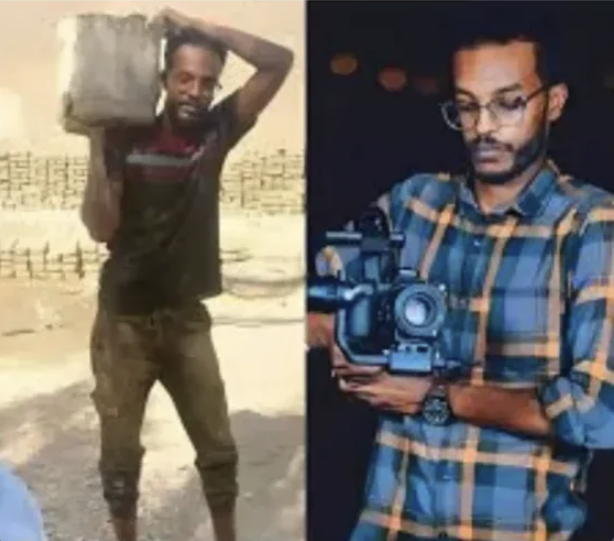
He was one of the best photographers in Khartoum. His work was recognized, respected, sought after. He held the top position in his field—the kind of professional achievement that takes years to build, that comes with status and security and the satisfaction of mastery. Photography wasn’t just what he did; it was who he was.
And then circumstances changed. War, economic collapse, displacement—the details matter less than the result. Suddenly, the work that had defined him disappeared. The equipment, the clients, the studio, the entire infrastructure of his professional life—gone. And in its place: survival mode. The desperate arithmetic of figuring out how to eat, how to shelter his family, how to keep going when everything you built has been taken away.
He could have stopped. Could have waited for better circumstances, for the situation to improve, for the world to return to some version of normal that might never come. He could have mourned what he’d lost and let that mourning paralyze him. Many people do. It’s not weakness—it’s grief. It’s the overwhelming weight of watching your identity dissolve and not knowing how to rebuild it.
But instead, he found different work. Not photography. Probably manual labor. Probably something that didn’t require the skill he’d spent decades developing. Probably something that people with his former status would consider beneath them.
He carries supplies on his back now. Works with his hands. Does whatever needs doing to earn enough to survive. And when people look at him—when they see a man who was once the city’s top photographer now doing menial labor—he meets their gaze with something powerful.
Not shame. Not apology. Not the downcast eyes of someone who believes they’ve failed.
Dignity.
“Work is never shameful,” he says.
Four words that carry the weight of a philosophy most people spend lifetimes trying to learn. Four words that reject the toxic hierarchy that says some labor is noble and some is degrading. Four words that insist your value isn’t determined by your job title, your salary, or how much prestige your profession carries.
Work is never shameful. Whether you’re operating a camera or carrying bricks. Whether you’re creating art or cleaning floors. Whether you’re at the top of your field or just trying to make it through another day. The labor itself—the act of contributing, of earning, of refusing to give up—that’s what matters.
This photographer understands something that eludes many people even in comfortable circumstances: your work doesn’t define your worth. Your response to adversity does. Your ability to adapt, to persevere, to maintain your dignity when the world tries to strip it away—that’s what reveals who you are.
The photo shows him in two states. On the left, carrying supplies, wearing work clothes, doing the labor that keeps him alive. On the right, holding a professional camera, dressed well, looking like the accomplished photographer he was—and, in some fundamental way, still is. Because losing the tools of your trade doesn’t erase the skill. Losing your position doesn’t erase your identity. Circumstances can take away your opportunities, but they can’t take away what you know, what you’ve learned, what you’re capable of.
He’s the same person in both images. The same mind. The same hands that once captured beautiful photographs now carry heavy loads. The same determination that made him excellent at his craft now makes him excellent at survival.
There’s something profoundly countercultural about his stance. We live in a world obsessed with titles, with status markers, with the external signifiers of success. We’ve built entire social hierarchies around what people do for a living, as if your profession determines your humanity. As if lawyers are worth more than janitors. As if white-collar work is inherently more valuable than manual labor.
But this photographer rejects that entire framework. He knows what many people refuse to accept: that all honest work has dignity. That earning your living through effort—any effort—is honorable. That shame has no place in survival.
His resilience is teaching a lesson that privileged people often miss. When you’ve never had to worry about where your next meal comes from, when your career path has been relatively smooth, when circumstances have generally bent in your favor, it’s easy to develop unconscious contempt for people doing work you consider beneath you. It’s easy to judge people for “failing” to maintain their status, for “settling” for lesser work, for not demonstrating the ambition or drive you imagine you’d have in their situation.
But this man is demonstrating something else entirely. That maintaining your dignity when everything else is stripped away requires more strength than climbing a career ladder ever does. That adapting to circumstances you didn’t choose takes more courage than succeeding in circumstances designed for your success. That there’s profound nobility in doing whatever needs to be done to take care of yourself and your family, regardless of how it looks to people who’ve never faced that choice.
He’s not waiting for rescue. He’s not expecting the world to restore what it took. He’s just working. Just surviving. Just refusing to let circumstances define his sense of self-worth.
And in doing so, he’s offering something valuable to everyone who sees his story: permission. Permission to let go of the shame that comes with setback. Permission to do what needs doing without apologizing for it. Permission to measure your worth by your character rather than your circumstances.
Because the truth is, most people are one or two disasters away from similar situations. Economic collapse, medical crisis, natural disaster, war—the factors that can dismantle a life are numerous and largely outside individual control. The photographer’s journey from respected professional to day laborer isn’t a cautionary tale about personal failure. It’s a reality check about how fragile security actually is.
But it’s also a testament to human resilience. To our capacity to adapt, to endure, to maintain our core sense of self even when the external markers of identity disappear. He was a photographer. He is a photographer, even if he’s not currently photographing. Because your skill doesn’t expire. Your knowledge doesn’t evaporate. Your worth doesn’t diminish.
Work is never shameful. Whether you’re photographing weddings or carrying supplies. Whether you’re where you thought you’d be or somewhere you never imagined. Whether you’re living your dream or just living through another day.
The labor that keeps you alive, that feeds your family, that lets you maintain your dignity in the face of circumstances that could easily break you—that labor is honorable. Always.
This photographer knows it. He lives it. And in doing so, he’s teaching the rest of us something we desperately need to learn: that resilience looks like continuing. That dignity looks like refusing to be ashamed. That strength looks like adapting when you can’t overcome.
He’s still the best photographer in Khartoum. Even if he’s not currently holding a camera. Because excellence isn’t just about skill—it’s about character. And his character is proving itself every single day, in work that society might dismiss but that he refuses to diminish.
Work is never shameful. And neither is survival. And neither is he.