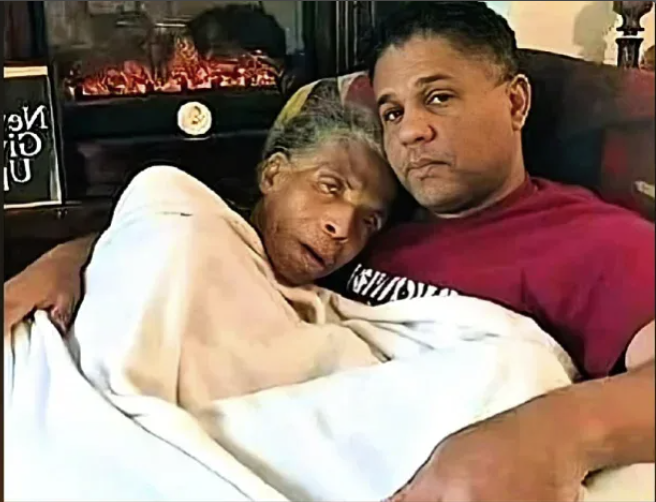
He holds his mother the way she once held him. Gently. Carefully. With the kind of tenderness that comes from understanding how fragile life becomes when age takes what strength used to be.
She’s small now, diminished by time and illness, her body frail in a way that would have seemed impossible decades ago when she was the strong one, the caregiver, the person who held everything together. But age changes everyone, and now she needs the kind of care she once provided without question or hesitation.
So her son holds her. And remembers.
He remembers being a baby, crying in the night, and her footsteps coming to comfort him. She stayed up all night when he was sick—not because she wanted to, but because that’s what mothers do. She paced the floor with him when he couldn’t sleep, her own exhaustion irrelevant compared to his need. She held him through fevers and nightmares, through growing pains and teenage heartbreak, through every moment when the world felt too big and scary and he needed someone to make it smaller and safer.
She packed his lunch even when she was tired. Made breakfast before school even when she’d worked late the night before. Showed up to every game, every concert, every mundane Tuesday afternoon event because her presence mattered more than her exhaustion. She smiled at him when he felt lost, reminding him without words that he wasn’t alone, that someone believed in him even when he didn’t believe in himself.
She gave him her last bite of food when money was tight. Her warm hugs when his heart was broken. Her quiet prayers when he faced challenges she couldn’t fix. She gave him everything without ever asking for anything in return. That’s what mothers do—they pour themselves out completely, never keeping a ledger, never expecting repayment, never treating love like a transaction that requires balance.
Now it’s his turn.
He holds her like she once held him—not out of obligation, but out of love. Because somewhere along the way, he learned what she’d been teaching him all along: that love isn’t just about the big moments. It’s about showing up. It’s about staying when things get hard. It’s about giving without counting the cost.
She can’t do everything she used to do. Can’t stand for long periods or remember things the way she once did. Can’t provide the same kind of care she gave him for so many years. But she’s still his mother—the person who shaped him, who taught him what it means to love unconditionally, who sacrificed more than he’ll ever fully comprehend so that he could have the life he has now.
So he becomes what she needs. He adjusts her blankets and monitors her medications. He listens to the same stories she tells repeatedly, never interrupting to mention he’s heard them before. He holds her hand and tells her she’s safe, the same words she whispered to him decades ago when he was the one who needed reassurance.
He gives that love back. Not because he can ever repay what she gave him—that debt is unpayable, and anyway, she never considered it a debt. He gives it back because that’s what you do when someone pours themselves out for you. You catch what they give, you let it shape you, and when the time comes, you become the giver.
She’s my strength, he says. My peace. My biggest blessing.
And he means it. Because even now, diminished by age and dependent on care, she’s still teaching him. Still showing him what matters. Still reminding him that the greatest legacy isn’t money or achievements or any of the things the world tells us define success. The greatest legacy is love—the kind that stays up all night with sick children, that packs lunches when exhausted, that smiles when you feel lost, that gives everything and asks for nothing.
She gave him that. And now he gets to give it back.
This is the circle of love that defines families at their best. Parents pour themselves into their children, not expecting anything in return but hoping—maybe unconsciously—that their children will learn what unconditional love looks like. And then, if the circle completes itself, those children grow into adults who understand that love isn’t just received. It’s practiced. It’s given back. It’s the way we honor the people who gave us everything by giving them the same care they once gave us.
He holds his mother like she once held him. And in that embrace, years collapse—he’s both the baby she comforted and the man who comforts her now. She’s both the strong woman who held everything together and the fragile one who needs holding. They’re both givers and receivers, teachers and students, strong and weak in turns.
That’s what real love looks like. It doesn’t keep score. It doesn’t measure who gave more or demand equal exchange. It simply shows up, stays present, and gives what’s needed when it’s needed. It holds when holding is required. It stays up all night if that’s what someone needs. It gives the last bite, the warm hug, the quiet prayer. It pours itself out completely and calls it blessing, not burden.
May God bless all mothers. The ones who gave everything. The ones who taught us what love means. The ones who held us when we were small and now need us to hold them. May they know, even as their strength fades, that the love they planted grew into something that will hold them safely until the very end.
And may all of us—sons, daughters, children who were once held—remember what we learned from the people who loved us first. May we become the holders when our time comes. May we give back the care we were given. May we complete the circle with grace and gratitude.
Because that’s what love does. It comes full circle. And when it does, it’s the most beautiful thing in the world.