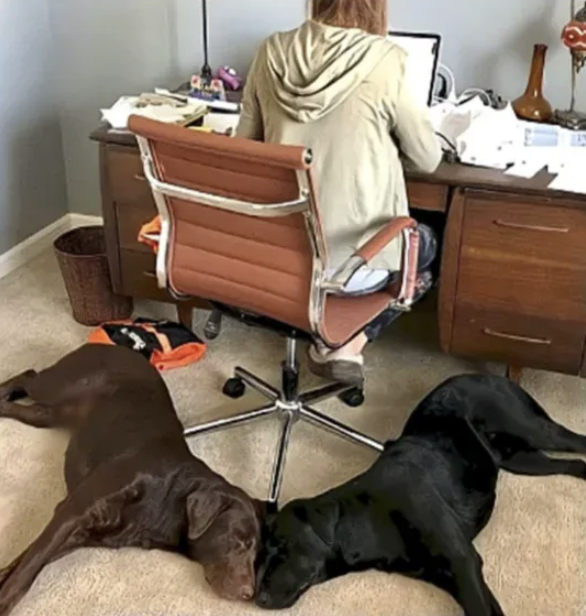
It was nothing, really. Just a disagreement. The kind that happens in every relationship—a difference of opinion, a misunderstood tone, the usual friction that comes with sharing a life with another person. Nothing loud. Nothing dramatic. Just two people in a room, tension hanging in the air like humidity before a storm.
But the dogs knew.
They didn’t bark. They didn’t whine. They simply moved. Quietly, deliberately, they positioned themselves between the couple—one dog near him, one near her—standing guard without a sound. Their eyes were watchful, their bodies still, as if they had appointed themselves mediators of a conflict they didn’t fully understand but sensed needed their presence.
The couple continued talking, voices careful, each trying to make their point without escalating. And through it all, the dogs stayed put. Unmoving. Alert. Waiting.
It wasn’t until later—after the tension had dissolved, after apologies and understanding had softened the edges—that the dogs finally relaxed. They drifted off to sleep, their vigilance no longer needed. And when the couple made up, truly made up, the dogs’ tails wagged with an enthusiasm that seemed to say: We’ve been waiting for this.
There’s something humbling about being watched over by creatures who don’t speak your language but understand your heart. Dogs don’t process conflict the way humans do. They don’t parse out who’s right or who’s wrong. They only know when something feels off, when the people they love are out of sync. And their response isn’t to choose sides—it’s to stand between, to hold space, to remind everyone in the room that love is still present even when voices are tense.
The photo captures it perfectly: two dogs lying on the floor of a home office, positioned between the couple’s desks like furry diplomats. Their presence is quiet but undeniable. They’re not doing anything extraordinary—just existing in the space where tension used to be. But sometimes, that’s enough.
We often think of dogs as loyal, as loving, as playful. But we don’t always recognize them as peacekeepers. As the ones who sense when the emotional temperature shifts and step in, not with judgment, but with presence. They don’t fix the problem. They don’t offer solutions. They just remind us that we’re not alone, that someone is watching, that the love in the room is bigger than the disagreement.
And when it’s over—when the air clears and laughter returns—they celebrate like it was their victory too. Because in a way, it was. They stood guard over something fragile and precious: the bond between two people learning to navigate life together. And when that bond held, their tails wagged like crazy, as if they had been waiting for that moment all along.
Because they had been.