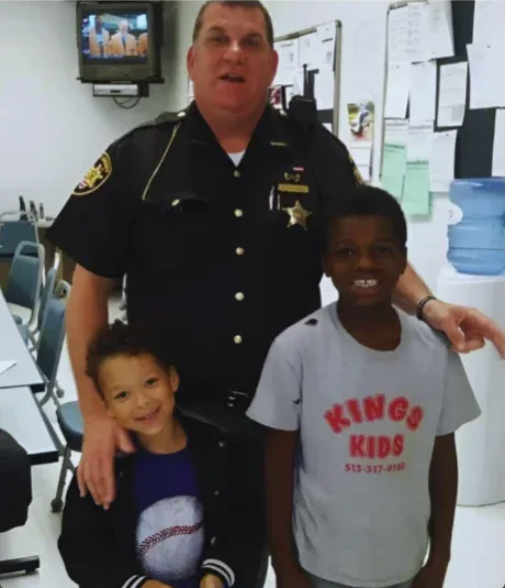
Deputy Bussell found them in the lobby. A mother and her two young boys, sleeping on chairs that weren’t designed for sleeping, their belongings in bags that told the story of people who’d run out of options. They were homeless—not by choice, not because they hadn’t tried, but because sometimes life breaks people and the systems designed to catch them fail.
The shelters were full. All of them. Every bed occupied, every space claimed by someone else who’d also run out of options. The mother had called everywhere, tried every resource, followed every suggestion social services gave her. But full is full, and when you’re homeless with two small children and no place to go, you end up in a hotel lobby hoping no one kicks you out before morning.
Deputy Bussell could have done what procedure required. Take a report, make some calls, connect the family with social services, and move on to the next call. His job was law enforcement, not social work. Not his responsibility to solve homelessness or fix broken systems. He’d done his duty by checking on them.
But he didn’t move on.
Instead, he pulled out his own wallet and paid for a ten-day hotel stay. His money. Not a departmental fund or a charity program. His personal savings used to give a homeless family ten days of safety, of beds instead of lobby chairs, of a place where the boys could sleep without fear and their mother could rest without worrying about where they’d go when morning came.
He didn’t stop there. He took them shopping—food, clothes, necessities that most people take for granted but become luxuries when you’re homeless. When the boys asked shyly if they could get shoes, he didn’t hesitate. He bought everything they needed, filling bags with the ordinary items that make life livable.
He kept it quiet. Didn’t tell anyone, didn’t post about it, didn’t use his kindness as content for social media. He just did what he felt was right and went back to his job, expecting nothing in return.
But someone noticed. A viral post revealed his kindness—not because he wanted recognition, but because the world needs to know that people like Deputy Bussell exist. That some people see suffering and respond not with policy or procedure, but with immediate, generous action.
Ten days in a hotel doesn’t solve homelessness. Deputy Bussell knew that. The mother probably knew it too. When those ten days ended, she’d still face the same systemic failures that had left her and her children sleeping in a lobby in the first place. The shelter beds would still be full. The affordable housing would still be out of reach. The social safety net would still have gaping holes that families fall through.
But for ten days, that family was safe. For ten days, the boys slept in real beds. For ten days, their mother could breathe without carrying the constant terror of where they’d sleep that night. For ten days, they experienced what everyone deserves but not everyone gets—basic security, basic dignity, basic acknowledgment that their lives matter.
And sometimes ten days is everything. Sometimes it’s the bridge between crisis and stability, the breathing room that lets someone gather strength to keep fighting. Sometimes it’s the difference between giving up and finding hope again. Sometimes it’s just knowing that one person saw you suffering and cared enough to help.
The boys will remember Deputy Bussell. They’ll remember being homeless and scared, sleeping in a lobby with their mother, feeling like the world had forgotten them. But they’ll also remember the deputy who bought them shoes and food, who gave them ten days of safety, who proved that even when systems fail, individuals can still show up with compassion.
That matters more than we realize. Children who grow up experiencing both hardship and kindness learn something essential—that the world holds both cruelty and compassion, and we get to choose which one we embody. They’ll face struggles as they grow. They’ll encounter people who look away from suffering. But they’ll also remember the deputy who didn’t look away, who used his own money to help strangers, who proved that one person’s kindness can matter enormously.
Deputy Bussell’s gesture wasn’t about solving homelessness. It was about seeing specific people in immediate need and responding with whatever resources he had. It was about recognizing that sometimes the most powerful thing we can do is simply help the person right in front of us, even if we can’t fix every systemic problem that created their situation.
We need both—people working to change systems and people showing up with immediate help. We need policy reforms and we need deputies who pay for hotel rooms. We need structural solutions and we need individuals who buy shoes for homeless children. Both matter. Both are necessary.
But on that day, in that lobby, what that family needed most wasn’t policy or programs. They needed one person with resources who was willing to share them. They needed Deputy Bussell.
And he showed up. He saw them. He helped them. He kept it quiet until someone else revealed his kindness, and even then, he probably brushed off the recognition because that’s what people like him do—they help because it’s right, not because they want credit.
The viral post revealed his kindness to thousands of strangers. But for one mother and her two boys, Deputy Bussell’s kindness wasn’t just a viral moment. It was ten days of safety. It was food and shoes and dignity. It was proof that even when systems fail and shelters are full and options run out, sometimes one person steps up with exactly what you need.
That’s heroism. Not the kind with uniforms and ceremonies, but the quiet kind that happens in hotel lobbies and shopping trips, the kind that uses personal resources to meet immediate needs, the kind that sees suffering and simply responds because that’s what decent humans do when they have the means to help.