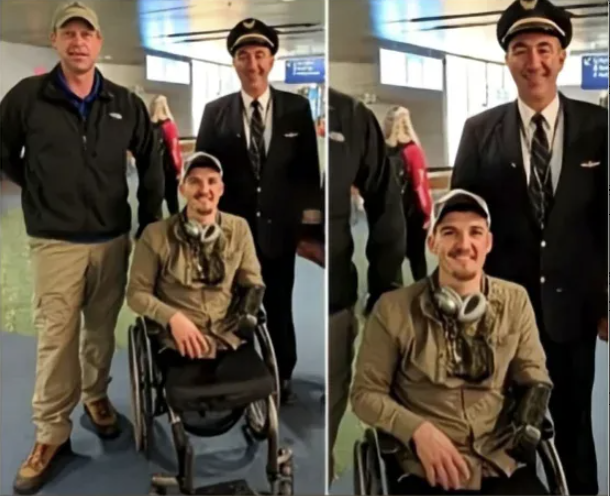
The pilot was standing nearby as he got out of his wheelchair to board his flight to Portland. Just standing there, watching, the way airline crew sometimes do during boarding. The flight attendant offered to carry his bag, and he accepted gratefully—transferring from wheelchair to seat requires enough effort without managing luggage.
After he’d thrown himself into his seat—that particular motion people with certain injuries develop, efficient but never quite graceful—the pilot approached. “Were you in the military?” he asked.
“Yes,” the veteran replied, not thinking much of it. People ask veterans these questions sometimes. Thank you for your service follows, and then everyone moves on.
But the pilot asked something more specific: “Afghanistan 2010?”
The veteran froze. Afghanistan 2010 wasn’t a guess. That was a very specific time and place. “Yessss,” he replied slowly, confused and surprised.
The pilot’s face changed. Recognition and emotion flooding through simultaneously. “I recognized your face and injuries and had always wondered if I survived.”
The words hung there for a moment before their full meaning landed. This pilot—Marc Vinceguerre—had flown him out of Afghanistan. Had transported a critically wounded soldier from battlefield to medical evacuation, probably one of dozens or hundreds of wounded he’d flown during his deployment. But this one face, these specific injuries, had stayed with him. For years, he’d wondered if this soldier had made it.
And now here they were. Airport terminal. Commercial flight to Portland. The wounded soldier healthy enough to travel independently, the military pilot now flying civilian routes. Both of them having survived Afghanistan and built lives beyond it, intersecting randomly—or not so randomly—years later.
Small world doesn’t quite capture it. This wasn’t running into a high school classmate at a restaurant. This was a pilot encountering the face he’d wondered about for over a decade. This was a veteran meeting the person who’d flown him toward survival when death seemed more likely. This was two people whose lives had intersected in the worst possible circumstances reuniting in the most ordinary setting.
They took photos together. Smiling. The pilot in his uniform, the veteran in his wheelchair, both of them present and alive when that outcome hadn’t been guaranteed. Both carrying Afghanistan with them but no longer defined solely by it.
Marc Vinceguerre had flown countless wounded soldiers. Each face, each injury, each desperate evacuation probably blurred together eventually—the self-protective amnesia that military personnel develop when processing individual trauma would break you. But some faces stick. Some injuries haunt you. Some evacuations make you wonder for years afterward: Did that one make it? Did I get them out fast enough? Are they alive somewhere?
For this veteran, Marc Vinceguerre wasn’t just a pilot. He was the person who’d flown him toward survival. Who’d gotten him out of Afghanistan and into medical care that would eventually allow him to build a life, travel independently, board commercial flights to Portland. He was part of the chain of people who’d kept him alive when dying seemed inevitable.
And now they stood together in an airport terminal, proof that both had survived. That the evacuation had worked. That years later, they’d both built lives beyond Afghanistan—one flying commercial passengers, one traveling to Portland, both carrying injuries visible and invisible but still here, still living.
The veteran will never forget that moment. Getting out of his wheelchair, settling into his seat, expecting a routine flight, and instead coming face-to-face with the pilot who’d flown him out of a war zone. The shock of recognition. The overwhelming gratitude. The strange, beautiful coincidence that brought them together again.
And Marc Vinceguerre finally got his answer. The face that haunted him, the injuries he remembered, the soldier he’d always wondered about—survived. Made it home. Built a life. Travels to Portland. Lives.
Sometimes small world means nothing more than unexpected coincidence. But sometimes it means two people whose lives intersected during the worst possible circumstances finding each other again during the most ordinary one. Sometimes it means a pilot finally knowing that yes, that soldier survived. Sometimes it means a veteran getting to thank the person who flew him toward life when death was so close.
Afghanistan 2010. An airport terminal. A pilot and a veteran. And the incredible, impossible gift of reunion.