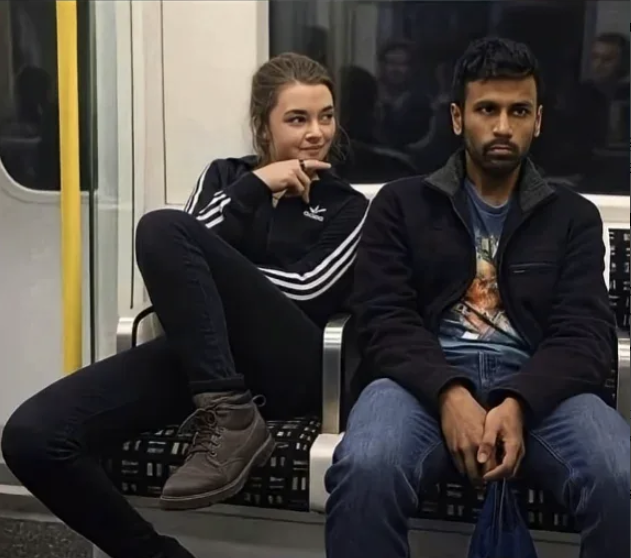
The photograph went viral almost immediately. A young Indian boy sitting on a German metro beside actress Maisie Williams, star of one of the biggest television shows in history. Her face was instantly recognizable to millions. His face was unknown to everyone except perhaps a few people back home who were wondering where he was, if he was safe, if he’d ever return.
Der Spiegel, Germany’s major news magazine, saw the photo circulating online and became curious about the boy who seemed so unbothered by his famous seatmate. In a world where people interrupt celebrities constantly, where fans create scenes and demand attention, here was someone sitting calmly beside a world-famous actress as if she were just another passenger.
So they searched for him. And eventually, they found him in Munich—living without legal documents, navigating each day with the uncertainty that comes from existing in a country where you have no official permission to be.
When they asked why he hadn’t reacted to sitting next to Maisie Williams, his answer was delivered with the calm clarity of someone who’d already learned lessons most people spend lifetimes avoiding. When you have no papers, no money, and travel illegally each day, you don’t care who sits beside you.
Think about what that statement contains. This boy was living in a state of constant low-level crisis. Every day began with the question of whether he’d be stopped, questioned, sent back to wherever he’d fled from. Every metro ride carried the risk of document checks. Every interaction with authority could be the one that ended his precarious existence in Germany.
Food was uncertain. Housing was uncertain. His legal status was nonexistent. The future was a fog he couldn’t see through, and the present was a constant negotiation between survival and invisibility. In that context, sitting next to someone famous becomes meaningless. What does celebrity matter when you’re worried about whether you’ll eat today? What does entertainment industry success mean when you’re trying to figure out where you’ll sleep tonight?
His honesty struck something in the journalists who found him. There was no self-pity in his statement, no plea for sympathy. Just a factual observation about priorities when you’re living on society’s margins. Fame is a luxury concern. Recognition is something you care about when your basic needs are met. When they’re not, when every day is about fundamental survival, everything else fades to background noise.
Moved by his situation and his straightforward honesty, Der Spiegel did something remarkable. They offered him a job—a postal position, something with a regular paycheck and, crucially, the paperwork needed for legal residency. Suddenly, this boy who’d been invisible to the system, who’d been traveling illegally each day, who had no papers and no legal right to be in Germany, had both.
A job offer changed everything. Not just financially, though that mattered enormously. But legally—work permits lead to residency papers, residency papers lead to stability, stability leads to the ability to plan beyond today. The boy who sat next to Maisie Williams without caring suddenly had reason to care about lots of things again.
The photograph that started it all captures something fascinating if you know the story behind it. Maisie Williams sits comfortably, probably scrolling through her phone or lost in thought, unaware that the moment is being captured. The boy sits beside her, his face thoughtful but unimpressed, living entirely in his own reality that has nothing to do with hers. Two people in the same physical space, inhabiting completely different worlds.
But destiny, as the original post suggests, had connected that moment to what came next. If the photo hadn’t gone viral, Der Spiegel wouldn’t have searched for him. If they hadn’t found him, the job offer wouldn’t have happened. If the job offer hadn’t happened, he’d still be traveling illegally, still living without papers, still in that state of constant precarious uncertainty.
One random metro ride, one photograph taken by someone else, one viral moment he didn’t orchestrate or seek—and his entire life trajectory changed. That’s not the kind of destiny we usually imagine, where hard work and determination lead to success. This is the stranger kind, where random chance and viral attention and an employer’s compassion combine to create opportunity from nothing.
The boy’s response to his situation reveals something about privilege that we often forget. The ability to care about celebrity, to get excited about fame, to seek recognition—those are luxuries that require a foundation of security. When that foundation is missing, when you’re in survival mode, your brain literally cannot afford to spend energy on things that don’t directly relate to meeting your basic needs.
He didn’t ignore Maisie Williams out of rudeness or arrogance. He ignored her because he was carrying cognitive and emotional burdens so heavy that celebrity recognition didn’t even register as relevant. His brain was busy with more pressing concerns: Where will I go today? What if police check documents? How will I eat? Where is safe?
Now, with legal residency and a job, he has the luxury of security that most of us take for granted. The luxury of planning beyond today. The luxury of breathing without constant anxiety about being discovered and deported. The luxury, perhaps, of caring about things beyond pure survival—including, maybe, recognizing when he’s sitting next to someone famous.
The story is remarkable not because a magazine helped someone—though that’s admirable—but because of what it reveals about visibility and invisibility, about who we notice and who we don’t, about how random moments can cascade into life-changing consequences. If someone hadn’t photographed that metro ride, if the photo hadn’t gone viral, if journalists hadn’t been curious, this boy would still be invisible in every sense—legally, socially, economically.
Maisie Williams probably doesn’t know the full story of the boy who sat beside her that day. She wouldn’t have known his circumstances just from looking at him. That’s how invisible marginalized people become—you can sit right next to them and have no idea what their daily reality contains.
But now, because of a viral photograph and a magazine’s compassion, one less person is invisible. One more person has papers, has legal status, has a path forward. And all because he sat calmly on a metro beside a famous actress, too preoccupied with survival to care about stardom, and someone found that calmness curious enough to investigate.
Destiny connects every moment to the next. Sometimes those connections are obvious and sometimes they’re invisible until much later. A metro ride. A photograph. A viral moment. A job offer. A life transformed. All because a boy who had nothing sat beside someone who had everything, and didn’t care at all—until caring became possible again.