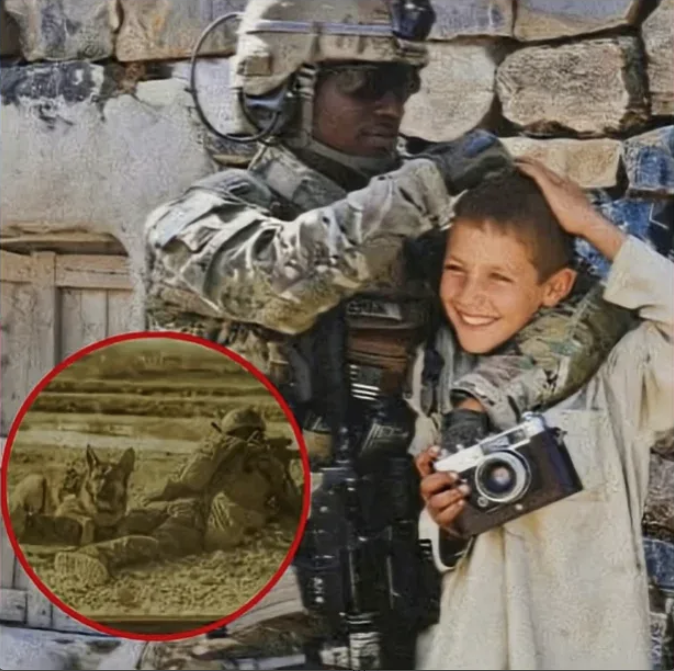
While deployed, a soldier gave a local boy an old camera. Not an expensive one—just a camera he’d brought with him but didn’t need, the kind of gesture soldiers sometimes make in foreign countries where children have so little and giving something feels better than keeping it unused.
The boy took the camera with shining eyes. Thanked the soldier in broken English. And the soldier moved on—to other missions, other days, other interactions that blur together when you’re deployed. He forgot about the camera. Forgot about the boy. Came home eventually and transitioned into veteran life with all its challenges.
Years later, the veteran hit rock bottom. His service dog—his only lifeline, the one being that kept him tethered to life when PTSD made every day a battle—passed away. And in that grief, the veteran realized something devastating: he had no photos of them together. No physical proof of the bond that had saved his life repeatedly. No images to hold when the loss felt unbearable.
He spiraled. Depression deepened. The kind of darkness that makes veterans check out permanently, that turns grief into something impossible to survive. He was losing his fight.
Then a battered package arrived from halfway across the world.
Inside was a single photograph. The soldier and his dog, side by side. Taken years ago by a local boy with an old camera. The boy had saved for months—probably giving up things he needed, probably making sacrifices the veteran would never know about—to mail one photograph he’d taken years ago.
The soldier gave a camera. The boy gave him a reason to keep going.
That photograph became everything. Proof that the bond was real. Evidence that his service dog had existed, that their connection mattered, that the love between them could be captured and held even after death. The veteran framed it, kept it where he could see it, let it remind him that his dog’s life—and his own—had meaning worth preserving.
But more than that, the photograph proved something else: that small gestures create ripples we never see. That giving a camera to a boy years ago in a war zone could somehow circle back years later as a lifeline. That kindness isn’t just about the immediate moment but about creating connections that might save lives in ways we’ll never predict.
The boy remembered the soldier. Kept the camera. Used it. And when he’d grown enough to understand what sending a photograph might mean, he spent months saving money to mail it halfway across the world to an address he’d somehow kept or found. Because the soldier had given him something once, and maybe the boy understood that now it was his turn to give something back.
We talk about the impact of military service—the sacrifices, the trauma, the way deployment changes people. But we talk less about the small interactions that happen in between. The cameras given to children. The conversations with locals. The tiny moments of humanity that bloom in the middle of war zones.
This is one of those moments. A soldier giving a camera. A boy taking it gratefully. Years passing. Lives changing. A dog dying. Grief overwhelming. And then—impossibly, beautifully—a photograph arriving that makes survival feel possible again.
The veteran keeps that photo close. Looks at it when grief threatens to drown him. Remembers his service dog and the boy with the camera and the strange, miraculous way that kindness circled back exactly when he needed it most.
He didn’t just give a camera. He created a connection that would eventually save his life. The boy didn’t just take a photo. He gave someone a reason to keep living when dying seemed easier.
Both of them changed each other’s lives with simple gestures that seemed small at the time but turned out to matter more than either could have imagined.