Jaedyn was fifteen years old when his body started betraying him.
It began with headaches—the kind that made light unbearable and silence a necessity. Then came the weight loss, unexplained and alarming, his athletic frame growing thinner even though nothing about his routine had changed. He’d been a bright STEM student in Texas, the kind of kid who loved physics problems and football practice in equal measure. But slowly, football became impossible. The headaches were too severe. His balance was off. Something was deeply, terribly wrong.
His mother, Maegan, took him to doctors. They ran tests. Checked his diet. Looked for infections, hormonal imbalances, anything that might explain why a healthy teenage boy was fading before their eyes. Nothing made sense. Until the CT scan.
The image came back stark and undeniable: a mass. Peach-sized. Pressing against Jaedyn’s brain.
The room went silent when the doctor delivered the news. Not the kind of silence that feels peaceful, but the kind that feels like the air has been sucked out of the world. Maegan heard the words—tumor, surgery, risk—but they felt distant, like they were being spoken to someone else. Not her son. Not her bright, smiling boy who just wanted to solve equations and throw a football.
But it was him. And the mass wasn’t going anywhere on its own.
Brain surgery. The phrase alone felt too heavy to carry. Surgeons would have to open Jaedyn’s skull, navigate the delicate architecture of his brain, and remove something that had no right to be there. The risks were staggering. Memory loss. Motor function impairment. Personality changes. Or worse—outcomes Maegan couldn’t even let herself think about.
She asked for prayers. Not because she didn’t trust the doctors, but because she needed to believe in something bigger than the fear that threatened to swallow her whole. She called Jaedyn her miracle child—not because the miracle had happened yet, but because she needed to speak it into existence. She needed to believe that this boy, who’d already overcome so much just by being born into a world that demanded so much of him, could overcome this too.
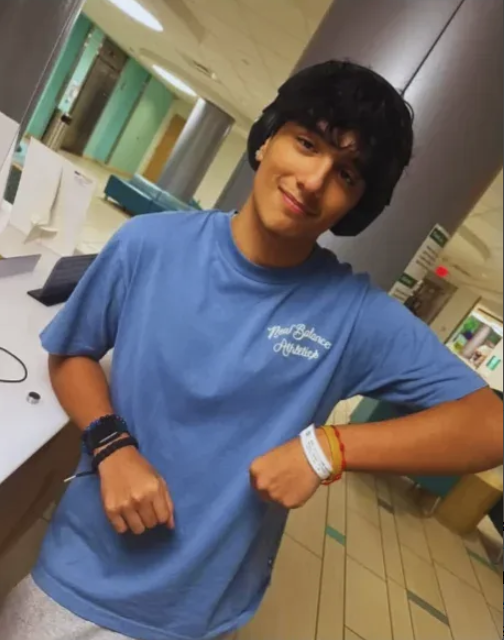
Jaedyn, meanwhile, faced the diagnosis with a courage that stunned everyone around him. He was fifteen—an age when most kids are worried about grades and friends and whether they’ll make the team. But Jaedyn had to worry about whether he’d wake up from surgery still knowing who he was. And somehow, impossibly, he smiled. He joked with the nurses. He reassured his mother when she cried. He wore his hospital bracelet like it was just another part of his day.
The photo captured him in a hospital hallway, wearing a blue shirt, his expression calm and almost playful despite everything. It was the face of a boy who refused to let fear define him. Who understood, at fifteen, that courage isn’t the absence of terror—it’s moving forward anyway.
Maegan posted the image with a simple request: prayers. Because in moments like this, when medical science has done all it can and the rest is unknown, sometimes all you have left is hope. And community. And the belief that the world still holds miracles, even when they seem impossible.
The surgery loomed ahead—complex, dangerous, necessary. The doctors were skilled, but even skill has limits when you’re operating inside the most intricate organ in the human body. One wrong move could change everything. One right move could save a life.
Jaedyn would go into that operating room carrying the weight of his mother’s prayers, his community’s hope, and his own quiet, unshakable belief that he wasn’t done yet. That there were still equations to solve, games to play, years to live.
Fifteen years old. A peach-sized mass pressing on his brain. A future hanging in the balance.
But Maegan called him her miracle child. And miracles, by definition, don’t follow the rules. They defy odds. They surprise doctors. They remind us that hope isn’t foolish—it’s essential.
Jaedyn’s story wasn’t over. It was just beginning its hardest chapter. And somewhere, in operating rooms and waiting rooms and homes across the country, people who’d never met him were praying anyway. Because that’s what we do when someone’s child is fighting for their life.
We hope. We pray. We believe in miracles. Even—especially—when they seem impossible.