In 2008, in the remote Afghan village of Wanat, a small U.S. Army outpost came under heavy Taliban fire. Not a minor skirmish. Heavy fire—coordinated assault, overwhelming numbers, the kind of attack designed to overrun a position and eliminate everyone there.
Despite being outnumbered five to one, soldiers of the 173rd Airborne Brigade held their ground. Didn’t retreat. Didn’t surrender. Didn’t abandon their position even though doing so might have saved their lives.
Staff Sergeant Ryan Pitts was severely wounded by grenade shrapnel. The kind of wounds that end combat capability for most soldiers. The kind that requires immediate medical evacuation. The kind that gives you permission to stop fighting, to focus on survival, to let others handle the defense.
But Pitts continued to fight. Continued to call for air support. Continued to coordinate defense even while wounded. Prevented the enemy from overrunning the base through his sustained resistance and leadership despite injuries that would have justified stopping.
His actions saved countless lives. Not through single heroic moment, but through sustained competence and courage under conditions that would break most people. Through fighting effectively while wounded. Through maintaining tactical awareness and communication while dealing with pain and blood loss. Through refusing to let his injuries stop him from doing what needed to be done.
He later received the Medal of Honor for his bravery. The highest military decoration. Recognition that what he did at Wanat went beyond duty, beyond expectation, beyond what should reasonably be asked of anyone.
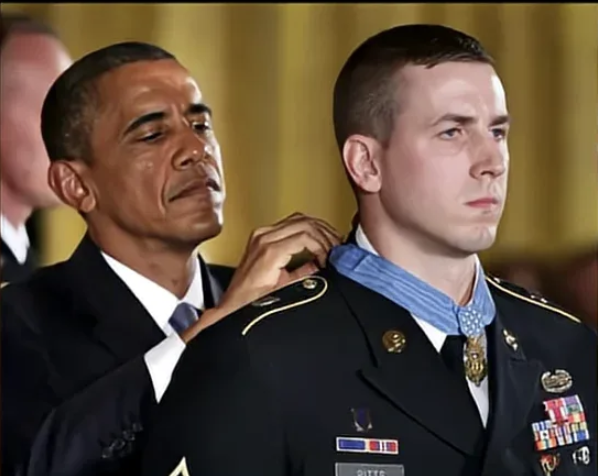
The photo shows President Obama placing the Medal of Honor around Staff Sergeant Pitts’ neck. Pitts is in dress uniform, standing at attention, receiving recognition for actions that saved lives during one of the most intense battles of the Afghanistan war.
The Battle of Wanat was brutal. Nine American soldiers died. Twenty-seven were wounded. The outpost was nearly overrun multiple times. The Taliban attacked with overwhelming force, expecting to eliminate the American presence.
They didn’t succeed. In large part because soldiers like Ryan Pitts refused to stop fighting even when wounded, even when outnumbered, even when stopping would have been understandable and justified.
Pitts was severely wounded by grenade shrapnel. Shrapnel wounds are devastating—metal fragments that tear through tissue, cause massive bleeding, create pain that’s difficult to manage without morphine. These aren’t injuries you can ignore or fight through easily. These are injuries that require medical intervention.
But Pitts kept fighting. Kept calling for air support—coordinating strikes that prevented Taliban forces from completely overrunning the position. Kept organizing defense—directing other soldiers, maintaining tactical awareness, ensuring that even while wounded he was contributing to their survival.
He did this while bleeding. While in pain. While his body was telling him to stop, to focus on survival, to let others handle the fighting.
He didn’t stop. Because if he stopped, more people would die. Because his position needed to be held. Because surrender wasn’t an option and retreat would mean abandoning the base and possibly dying anyway.
So he fought. Severely wounded. Outnumbered five to one. Under heavy fire. For hours.
That’s not just courage. That’s extraordinary mental and physical toughness. That’s the refusal to accept what seems inevitable, the determination to keep fighting when everything suggests fighting is futile.
The Medal of Honor recognizes actions “above and beyond the call of duty.” Ryan Pitts’ actions at Wanat qualify absolutely. Duty would have been fighting until wounded, then accepting medical evacuation. Above and beyond was fighting while wounded, continuing to lead and coordinate defense, preventing enemy from overrunning the base through sustained resistance despite injuries.
When President Obama placed that Medal of Honor around Pitts’ neck, he was recognizing not just one soldier’s bravery, but a standard of courage that most people will never have to meet. A willingness to keep fighting when wounded, when outnumbered, when survival seems impossible.
Pitts survived the Battle of Wanat. Many didn’t. Nine soldiers died that day. Nine families lost fathers, sons, brothers. Nine young men who went to Afghanistan and didn’t come home.
Pitts carries that. Carries the memory of soldiers who died while he survived. Carries the knowledge that his actions helped prevent more deaths but couldn’t prevent all of them. Carries survivor’s guilt along with Medal of Honor.
That’s the complicated reality of military decorations. They recognize extraordinary courage. But they also mark extraordinary trauma. Pitts earned that Medal of Honor through actions that saved lives, but those actions happened during a battle where he watched fellow soldiers die, where he was severely wounded, where he faced hours of combat that will probably live in his memory forever.
The photo shows him standing tall, receiving recognition, looking disciplined and composed. But behind that composed exterior is someone who survived one of the most intense battles of the Afghanistan war. Who fought while severely wounded. Who held ground against overwhelming odds. Who saved lives while losing fellow soldiers.
That complexity doesn’t diminish his courage. If anything, it emphasizes it. Because courage isn’t the absence of fear or trauma. It’s continuing to act effectively despite both.
Staff Sergeant Ryan Pitts held his ground at Wanat. Severely wounded. Outnumbered five to one. Under heavy Taliban fire. For hours.
He called for air support. Coordinated defense. Prevented enemy from overrunning the base. Saved countless lives.
And years later, he received the Medal of Honor. Recognition that what he did went above and beyond. That his actions represented the absolute highest standard of courage and competence under fire.
Nine soldiers died at Wanat. But more would have died without Ryan Pitts. That’s the reality that Medal of Honor recognizes. That’s why President Obama placed that medal around his neck. That’s why his story deserves to be remembered.
Severely wounded. Outnumbered five to one. Still fighting. Still leading. Still saving lives.
That’s not just bravery. That’s extraordinary.