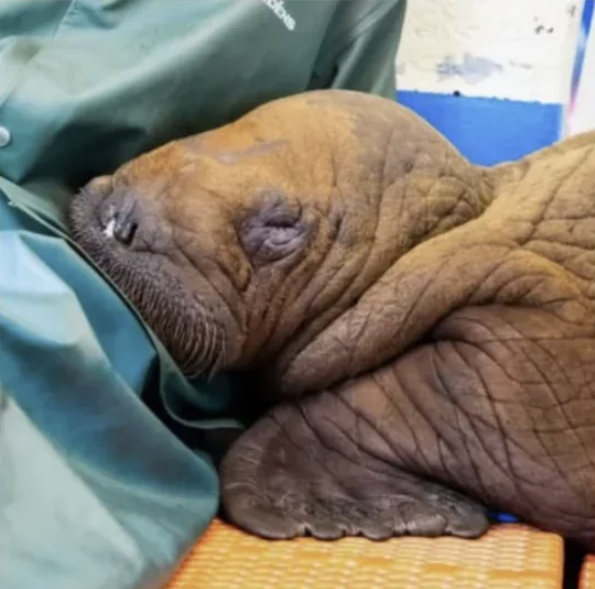
On Alaska’s icy coast, oil workers found a lone walrus calf crying for its mother.
The discovery was heartbreaking — a baby walrus separated from its mother in an environment where survival requires maternal care, where being alone means certain death. The calf’s cries carried across the ice, desperate calls for a mother who wasn’t coming.
Rescuers brought him to the Alaska SeaLife Center, where staff created a solution: 24-hour “cuddling therapy.”
This remarkable intervention recognized something profound: that walrus calves can’t survive without touch. Food and shelter aren’t enough. The baby needed what his mother would have provided — constant physical contact, warmth, presence.
Because walrus calves can’t survive without touch, caregivers held him constantly, feeding him bottles and whispering softly.
Imagine the commitment: 24-hour shifts of staff members holding a walrus calf, never leaving him alone, providing continuous physical contact because that’s what survival required. Not just feeding on schedule, but constant touch, constant presence, constant communication through contact.
Slowly, he healed — recognizing his caregivers, drinking eagerly, making soft warbling sounds of joy.
The transformation from desperate crying to warbling sounds of joy shows the healing power of sustained care. The calf learned these humans were safe, learned to accept nourishment, learned that touch meant safety rather than danger.
“He reminds us,” one rescuer said, “that survival isn’t just about food and shelter — it’s about love.”
This statement captures essential truth that extends beyond walruses to all mammals, including humans. Physical survival requires food and shelter, yes, but thriving requires connection, touch, love. Without those emotional elements, even well-fed and sheltered beings fail to thrive.
The photograph shows the walrus calf being held by caregivers — his wrinkled skin, closed eyes, relaxed body posture all indicating trust and contentment. He’s pressed against fabric, receiving the touch he needs, looking peaceful rather than distressed.
Walruses are marine mammals that spend much of their life in cold water and on ice. Mothers provide crucial care including nursing, teaching swimming and hunting skills, and physical contact that regulates body temperature and provides emotional security.
When this calf was found crying for his mother, he was experiencing both physical vulnerability and emotional trauma. Separated from his mother on Alaska’s icy coast meant exposure, lack of food, and terrifying isolation.
Oil workers who discovered him probably weren’t expecting to encounter an orphaned walrus. But they recognized distress, understood the calf couldn’t survive alone, contacted rescue organizations instead of leaving him to die.
The Alaska SeaLife Center’s response — creating 24-hour cuddling therapy — shows sophisticated understanding of marine mammal needs. They couldn’t simply put the calf in a tank with food and expect survival. They recognized he needed what his mother provided: constant touch.
Staff members committed to this round-the-clock care, holding him constantly, feeding bottles instead of allowing natural nursing, whispering softly the way mothers might vocalize to their calves. They became surrogate mothers through sustained physical presence.
“Because walrus calves can’t survive without touch” — this isn’t metaphorical or exaggeration. It’s biological fact. Baby mammals need physical contact for emotional regulation, temperature control, stress reduction, and overall development. Without touch, they fail to thrive even when food and shelter are adequate.
The calf slowly healing shows the therapy working. He began recognizing his caregivers — learning their voices and touch, understanding these humans were safe. He started drinking eagerly rather than refusing bottles, accepting nourishment because he felt secure enough to eat.
The soft warbling sounds of joy indicate emotional transformation. He went from crying desperately for his absent mother to making contented sounds while being held by human caregivers. The sounds show he’s bonding with his rescuers, accepting them as his new family.
“Survival isn’t just about food and shelter — it’s about love” applies to humans as profoundly as to walruses. Studies of human infants show that babies who receive adequate food and shelter but lack touch and affection fail to develop properly. Orphanages where children are fed but not held produce profound developmental delays.
This walrus calf reminds us that love isn’t luxury or sentiment but biological necessity. Touch regulates stress hormones, promotes healthy development, creates sense of security that allows learning and growth. Without it, survival becomes merely existing rather than thriving.
The rescuer who made that statement wasn’t being sentimental but accurately describing what they’d learned through caring for this calf. That food and shelter alone wouldn’t have saved him. That the constant holding, the whispered words, the sustained physical contact — that was love expressed through caregiving, and it was what actually enabled survival.
The calf will presumably grow strong enough eventually to be released or live in permanent care facility. His future depends on this early intervention, this 24-hour cuddling therapy that provided what his mother’s absence had stolen.
He was found crying for his mother. He healed while being held by humans who understood that survival requires more than physical needs being met. He learned to make warbling sounds of joy because love — expressed through constant touch — gave him reason to feel joyful again.