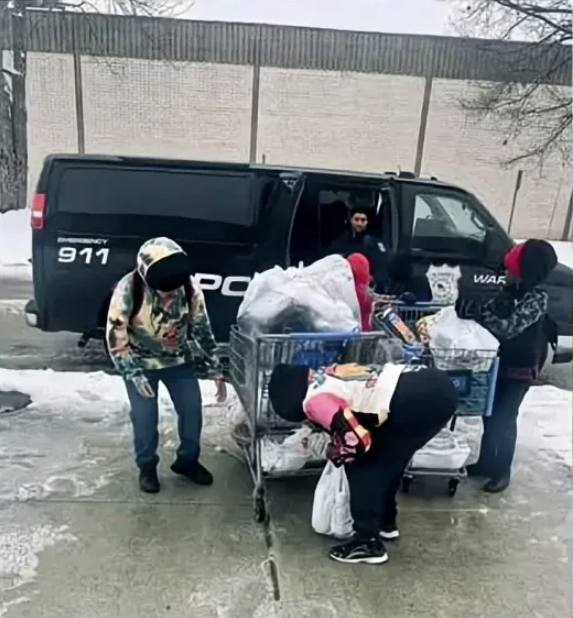
Officer Bryce Moon was finishing his shift on a Saturday afternoon, that particular kind of tired that comes from hours of responding to calls, filling out reports, and maintaining constant vigilance. He was ready to clock out, head home, let the weight of the badge lift for a few hours. Then he saw them.
A mother and five young children in a freezing parking lot, their entire world packed into two shopping carts. The kids huddled close to their mom, their breath visible in the cold air, their faces showing that particular kind of exhaustion that comes not from a long day but from too many long days strung together. Everything they owned was right there, exposed to the elements and the uncertainty of what happens next.
Most people would have looked away. It’s easier that way—to convince yourself that someone else will handle it, that there are systems in place, that your shift is over and this isn’t your responsibility. But Officer Moon stopped. And in that moment of stopping, he made a choice that would change everything for that family.
He didn’t just make one call. He made call after call, working through contacts and connections, reaching out to charities and resources until he found one that could offer the family a hotel stay—a real bed, a warm room, a door that locks, a place to breathe without fear. But finding the solution was only the first step. He and his fellow officers loaded the family and their belongings into their vehicles and transported them to safety themselves.
And then, after ensuring they had a place to sleep, after making sure their possessions were secure, the officers did something that wasn’t in any protocol manual. They reached into their own pockets and bought those hungry kids a warm meal. Not because they had to. Not because someone was watching. But because they saw children who needed food, and they had the power to provide it.
There’s something profound about that gesture—about officers who’d already given their time, their effort, their compassion, choosing to give even more. It wasn’t about recognition or praise. It was about seeing human beings in crisis and responding with the full measure of their humanity.
Officer Moon could have driven past that parking lot. He could have called it in and let the system handle it. He could have done the minimum required and still been considered a good officer. But he understood something essential: that the badge isn’t just about enforcing laws or responding to emergencies. It’s about recognizing moments when you have the power to change someone’s story, and choosing to use that power with compassion.
That mother and those five children went from a freezing parking lot to a warm hotel room because one officer refused to look away. They went to bed with full stomachs because a group of officers saw them not as a problem to be processed but as people deserving of care.
We talk a lot about what police should be, about the ideals of service and protection. Officer Moon and his colleagues didn’t talk about those ideals. They lived them. They saw a family at their most vulnerable moment and responded not with indifference but with action. Not with judgment but with generosity.
Those kids will remember that night. They’ll remember the officers who stopped, who made calls, who drove them to safety, who bought them food. They’ll remember that when their world was reduced to two shopping carts in a cold parking lot, strangers in uniform saw their humanity and responded with their own.
Officer Moon was finishing his shift. Instead, he started something more important—a reminder that sometimes the most powerful thing we can do is simply refuse to drive past someone who needs help. That compassion isn’t measured by what’s convenient, but by what’s necessary. That service means seeing people in crisis and choosing, every single time, to stop.