Eight-year-old Eli, who has Down syndrome and uses a wheelchair, refused to leave the car.
His mother probably tried everything — encouragement, reasoning, promises of treats afterward. But Eli wouldn’t budge. Because going inside meant facing what he’d been facing for weeks, what had made even the thought of school unbearable.
Bullies had tormented him for weeks – knocking books, whispering names, slamming doors.
The systematic cruelty that children inflict on those they perceive as different, vulnerable, unable to retaliate. Eli couldn’t chase them when they knocked his books down. He couldn’t physically defend himself when they slammed doors. He could only endure, day after day, watching other children deliberately making his life harder because he has Down syndrome and uses a wheelchair.
His mom called Officer Robles.
She recognized that this was beyond normal parenting challenges, that her son needed intervention she couldn’t provide, that sometimes protecting your child means calling for help from someone who has authority and power to change the situation.
Officer Robles spent hours reviewing camera footage, identified the bullies, called their parents.
This matters enormously. He didn’t just show up and give a generic talk about being nice. He did the work — hours of reviewing surveillance footage, identifying specific children, documenting specific incidents, contacting parents with evidence of what their children had been doing.
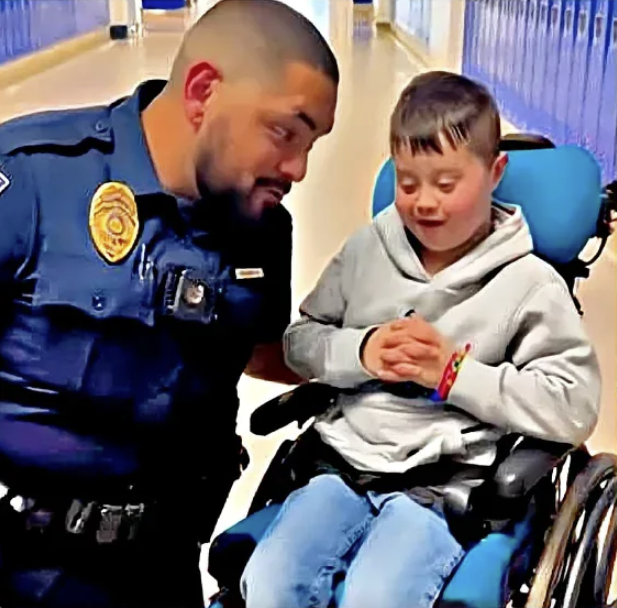
Then he found Eli in the hallway and knelt down.
Physical positioning matters. Officer Robles didn’t stand over Eli using his authority and size as intimidation. He lowered himself to Eli’s level, made himself equal rather than towering, communicated through body language that this conversation was between two people, not an authority figure delivering pronouncements to a child.
“Nobody’s gonna mess with you anymore,” he promised.
Simple words carrying enormous weight. Not “I’ll try to help” or “things should get better.” A promise, direct and certain, that the torment was over, that someone with power and authority had intervened on Eli’s behalf.
“If anybody tries, they deal with me first.”
This addition transformed the promise from hope into guarantee. Officer Robles wasn’t just expressing wishes or making vague commitments. He was putting himself between Eli and anyone who might hurt him, making clear that future bullying would have immediate and serious consequences.
Eli’s shoulders relaxed for the first time in weeks.
That physical response reveals everything. His body had been holding tension constantly, braced for the next knock of books or whispered insult or slammed door. Officer Robles’ promise allowed him to release that tension, to believe that maybe school could be safe again, that someone strong enough to protect him had chosen to do so.
He wasn’t alone anymore.
That’s what bullied children need most — not just for the bullying to stop, but to know they’re not facing it alone, that someone sees what’s happening and cares enough to intervene, that their suffering matters to an adult who has power to change things.
The photograph shows them together — Officer Robles kneeling beside Eli’s wheelchair, both of them looking at something, possibly a book or toy. Officer Robles is in full uniform with his badge visible, his body language protective and engaged. Eli looks relaxed and focused, no longer showing the fear that kept him in the car.
This story reveals the complexity of bullying situations involving children with disabilities. Eli couldn’t defend himself physically. His Down syndrome and wheelchair made him an easy target for children who wanted to feel powerful by hurting someone vulnerable.
His mother couldn’t stop it. She could comfort him at home, could advocate with school administration, but she couldn’t be with him in the hallways protecting him from children who saw his vulnerability and exploited it.
The school system had apparently failed to adequately address the situation. Camera footage existed, which means the school could have reviewed it and identified the bullies themselves. But they either didn’t or didn’t intervene effectively, allowing weeks of torment to continue.
Officer Robles did what should have been done immediately. He investigated thoroughly, identified perpetrators, contacted parents, and then made a promise to Eli that no adult had apparently made before: that the bullying would stop, that someone would protect him, that he mattered enough for someone to use their authority on his behalf.
The promise worked not because Officer Robles has magical powers, but because he has authority and follow-through. The bullies now know that Officer Robles is watching, that their parents have been contacted with evidence, that continued torment will bring consequences from someone they can’t ignore or overpower.
Eli’s shoulders relaxed. After weeks of tension, of dreading school, of enduring daily cruelty from children who should have been his peers and friends, he could finally release the fear that had been holding his body rigid.
He wasn’t alone anymore. That’s the transformative element. Eli had been fighting this battle by himself, enduring torment without adequate support, suffering in isolation even while surrounded by adults and other students.
Now he has Officer Robles — not just as one-time intervention but as ongoing presence. The officer didn’t just solve the immediate problem and disappear. He created relationship, made a promise that implies continued vigilance, positioned himself as Eli’s protector going forward.
“If anybody tries, they deal with me first.” That statement creates a buffer between Eli and future harm. Potential bullies now have to calculate whether tormenting Eli is worth dealing with Officer Robles. Most will decide it’s not.
Eight-year-old Eli, who refused to leave the car because facing school felt unbearable, can now go inside knowing someone strong has promised to protect him. His Down syndrome and wheelchair haven’t changed. The bullies still exist. But everything is different because one officer took hours to review footage, identify perpetrators, contact parents, and kneel down to promise: “Nobody’s gonna mess with you anymore.”