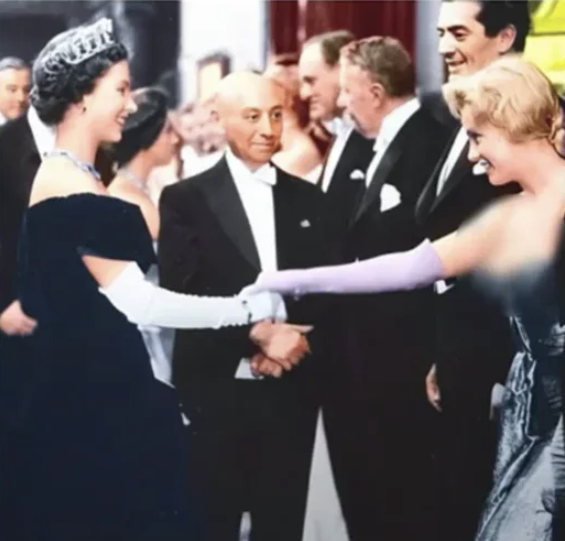
London, 1956. The flashbulbs popped like champagne corks as Hollywood’s brightest star stood in a receiving line at the Empire Theatre. Marilyn Monroe, draped in white satin and diamonds, had walked red carpets around the world. She’d faced cameras that never blinked and crowds that never stopped screaming her name. But that night, her hands trembled.
She was about to meet Queen Elizabeth II.
Both women were thirty years old. Both had become icons before they’d fully grown into themselves. One wore a tiara passed down through centuries; the other wore a dress that would be remembered for generations. The world had crowned them both, just in different ways. And in that gilded theater, surrounded by Britain’s elite and Hollywood royalty, two women who lived under the weight of impossible expectations were about to shake hands.
Marilyn’s smile that night told a story all its own. It wasn’t the practiced curve of lips she’d perfected for the cameras. It was softer, more vulnerable. As she approached the young Queen, her curtsy was deep and genuine, born not from protocol but from something closer to awe. Here was a woman who understood, perhaps better than anyone, what it meant to belong to the world while trying to hold onto yourself.
The Queen extended her gloved hand with the composure she’d been trained for since childhood. But those who were there remembered something else in her eyes—a flicker of curiosity, maybe even admiration. Because Elizabeth, raised behind palace walls and prepared for duty before she could choose her own path, knew what it was like to be watched. And Marilyn, who’d clawed her way up from foster homes and exploitation, knew what it was like to perform even when your heart was breaking.
What the photographs couldn’t capture was the paradox hanging in the air between them. Marilyn, who the world saw as free and wild and dangerous, privately longed for the dignity and respect that came with Elizabeth’s title. And Elizabeth, bound by duty and tradition and a thousand years of history, must have wondered what it felt like to choose your own story, even if that story came with its own kind of cage.
The handshake lasted only seconds. They exchanged pleasantries that would be forgotten. No profound words were spoken, no lifetime friendship forged. But something passed between them in that brief moment—a recognition, perhaps, that neither woman’s life was quite what the world imagined. That behind the crown jewels and the platinum curls, both carried burdens that glittered from a distance but felt impossibly heavy up close.
Years later, people would call them the Queen of Honor and the Queen of Beauty, as if those titles explained everything. But they explained nothing about the complexity of two women who’d become symbols before they could become themselves. They said nothing about the loneliness that comes with being worshipped, the exhaustion of never being allowed to be ordinary, the strange isolation of being seen by millions while being truly known by almost no one.
Marilyn would be gone within six years, her light extinguished at thirty-six. Elizabeth would reign for seven decades more, carrying her crown until the very end. Their paths crossed only once, for mere moments in a London theater. But in that brief encounter lived something achingly human—two women, the same age, from impossibly different worlds, recognizing in each other a reflection of what it costs to be extraordinary.
Sometimes the most powerful moments aren’t the ones that change everything. They’re the ones that simply remind us we’re not alone in carrying what we carry. That night in 1956, beneath the chandeliers and the weight of expectation, two queens met. And for just a heartbeat, they saw each other not as icons, but as women who understood.