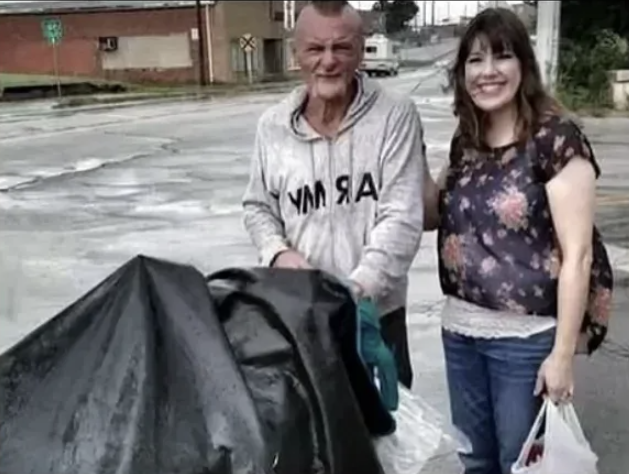
The stolen property was strewn all over downtown Tulsa — bags, personal items, belongings that had been taken and then discarded or dropped during whatever chaos led to their theft.
Most people who encountered this scattered mess would have walked past. Not their problem, not their responsibility, easier to ignore than to involve themselves in someone else’s misfortune.
But a homeless man saw it differently.
He took the time to gather it all up in the rain. Not quickly or carelessly, but with attention and care, collecting each item, organizing the belongings, making sure nothing was left behind. Then he called the family for retrieval, connecting what he’d found with the people who’d lost it.
The daughter whose property was stolen wrote simply: “I just want to recognize him as an awesome human being.”
That recognition matters because homeless people are usually invisible except when they’re being moved along or told they can’t be somewhere. They exist at the margins of community, their humanity often dismissed, their actions rarely celebrated unless they fit convenient narratives about pulling themselves up or accepting help.
This man did something remarkable while having nothing. He spent hours in the rain protecting someone else’s belongings when he had no belongings of his own to protect. He made phone calls to reunite property with its owners when he had no property, no phone plan, no stable address where gratitude could easily reach him.
The story includes something important about Tulsa’s history. The city has Native American roots, its origins dating back to 1836 as a settlement of Creek Indians who named it for their former town in Alabama. It was part of the Indian Territory, a place for the forced relocation of various Native American tribes.
This context matters because it reminds us that displacement and homelessness have long histories in America, that the land we occupy has been home to people who were forced from their homes, that poverty and struggle aren’t individual failures but often the consequences of systemic violence and historical injustice.
The daughter’s heart hopes that there will be no more homeless souls in Tulsa. It’s a beautiful wish, acknowledging that homelessness isn’t a character flaw but a circumstance that shouldn’t exist in a wealthy society.
But her deepest wish goes further: “for a world where no one, anywhere, has to live without a safe, warm place to call home.”
That’s the vision that matters. Not charity or temporary help, but actual systemic change that ensures everyone has shelter. Not gratitude that a homeless man helped despite having nothing, but outrage that someone capable of such kindness lives on the streets.
The photograph shows them together after the property retrieval — the homeless man standing beside the daughter, both smiling, a shopping cart visible behind them holding the recovered belongings. He looks weathered and tired, wearing a worn sweatshirt. She looks grateful and determined, her expression showing both thanks for what he did and recognition of the injustice that he remains homeless.
He’s an awesome human being. That assessment is accurate and important. But being an awesome human being shouldn’t require living on the streets. His kindness and effort and care for others’ property doesn’t make homelessness acceptable or deserved for anyone, including him.
This story asks us to hold two truths simultaneously: gratitude for what this man did, and anger that he remains without a home. Celebration of his character, and demand for systemic change. Recognition of his humanity, and insistence that recognition alone isn’t enough.
Tulsa has a complicated history of displacement and violence. The daughter acknowledges this, connecting her hope for no more homelessness with the city’s origins in forced relocation. Perhaps that historical awareness makes her more sensitive to the ongoing injustice of people living on streets in one of the wealthiest nations in human history.
The homeless man gathered stolen property in the rain and called for its retrieval. He didn’t have to. No one would have blamed him for ignoring it or even taking what he needed. Instead, he spent hours ensuring someone else got their belongings back.
He deserves recognition as an awesome human being. And he deserves a safe, warm place to call home.