The loose slat on the old playground bench had been wobbling for weeks. Parents noticed it every time they visited the park with their children—saw the board shifting under weight, making the bench unstable and potentially dangerous. Some mentioned it to each other. A few even called the city to report it. But weeks passed, and nothing happened.
Then, early on a cool Saturday morning, 78-year-old Harold Lindstrom walked down from his apartment carrying a small toolbox he’d kept since the 1960s.
He didn’t call anyone for permission. Didn’t wait for the city to finally respond to complaints. Didn’t assume someone else would handle it. He simply saw a problem that needed fixing and decided to be the person who fixed it.
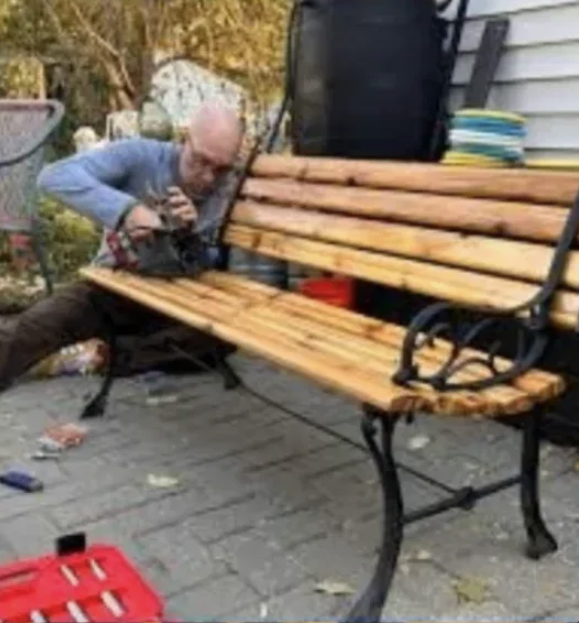
Harold measured the cracked board with the precision of someone who’d spent a lifetime working with his hands. He sanded the rough edges on-site, smoothing them carefully so no splinters would catch small fingers. He’d cut a replacement piece from leftover pine in his garage—wood he’d been saving for decades, waiting for a project that mattered enough to use it.
The work took time. Harold moved slowly now, his 78-year-old body requiring more breaks and more patience than it once did. But he didn’t rush. He fitted the replacement board carefully, checking that it sat flush with the others. He tightened each bolt with steady hands, making sure everything was secure.
Parents arriving later found him finishing up—an elderly man kneeling beside the bench, tightening the final bolts with the kind of methodical care that spoke of decades of experience. They watched for a moment, curious about who this man was and why he’d taken on a job that wasn’t his responsibility.
A toddler climbed onto the bench first, testing it with the fearless curiosity only small children possess. The board held firm. The child bounced slightly, grinning at the sturdiness. Harold watched and nodded, pleased that it would hold for another season.
He didn’t introduce himself or explain why he’d spent his Saturday morning repairing a playground bench. He simply packed up his toolbox—the one he’d kept since the 1960s, through moves and marriages and decades of life—and prepared to head home.
But the parents saw. They saw an elderly man who could have spent his Saturday resting or pursuing easier hobbies. They saw someone who noticed a problem and fixed it, not because anyone would thank him or because he’d get recognition, but because children deserved a safe place to play and he had the skills to provide it.
They saw what we all need to see more often: that community isn’t just about paying taxes and expecting services. It’s about noticing what needs doing and being willing to do it yourself. It’s about using your skills—however humble, however aged—to make your corner of the world a little better.
Harold had kept that toolbox since the 1960s. Through decades of use, through changes in tools and technology, through years when his hands were steadier and years when they trembled more. He’d kept it because tools matter, because knowing how to fix things matters, because being the kind of person who can solve problems matters.
And on that cool Saturday morning, that toolbox and those decades of experience mattered more than any city maintenance schedule or official work order. They mattered because a bench was broken and children needed a safe place to sit, and Harold understood that sometimes being a good neighbor means quietly fixing what’s broken without waiting for permission.
The parents thanked him. He brushed off the gratitude the way people from his generation often do—it was nothing, just a loose board, no big deal. But they knew better. They knew that what seemed like a small gesture represented something much larger: a commitment to community, a willingness to serve without recognition, an understanding that we all have a responsibility to care for the shared spaces that make neighborhoods feel like home.
That toddler who tested the bench first will probably never remember Harold. Won’t know that an elderly man spent his Saturday morning making sure that board would hold. Won’t understand that the playground bench was safe because someone cared enough to fix it rather than just complaining about it.
But maybe that’s okay. Maybe the best acts of service are the ones done without expectation of recognition or gratitude. Maybe fixing a playground bench at 78 years old is its own reward—the satisfaction of using skills you’ve honed over decades to solve a problem that matters, the quiet pride of knowing you made something safer for children you’ll never meet.
Harold walked home that morning with his 1960s toolbox, pleased that the bench would hold for another season. The playground opened later that day, and children climbed and played and sat on the bench he’d repaired, completely unaware of the elderly man who’d spent his Saturday making sure they could do so safely.
That’s community. That’s service. That’s what it means to be a good neighbor—not waiting for someone else to fix what’s broken, but using whatever skills and resources you have to make things better. Even if you’re 78. Even if your toolbox is older than most of the parents at the playground. Even if no one will remember your name.
Harold nodded with satisfaction, knowing the bench would hold for another season. And in that simple act—an elderly man fixing a playground bench on a Saturday morning—the world became a little bit better. Not through grand gestures or official programs, but through one person who saw a problem and quietly, competently, lovingly fixed it.
That’s the kind of hero we need more of. The kind who carries a toolbox from the 1960s and uses it to make sure children can play safely. The kind who doesn’t wait for permission or recognition. The kind who simply sees what needs doing and does it, then goes home satisfied that they’ve left their corner of the world a little better than they found it.