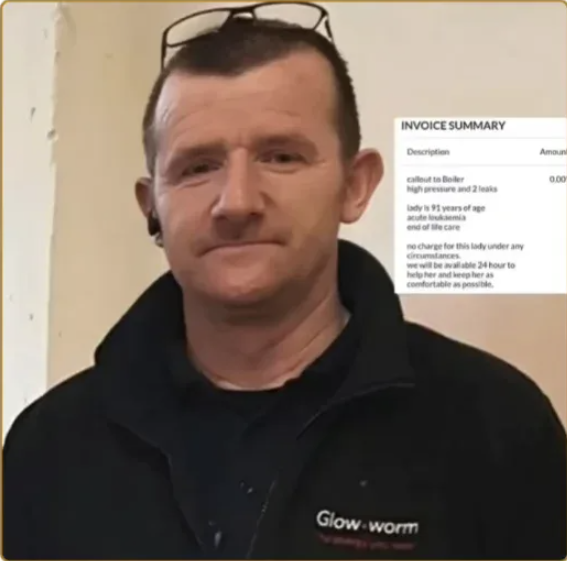
James Anderson is a plumber. He fixes boilers, repairs leaks, unclogs drains—the unglamorous work that keeps homes functional and people comfortable. It’s practical work, necessary work, the kind most people don’t think about until something breaks. And when something breaks, they call someone like James.
The call came in about a boiler. A ninety-one-year-old woman with leukemia, receiving end-of-life care, needed heat. Winter doesn’t care about your diagnosis or your age or how much time you have left. It just demands warmth, and without a working boiler, her home would become uninhabitable during the coldest, most vulnerable chapter of her life.
James went. Assessed the problem. Fixed it. The work was done professionally, competently, the way he’d fix any boiler for any client. But when it came time to write the invoice, he made a decision that had nothing to do with pipes or pressure valves or technical expertise.
He charged her nothing. Zero dollars. Zero cents.
The invoice itself became the message. Where the total should have been, he wrote that there would be no charge under any circumstances. That he would be available twenty-four hours a day, seven days a week, to keep her comfortable. That if anything else went wrong, she should call him, and he would come, and there would still be no charge.
He didn’t make this offer conditional on her being able to pay later. He didn’t set up a payment plan or suggest she apply for assistance. He simply removed money from the equation entirely, as if to say: your comfort in these final weeks matters more than profit, and I have the ability to ensure it, so I will.
The invoice went viral because it captured something people recognize but rarely see: compassion that doesn’t announce itself, doesn’t seek recognition, doesn’t perform for applause. James didn’t post about his generosity. He didn’t write a social media caption about his good deed. He just fixed a boiler, wrote an invoice, and moved on to the next job. Someone else shared his story. Someone else saw the beauty in what he’d done.
Because what James fixed wasn’t really the boiler. It was the worry. The fear that this woman, already facing the end of her life, already navigating leukemia and the complex emotions of palliative care, would also have to stress about money. About whether she could afford heat. About whether staying comfortable would bankrupt her family or force impossible choices.
He removed that burden. Took it off the table completely. And in doing so, he gave her something far more valuable than a functioning heating system—he gave her peace.
End-of-life care is complicated. There are medical decisions and emotional preparations and the exhausting work of saying goodbye. People in that situation are already carrying more than anyone should have to carry. They don’t need additional stress. They need gentleness. They need people who see their humanity and respond with grace.
James is a plumber, not a hospice worker, not a social worker, not someone whose job description includes emotional labor. But he understood that sometimes the most important repair isn’t mechanical—it’s spiritual. It’s the repair of dignity, the restoration of comfort, the fixing of circumstances that shouldn’t exist but do.
The comment at the end of the post said it perfectly: “Sometimes the kindest repairs aren’t to pipes, but to the heart.”
Because that’s exactly what James did. He repaired the broken part of a system that tells elderly people in end-of-life care that they still need to worry about bills. That tells them their comfort has a price tag, and if they can’t pay it, they’ll suffer. That treats warmth in winter as a commodity rather than a human right.
James looked at that system and said: not this time. Not for this woman. Not while I have the skill to help and the choice to refuse payment.
His company, Glow-worm, probably didn’t train him to do this. There’s no plumbing manual that explains how to calculate the value of someone’s peace of mind. No business course that teaches when to waive a fee for reasons that have nothing to do with profit margin. James made this decision himself, guided by something deeper than economics—by the recognition that he had the power to make someone’s final days easier, and that power carried responsibility.
The internet calls people like James heroes. And maybe he is. But he’d probably shrug at the label, insist he was just doing what felt right, claim that anyone else would have done the same. Except most people wouldn’t. Most businesses operate on transactions, not compassion. Most service providers can’t afford to work for free. Most people, even good people, would have charged something.
James didn’t. And that choice rippled outward in ways he’ll never fully measure. The woman stayed warm. Her family could focus on being present with her instead of scrambling for money. And thousands of people who heard his story felt something shift inside them—a reminder that kindness isn’t extinct, that some people still prioritize humanity over profit, that the world contains people like James Anderson who fix boilers and hearts with equal care.
He promised to be available twenty-four hours a day. Not because she was paying him. Not because there was anything in it for him. But because she deserved to be comfortable, and he had the ability to ensure it, and that was enough.
In her final weeks, this ninety-one-year-old woman with leukemia won’t remember the technical details of how her boiler was fixed. She probably won’t remember James’s face or the exact words on the invoice. But she’ll remember the feeling of being seen. Of being valued. Of being told, through actions more powerful than words, that her comfort mattered to someone who didn’t even know her.
That’s not plumbing. That’s ministry. That’s what it looks like when someone uses their ordinary skills to address extraordinary needs. When competence meets compassion and decides that warmth—both physical and emotional—is something worth giving freely.
James Anderson fixed a boiler. But what he really did was restore faith. In generosity. In strangers. In the possibility that when systems fail, individuals can still choose to care.
The invoice total was zero. But the impact? Immeasurable.