Flea markets are treasure hunts where most items are just old things looking for new homes. Mason was fifteen, browsing tables of forgotten objects on an ordinary weekend, when something caught his eye. An American flag, folded carefully, with a note tucked inside that stopped him cold.
“Please return to family if found. CPL T. A. Kessler – 1944.”
The year alone told a story. 1944. The middle of World War II, when American soldiers were fighting across Europe and the Pacific, when every day brought news of casualties and heroes and young men who’d never come home. Corporal T. A. Kessler had written that note eighty years ago, tucking it with his flag, creating a breadcrumb trail home that somehow never completed its journey.
The vendor wanted ten dollars. A small price for what turned out to be an enormous responsibility.
Mason could have bought the flag as a historical curiosity, displayed it in his room, appreciated it as an artifact. Most fifteen-year-olds would have. But something about that note—the careful handwriting, the hope contained in “please return to family,” the fact that Kessler had known even then that he might not make it home—compelled Mason to do more.
He began researching. Not casual internet searches, but months of dedicated investigation. Learning about D-Day, where Kessler had died. Tracking down military records from 1944. Following genealogical trails through databases and historical societies. Teaching himself research skills most adults never develop, driven by the conviction that this flag deserved to complete its journey home.
Corporal T. A. Kessler was a WWII hero who died on D-Day—June 6, 1944, one of the bloodiest days in military history, when Allied forces stormed the beaches of Normandy and thousands of young men fell in the sand and surf. Kessler had carried this flag into battle, had taken time to write that note knowing the risks he faced, had trusted that if he didn’t survive, someone would care enough to return it to his family.
But it never made it home. For eighty years, this flag existed in the world separate from the family who should have received it. Through estate sales and donations and flea market tables, it traveled further from Kessler’s relatives while they lived without this tangible piece of their loved one’s service and sacrifice.
Until Mason found it. Until a fifteen-year-old decided that ten dollars and months of research were worth spending to honor a soldier he’d never met.
When he finally tracked down Kessler’s family—three generations removed from the corporal who died at twenty-something years old on a French beach—Mason didn’t just mail the flag. He drove two hours to meet them in person, to place it directly into the hands of people who shared Kessler’s blood and had lived their entire lives without knowing this piece of their family history existed.
The meeting must have been overwhelming. Imagine being Kessler’s relatives—perhaps grandchildren or great-grandchildren who’d heard stories about the uncle or great-grandfather who died in the war but had nothing physical to connect to that history. And then a teenage boy appears at your door holding a flag your ancestor carried into battle, with a note in his handwriting asking for exactly this—for the flag to find its way home.
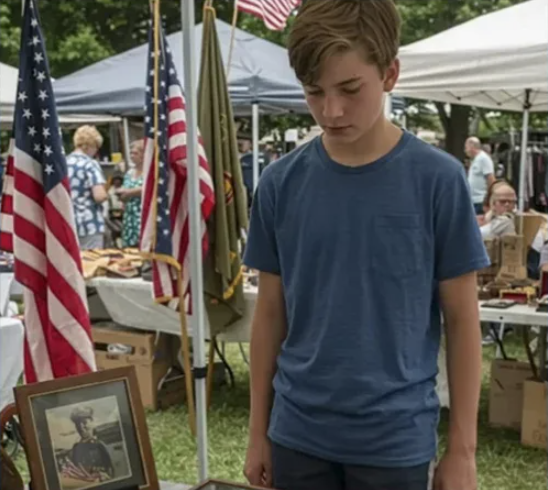
The photograph shows Mason at what appears to be that meeting or a commemoration afterward—standing solemnly at a flea market or outdoor event, American flags displayed nearby, a framed photo of a soldier visible. His expression is serious, contemplative, bearing the weight of what he’s carrying. Not just a flag, but the completion of an eighty-year journey. Not just an artifact, but proof that some promises can still be kept even when decades have passed.
Three generations of Kessler’s grateful relatives received that flag. People who exist because Kessler’s siblings survived the war and built families. People who carry his name and his legacy without having anything tangible from his service until Mason decided their connection to this hero mattered more than ten dollars and convenience.
The story is heartwarming, but it’s also a reminder of something we often forget: that heroes make sacrifices we can’t fully appreciate until we hold the physical evidence of their service. That World War II veterans like Kessler carried flags and wrote notes and hoped someone would care enough to return these items to families who’d already paid the highest price.
Kessler died on D-Day never knowing if his flag would make it home. For eighty years, the answer was no—it floated through the world, separated from its intended destination, ending up on a flea market table where most people would see it as a nice historical piece worth ten dollars.
But Mason saw it differently. He saw an unfulfilled promise, a journey interrupted, a family missing a piece of their history. And he spent months of his young life—time he could have spent on sports or friends or the normal concerns of fifteen-year-olds—researching and tracking and ultimately driving two hours to complete a mission that started in 1944.
This is what remembering heroes looks like. Not just ceremonies and holidays, though those matter. But also the quiet, painstaking work of returning what belongs to families who’ve already sacrificed so much. The research and dedication and conviction that these connections matter even after everyone directly involved has passed away.
Kessler’s flag is home now, finally. Eighty years late, but home. With family who can pass it down to future generations, who can tell the story not just of Corporal T. A. Kessler who died on D-Day, but also of the fifteen-year-old boy named Mason who cared enough to bring it back to them.
The note said “please return to family if found.” Mason found it. And months later, mission accomplished. A promise kept across eighty years, completed by someone who wasn’t even alive when that promise was made, who had no obligation except the one he felt in his heart when he read those words and decided they mattered.
Heroes make sacrifices. But heroes are also made by people who remember those sacrifices and honor them with action. Mason, at fifteen, understood that better than most adults. He saw a flag with a note and recognized it wasn’t just an object—it was a story waiting for its ending, a circle waiting to be closed, a hero waiting to be properly remembered by the family he’d left behind.
Now when Kessler’s descendants hold that flag, they hold something their ancestor touched before he died defending freedom. They hold proof that he hoped they’d receive it. They hold evidence that even eighty years later, there are still people—like a fifteen-year-old at a flea market—who believe these connections are sacred and worth preserving.
The flag made it home. The hero is remembered. And a young man named Mason proved that the importance of honoring those who served isn’t just something we say on holidays—it’s something we do when we’re willing to spend months of our lives making sure promises written in 1944 finally get kept.