Living in the USA while his parents are in the UK is hard under any circumstances. The time zones make phone calls difficult. Video chats can’t replace sitting across the table. Holidays feel empty when the people who made them meaningful are an ocean away. But manageable, mostly. Until his dad lost both legs.
Then distance became something else entirely. It became guilt and helplessness and the aching knowledge that his father was fighting the hardest battle of his life, and he couldn’t be there to help. Couldn’t drive him to appointments. Couldn’t sit beside him during recovery. Couldn’t offer the kind of presence that matters more than words when someone you love is struggling.
He called. Video chatted. Sent messages of encouragement. But it wasn’t enough. Nothing felt like enough when you’re thousands of miles away from someone who needs you, when the person who raised you and taught you strength is learning to navigate a world that suddenly looks completely different.
The amputation had been necessary—medical complications that gave doctors no choice. But necessary doesn’t mean easy. His father faced a reality most people can’t imagine: relearning balance, rebuilding strength, accepting help for things he’d done independently his entire life. The physical challenge was enormous. The emotional weight even heavier.
Recovery is lonely. Painful. Full of moments when giving up seems easier than continuing. But his father didn’t give up. He worked with physical therapists. Practiced with prosthetics. Pushed through pain and frustration and the hundred small defeats that come with relearning how to exist in a body that no longer works the way it once did.
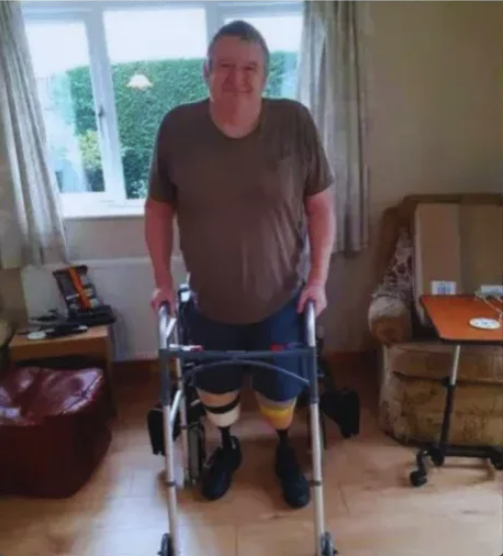
Then, just before Christmas, a photo arrived.
His father, standing completely on his own for the first time since the amputation. No help. No hands steadying him. No walker or crutches supporting his weight. Just sheer determination holding him upright, proving that what seemed impossible weeks ago had become real.
The son stared at that photo for a long time. His father standing in his UK living room, a walker nearby but not being used, his face showing the exhaustion and pride of someone who’d just climbed their personal Everest. Standing. Alone. Through nothing but determination and strength.
He is so incredibly proud of his father’s strength. Proud in a way that makes words feel inadequate. Because this isn’t just about physical recovery. It’s about refusing to let circumstances define you. It’s about facing something devastating and deciding that it won’t be the end of your story. It’s about getting up—literally—when everything in you wants to stay down.
His father didn’t have his son beside him during this journey. Didn’t have the comfort of family nearby to help through the hardest moments. He had his wife, yes—the steady presence that makes survival possible. But his son, the child he’d raised and loved and wanted to protect, was across an ocean, unable to provide the kind of support that distance makes impossible.
So his father stood on his own. Not because he wanted to prove something, but because that’s what survival required. Because when you lose your legs, you don’t have the luxury of waiting until conditions are perfect or help is available. You work with what you have. You push through pain. You stand when standing seems impossible, and you keep standing until your body remembers how.
The photo arrived just before Christmas—the best gift his son could have received. Not wrapped in paper or tied with ribbon, but infinitely more valuable than any object. Proof that his father was fighting and winning. Proof that distance couldn’t diminish the strength he’d always known his father possessed. Proof that even separated by an ocean, they were still connected by something stronger than geography—the bond between parent and child, the love that makes you proud even when you can’t be present.
Living apart from aging or struggling parents is one of the hidden costs of modern life. We move for jobs, for opportunities, for the lives we build that sometimes take us far from the people who raised us. And most of the time, it’s manageable. Phone calls and visits, photos and video chats bridging the distance.
Until crisis comes. Until your father loses his legs or your mother gets sick or something happens that makes distance feel like betrayal. Then you carry guilt alongside pride, helplessness alongside hope. You cheer from afar while wishing desperately you could be there in person. You look at photos of your father standing alone and feel both joy at his strength and sorrow that you couldn’t be beside him when he needed support.
But his father stood anyway. Because that’s what parents do—they find strength even when their children can’t be there to witness it. They fight battles while their kids are building lives elsewhere. They stand alone, not because they want to, but because they love their children enough to not let their struggles become burdens that hold them back.
The son keeps that photo. Looks at it when he needs reminding of what strength looks like. When he faces his own challenges and feels like giving up. When distance makes him forget that the values his father taught him—determination, resilience, refusal to surrender—are still there, still true, still the foundation everything else is built on.
His father standing alone in a UK living room, thousands of miles away, proves something profound: that love doesn’t require proximity, that strength doesn’t need witnesses, and that even separated by an ocean, family remains family. The connection holds. The pride remains. The love endures.
And sometimes, the best gift you can receive isn’t something wrapped and mailed, but a photo showing that the person you love most is still fighting, still standing, still refusing to let anything—not even the loss of both legs—define the limits of what they can overcome.