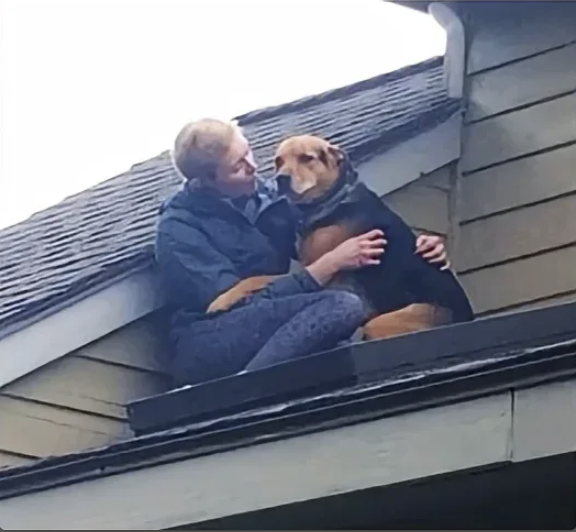
The dog opened the upstairs door. Nobody knows exactly how—dogs are surprisingly resourceful when they want to be—but somehow he managed it. And then he followed the cat onto the roof.
It probably seemed like a good idea at the time. Dogs don’t have great impulse control. They see something interesting, and they go after it. The cat was going somewhere, and the dog decided that wherever the cat was going must be worth checking out. So he followed.
And then he got onto the roof and realized his mistake.
Cats are built for vertical spaces. They have retractable claws, superior balance, and an innate understanding of how to navigate heights. Dogs have none of these advantages. They’re ground animals. They’re built for running and digging and sprawling across floors, not for precarious situations on slanted surfaces several stories up.
So the dog sat down. Just sat there, looking confused. Looking like he’d made a series of decisions he was now deeply regretting. Looking, according to his owners, like he was silently communicating: this was a bad idea, and I would like help now please.
His humans had to climb onto the roof with him. Not to scold him or laugh at him—though they probably did both—but to sit with him. To hug him. To talk to him until he calmed down enough to be coaxed back inside.
Because sometimes, when you’re scared and stuck and don’t know how to get yourself out of a situation you never should have gotten into in the first place, what you need isn’t instructions or judgment. You just need someone to sit with you until you’re okay again.
The dog eventually came back inside. But not before giving the cat “a very suspicious look, as if to say, ‘Next time, you’re on your own!'”
That line, more than anything, captures the entire emotional arc of the story. The dog followed the cat into a bad situation, learned a lesson the hard way, and is now slightly resentful about the whole thing. It’s the most relatable sequence of events: trust someone, follow them somewhere you shouldn’t go, immediately regret it, and then blame them even though it was technically your own choice.
But beyond the humor, there’s something deeply sweet about this moment. The humans didn’t just retrieve their dog from the roof like an inconvenient package. They climbed up there. They sat with him. They provided comfort before offering solutions. They recognized that their dog wasn’t being defiant or stubborn—he was scared. And fear doesn’t respond well to commands or frustration. It responds to presence.
Dogs trust their humans completely. It’s one of the most beautiful and humbling things about having a dog. They look at you like you can fix anything, protect them from everything, make the world safe just by being there. And usually, you can’t. Usually, the world is too big and too complicated and full of dangers you can’t control.
But on a roof? When a dog has followed a cat into a situation he doesn’t know how to escape? In that moment, you actually can fix it. You can be exactly what he needs you to be. You can climb up there, wrap your arms around him, and prove that his trust wasn’t misplaced.
That’s what these owners did. And their dog learned two things: one, don’t follow the cat onto the roof. And two, when you’re stuck and scared, your people will come for you.
The cat, presumably, was fine. Cats always are. They navigate the world with a confidence that borders on arrogance, entirely unbothered by the chaos they create. The dog followed the cat, got stuck, needed rescue. The cat probably barely noticed.
Which is, honestly, the most cat thing imaginable.
But the dog knows now. He gave the cat that suspicious look—the kind that says, “I see you, I know what happened, and I’m not making that mistake again.” Except he probably will. Because dogs are loyal and optimistic and not particularly good at holding grudges. Next time the cat goes somewhere interesting, the dog will probably follow again, hoping this time will be different.
And his humans will probably end up on the roof again. Hugging him. Talking to him. Reminding him that even when he makes questionable choices, they’ll be there.
Because that’s what love looks like. Not preventing every mistake, but showing up when mistakes happen. Not saying “I told you so,” but saying “I’ve got you.”
The dog came back inside. Safe, slightly embarrassed, definitely wiser. And somewhere in his dog brain, he filed away the lesson: roofs are bad. Cats are untrustworthy. Humans are good.
And really, that’s all any of us need to know.