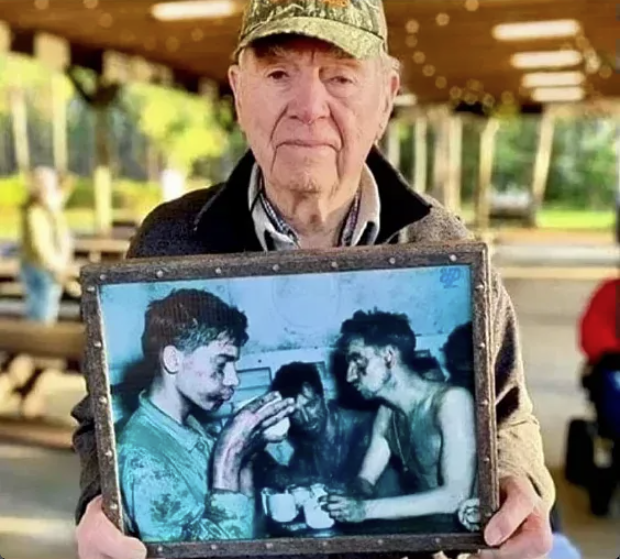
- Pacific island. Marine Faris Tuohy, 20, emerged from two days of hell – clutching a cup of coffee like a lifeline.
Two days. Think about that. Forty-eight hours of combat so intense that when it ended, when he finally emerged from whatever hell the Pacific War had delivered, he held onto a cup of coffee like it was the only thing tethering him to sanity.
Soot-smudged, silent, he stood there breathing.
The photograph captured him in that moment — young face marked by combat, body clearly exhausted, but standing upright, holding that cup with both hands. He’s looking down at it, not at the camera, focused entirely on this simple object that represents everything war had temporarily taken from him: safety, normalcy, the small comforts of being human rather than a warrior.
That cup was his anchor back to being human.
After two days of whatever horrors the Pacific islands delivered — the landings, the lost friends, the fear that never stops even when the shooting briefly pauses — that cup of coffee represented civilization, routine, the possibility of ordinary moments existing even in war.
He rarely spoke of the horrors – the landings, the lost friends, the fear.
Like many combat veterans, Faris Tuohy carried his experiences privately. The people who need to talk most about trauma are often the least able to speak about it, the memories too overwhelming to transform into words, the fear that others won’t understand or will judge or will see him differently.
But this photo captured something else: his unbroken spirit.
Despite the soot and exhaustion and whatever horrors he’d just survived, the photograph shows a young man who’s still intact somewhere inside. Traumatized certainly, changed forever absolutely, but not destroyed. The spirit that went into combat emerged damaged but not extinguished.
Decades later, at 99, he held that same photograph.
The photograph shows the elderly Faris Tuohy, now almost a century old, holding the framed image of his 20-year-old self clutching that coffee cup. He’s wearing a cap and jacket, his aged face carrying all the years between that Pacific island and this moment, all the life he lived after surviving what he survived.
“That coffee,” he whispered, “reminded me I was still alive.”
Those words reveal what the coffee represented. Not just caffeine or warmth, but proof of continued existence. After two days of hell where staying alive was uncertain moment by moment, where death surrounded him constantly, that cup of coffee was confirmation: I survived. I’m still here. I’m still human.
Some moments don’t end wars – they save the warrior.
This profound truth acknowledges that victory doesn’t happen only on battlefields or in surrender ceremonies. Sometimes it happens in small, private moments when someone clutching a coffee cup realizes they’re still breathing, still capable of tasting something, still connected to the ordinary world that exists beyond combat.
For Faris Tuohy, that cup of coffee became the symbol of his survival. Not his medals or commendations, not the battles won or territory secured, but that single moment when he emerged from hell and someone handed him something warm and familiar and completely ordinary.
He kept the photograph for 79 years. Through his twenties and thirties, through middle age and into old age, through marriage and children and grandchildren and great-grandchildren, he kept that image of his 20-year-old self holding coffee after two days of hell.
At 99, he could still remember what that coffee meant. The trauma hadn’t faded — combat trauma rarely does — but the memory of that anchor moment remained clear. He could still feel what it meant to emerge from horror and be handed something normal, something that said: you’re human again, not just a Marine in combat but a person who drinks coffee.
The Pacific War killed hundreds of thousands. Faris Tuohy survived battles that many didn’t, witnessed horrors that some couldn’t psychologically survive even when their bodies remained intact. He carried those memories for 79 years, rarely speaking of them but never forgetting.
That photograph became his way of remembering without speaking. When words failed to capture what he’d experienced, he could look at that image and remember: I survived. I clutched that coffee cup and I was still alive.
His survival wasn’t guaranteed. Twenty-year-olds died constantly in Pacific combat. The two days of hell he emerged from killed many of his friends, the lost friends he rarely spoke about, the people who never got to hold a coffee cup after combat because they didn’t emerge at all.
But he did. He made it through, stood there breathing and soot-smudged and silent, holding his anchor back to humanity.
At 99, he held the photograph of that moment. An old man remembering the young warrior he’d been, honoring the cup of coffee that reminded him he was still alive, acknowledging that some moments save warriors even when they don’t end wars.
That coffee didn’t stop the fighting. It didn’t bring his lost friends back. It didn’t eliminate the horrors or erase the fear. It simply reminded one young Marine, after two days of hell, that he was still human, still breathing, still alive.
Sometimes, that’s enough.