Gina was thirty-four years old when she went for what she thought would be a routine thirteen-week ultrasound.
She and her partner were expecting their first child. The appointment was supposed to be straightforward—check the baby’s development, confirm everything was progressing normally, maybe find out the gender. Standard procedure for expectant parents.
Instead, the ultrasound revealed something doctors had never seen before.
Not one baby. Not twins. But three identical boys—all sharing the same placenta.
The odds of identical triplets occurring naturally are approximately one in 200 million. Most triplets are fraternal, developing from separate eggs. But Gina was carrying three babies who’d developed from a single fertilized egg that had split twice—an extraordinarily rare phenomenon that happens so infrequently that many obstetricians go their entire careers without encountering it.
The doctors were shocked. Gina and her partner were overwhelmed. Three babies. Identical. All sharing one placenta, which meant the pregnancy carried significant risks. The boys would need to be monitored constantly, delivered early, and given immediate intensive care.
A month before their due date, Jimmy, Jensen, and Jaxson were delivered via C-section with thirty doctors in the room. Each baby had their own medical team—ten doctors per child—ready to address any complications the moment they were born.
All three boys were immediately admitted to the NICU. For six weeks, Gina and her partner lived in that uncertain space where hope and fear coexist—visiting their tiny sons hooked up to monitors and machines, praying they’d grow strong enough to come home.
But they did. After six weeks in the NICU, all three went home healthy.
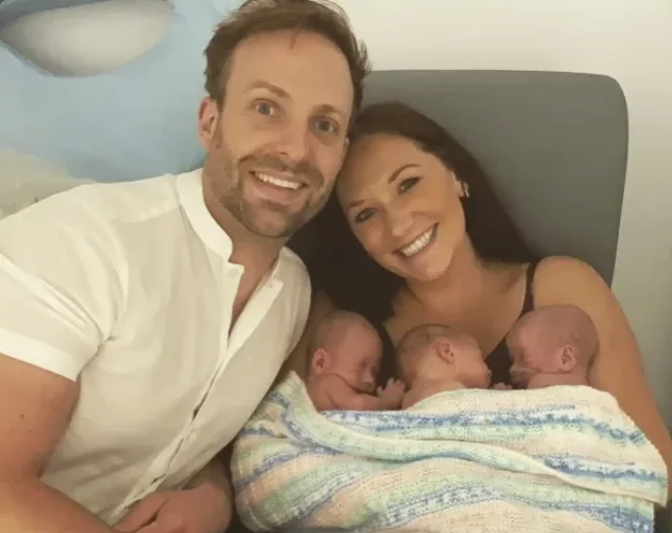
The photo shows Gina and her partner beaming with pride, their three identical newborn sons bundled together in a striped blanket. The boys are impossibly small, nestled against each other, indistinguishable to anyone who doesn’t know them intimately.
But now, at five months old, despite sharing identical DNA, they’re already showing completely different personalities. One is calm and observant. Another is energetic and vocal. The third is somewhere in between. Proof that even when genetics are identical, individuality finds a way to emerge.
The story went viral because it represents something extraordinary—not just the astronomical odds of identical triplets, but the triumph of survival against those odds. Three babies who shared one placenta, who were born premature, who required months of intensive medical care, all thriving.
Gina didn’t expect to become the mother of identical triplets. She expected one baby. But life had different plans—plans that required thirty doctors, six weeks of NICU care, and more love, patience, and strength than she’d known she possessed.
The caption asks: If this miracle amazed you, hit ❤️ and comment “One in 200 million!”
Because it truly is miraculous. Not just the rarity of their conception, but their survival. The fact that all three boys came home healthy after such a high-risk pregnancy. The way they’re already developing distinct personalities despite being genetic copies of each other.
One in 200 million. Three identical boys. Three different people emerging from the same DNA. Three lives that almost didn’t happen but did—against astronomical odds, through medical intervention, and with parents who were ready to love them through every uncertain moment.
Jimmy, Jensen, and Jaxson. One in 200 million. And absolutely worth every miraculous, terrifying, beautiful moment of their arrival.