Some stories don’t get the endings we need. They don’t resolve in tearful reconciliations or mutual understanding. They end abruptly, with packages left unopened and words that will never be said aloud. This is one of those stories.
His mother left when he was a baby. Not gradually, not with explanations he was too young to understand anyway—she just left. And his father stayed. His father, who could have been bitter or absent in different ways, chose instead to be present for everything. The scraped knees and school plays. The teenage heartbreaks and late-night talks. His father became both parents, filling the space his mother had abandoned with a love big enough to cover the gap.
For eighteen years, that absence was complete. No birthday cards. No phone calls. No gradual reappearance. Just silence that hardened into something like scar tissue—not actively painful anymore, but permanently marking where the wound had been.
Then, at eighteen, she returned.
She came back the way people do when they’ve decided it’s time to make peace with their past, seeking forgiveness without first acknowledging the scope of what they’d done. She wanted reconciliation. She wanted him to understand, to listen, to absolve her of the years she’d been gone.
But he was eighteen and angry and not ready. The man who’d raised him had earned his trust through consistency and presence. This woman was a stranger wearing the title of mother without having done any of the work that made that word meaningful. So he refused to listen. He held onto his anger because it felt safer than vulnerability. He kept his heart closed because opening it meant risking being abandoned all over again.
A week later, she died.
An illness, sudden and final. And only then—only after it was too late for conversations or second chances—did he open the package she’d sent. The one that had arrived before she showed up at his door. The one he’d shoved aside, unopened, because acknowledging it meant acknowledging her.
Inside was something that shattered him completely. We don’t know exactly what it held—maybe letters explaining what happened, maybe photographs of a life he’d never known she’d lived, maybe evidence of struggles he’d been too young and too hurt to consider. Whatever it was, it changed everything about how he understood her absence.
But understanding came too late. The person he needed to talk to was gone. The questions he should have asked would never get answers. The anger he’d held onto so tightly suddenly had nowhere to go except inward, transforming into regret and the particular kind of grief that comes when you realize you can’t undo your last interaction with someone.
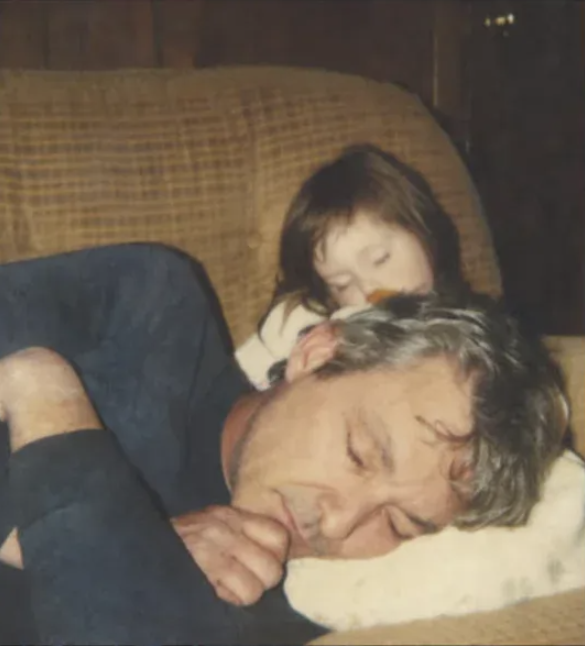
There’s a photograph in this story—a father and child sleeping, the child draped across the father’s chest in the complete trust that only small children have. It’s an image of safety and presence. Of someone who stayed. And looking at it now, with the weight of everything that came after, it holds all the complexity of this situation.
His father gave him everything. Protection and love and the fierce consistency that meant he never had to wonder if he was wanted. That photograph is proof of devotion, of a man who stepped up when someone else stepped away. And nothing that came later diminishes that.
But his mother’s death forced him to reckon with something painful: that people can be both wrong and human. That his father could be a hero without his mother necessarily being a villain. That her leaving could have been the wrong choice and still been made by someone struggling with circumstances he’d never fully understand.
The package sat unopened for days, maybe weeks. And then for a week more while she was alive and seeking forgiveness. If he’d opened it sooner—if he’d listened when she came to his door—would it have changed anything? Would there have been time for understanding, if not full forgiveness? Would he have been able to say goodbye differently, with less anger and more questions?
He’ll never know. And that uncertainty is its own kind of torture.
Grief is complicated when it involves someone who hurt you. You’re not just mourning who they were; you’re mourning who they might have been, what they might have explained, how your relationship might have transformed if given more time. You’re grieving the version of them you never got to meet—the one who’d grown or changed or could articulate what drove them away.
The anger he’d held for eighteen years doesn’t just disappear when someone dies. It lingers, but now it’s mixed with guilt and regret and the awful realization that his last act toward her was rejection. That she died knowing he refused to hear her. That whatever explanation or apology she’d prepared died with her, never received by the person it was meant for.
His father raised him with love and strength. That truth stands solid and unchanging. But now he also carries this truth: that he’ll never know what his mother wanted to say, why she left, what the package contained that changed everything. He’ll live with the knowledge that he had a chance—one brief, uncomfortable chance—to hear her side, and he chose anger instead.
Maybe she didn’t deserve forgiveness. Maybe her explanation wouldn’t have been good enough. Maybe her leaving caused damage that no retroactive apology could repair. All of that can be true while it’s also true that he deserved the chance to make that determination after hearing her, not before.
The photograph of him sleeping peacefully on his father’s chest is beautiful because it’s true. His father was there. His father stayed. His father proved that love is action sustained over time. Nothing challenges that.
But the package that shattered him after his mother died is also true. The complexity is also real. The regret is also valid. We can hold both—gratitude for who stayed and sorrow for what we’ll never understand about who left.
This is the shape of some griefs: not clean or simple, but knotted with missed chances and words unsaid and anger that outlived its usefulness. It’s the particular pain of realizing too late that someone’s worst decision doesn’t have to be their only story, and that refusing to hear their story was itself a choice he’ll carry forever.
The baby in that photograph grew up loved and protected. But the eighteen-year-old who refused to listen will live with questions that have no answers now. Both things are true. Both things matter. And both things will shape who he becomes.