On Thanksgiving, the hospital was full of families. Visitors crowded hallways and patient rooms, bringing food and laughter and the warmth that comes from people gathering together for holidays. The sounds of celebration filled the building—multiple conversations, children’s voices, the particular energy of families being together on a day dedicated to gratitude and connection.
Except for 92-year-old Walter, who had no one left.
He turned to the wall, trying to sleep through the loneliness. Not because he was tired, but because sleep was the only escape from the awareness that everyone around him had family visiting while he had no one. That Thanksgiving was happening all around him while he spent it alone in a hospital bed, the contrast making his isolation feel even more profound.
His nurse, Jasmine, noticed. In the chaos of a holiday shift where every patient had needs and every room had visitors creating additional demands on staff time, she noticed the one patient facing the wall, trying to sleep through loneliness that shouldn’t be part of anyone’s Thanksgiving experience.
When her shift ended, she couldn’t leave. Not couldn’t in the sense of being required to stay, but couldn’t in the sense of being unable to walk away from Walter spending Thanksgiving alone. Her work obligation was finished, she’d fulfilled her professional duties, she could have gone home to her own family and her own holiday plans. But she stayed.
She bought a Thanksgiving meal with her own money. Not hospital food, but a proper Thanksgiving dinner—turkey, sides, all the traditional foods that make the holiday feel special. Purchased on her own time with her own money because Walter deserved better than institutional food eaten alone on Thanksgiving.
And she sat beside him with a simple question: “Walter, would you mind if we had dinner together?”
He hadn’t shared Thanksgiving with anyone since his wife passed. How many years that had been, we don’t know. But long enough that being alone on Thanksgiving had become his new normal, something he’d resigned himself to as just how holidays work now—watching everyone else celebrate while he tried to sleep through the loneliness.
Tears filled his eyes. Not sad tears exactly, though sadness was certainly present. But overwhelmed tears—the kind that come when someone shows you unexpected kindness, when you’ve accepted loneliness as inevitable and someone refuses to accept it on your behalf. “I thought everyone forgot about me,” he said.
That statement contains so much pain. Not just “I’m alone this Thanksgiving” but “I thought everyone forgot about me”—the deeper fear that comes with outliving your generation, your spouse, your social circle. The fear that you’ve become invisible, that nobody notices or cares about your existence anymore, that you could disappear and it wouldn’t matter to anyone.
But Jasmine noticed. In a busy hospital on a holiday when she had every excuse to focus on her own plans, she noticed the elderly patient turned to the wall trying to sleep through loneliness. And she chose to do something about it—not through extra medical care or professional duties, but through simple human connection. Through sitting beside him and sharing a meal, through asking permission to give him company as if his preferences and comfort mattered.
For one quiet hour, he wasn’t alone. For one hour on Thanksgiving, Walter had company, had someone choosing to spend time with him, had a proper holiday meal shared with another person who cared enough to make it happen. The loneliness that had driven him to face the wall and try to sleep lifted for that hour, replaced by the kind of connection that holidays are supposed to provide.
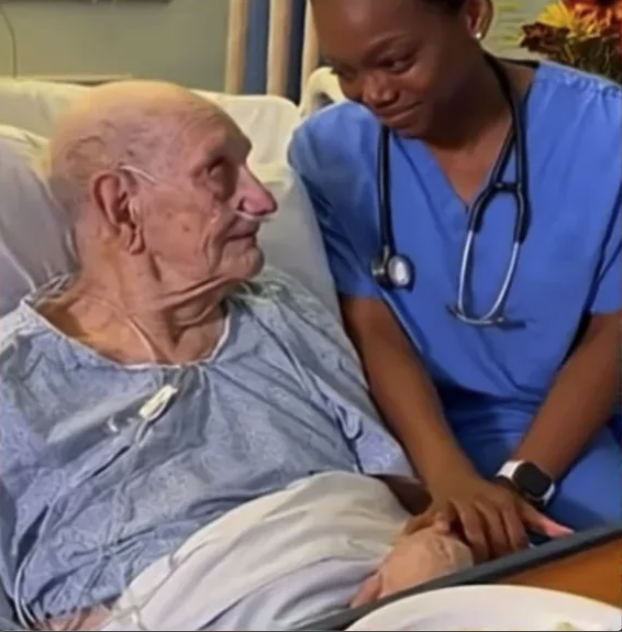
The photograph shows them together—Walter in his hospital bed, elderly and frail, looking at Jasmine with an expression that speaks to emotional relief. Jasmine beside him in her blue scrubs, professional but present, giving her time not because it’s required but because it’s right. Between them, evidence of the Thanksgiving meal she brought, the holiday happening in this small hospital room because one nurse refused to let one patient spend it alone.
Moments like this are truly remarkable not because they’re impossible but because they’re rare. What Jasmine did wasn’t beyond anyone’s capability. Any nurse could have stayed after their shift. Any staff member could have bought a Thanksgiving meal and shared it with a lonely patient. The remarkability lies in the choosing—in actually doing something that most people, for understandable reasons, wouldn’t do.
Thanksgiving shifts end and nurses go home to their own families and celebrations. That’s normal, expected, entirely reasonable. Nobody would blame Jasmine for leaving when her shift ended, for spending Thanksgiving with her own loved ones, for deciding that her professional obligation to Walter ended when her work hours did.
But she stayed. And that choice—to give her own time, spend her own money, delay her own holiday plans so that a 92-year-old man wouldn’t spend Thanksgiving alone—that’s what makes this remarkable. Not impossible, not superhuman, just remarkably kind in a world where kindness often stops at the boundaries of professional obligation.
Walter thought everyone forgot about him. That statement will haunt anyone who’s spent time thinking about elderly isolation, about how many people are alone not because they’re difficult or unlovable but because they’ve simply outlived everyone who knew them well. How many elderly people spend holidays facing walls, trying to sleep through loneliness, believing they’ve been forgotten.
But Jasmine remembered. Noticed, cared, acted. Made sure that for one Thanksgiving, one elderly man who thought everyone had forgotten him experienced being remembered, being valued, being worth someone’s time and effort and company.
For one quiet hour, he wasn’t alone. In a life that probably contains many lonely hours now, one hour of connection matters. One Thanksgiving spent with company instead of facing the wall in isolation matters. One experience of someone choosing to sit with you, share a meal with you, make you feel like you matter—that memory probably sustained Walter through holidays that followed.
Jasmine’s Thanksgiving was different that year—started later, included a quiet hour in a hospital room with an elderly patient instead of immediately joining her own family. But she gave Walter something irreplaceable: proof that he hasn’t been forgotten, that someone notices when he’s alone, that he still matters enough for someone to choose to spend time with him.
Moments like this are truly remarkable. Not because they require special skills or resources, but because they require seeing past professional boundaries and institutional structures to recognize shared humanity. Because they require choosing connection over convenience, choosing to care when you could justifiably choose to leave.
On Thanksgiving, 92-year-old Walter had no one left. His nurse Jasmine noticed, stayed after her shift, bought a meal with her own money, and asked “would you mind if we had dinner together?” For one quiet hour, he wasn’t alone. And that hour, that choice, that simple act of refusing to let someone spend Thanksgiving isolated—that’s what remarkable kindness looks like.