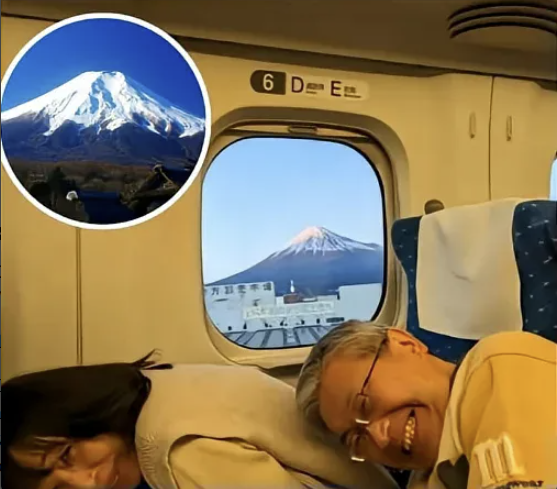
Abdullah Ghazanfar was riding a Japanese bullet train, watching the landscape blur past at speeds that make ordinary travel feel impossibly slow. Then Mount Fuji appeared outside the window—that iconic, snow-capped peak that defines Japanese landscapes, that travelers come from around the world to photograph, that somehow manages to be both exactly what you expect and more breathtaking than any image can capture.
He lifted his camera, trying to frame the shot from across the aisle. But the angle was wrong. Mount Fuji was visible through the window on the opposite side of the train, and from where he sat, he couldn’t capture it properly. The geometry was against him—too much train interior, not enough mountain, the perspective all wrong for the photograph he wanted.
A Japanese couple sitting by the window noticed his struggle. They could see him leaning, adjusting, trying to find an angle that would work, clearly frustrated by the limitations of his seat position. And without hesitation, without shared language to discuss what they were about to do, they both ducked down in their seats simultaneously.
Just dropped below window level, clearing the frame completely, and motioned him over for the perfect shot.
Abdullah moved quickly, crossing the aisle while Mount Fuji remained visible, positioning himself at their window, and captured the photograph he’d been attempting. The mountain filled the frame properly now, majestic and clear, exactly the shot he’d hoped for. The couple stayed ducked down until he signaled he’d gotten it, then rose back up as smoothly as they’d descended, smiling, pleased to have helped.
No shared language. No discussion or negotiation. Just two people who saw someone struggling with something simple and chose to help in the most direct, uncomplicated way possible. They sacrificed their own view temporarily—gave up watching Mount Fuji pass by their window during those precious seconds when the train’s position made it perfectly visible—so a stranger could have a photograph.
Abdullah later reflected that he might forget a normal Mount Fuji photo. The mountain is spectacular, yes, and the photograph itself captures that natural beauty perfectly. But what made this moment unforgettable wasn’t the mountain—it was the kindness. The spontaneous, generous gesture from two strangers who could have simply smiled sympathetically and returned to their own viewing, but instead chose to make his experience better.
The photograph shows Mount Fuji through the bullet train window, snow-crowned and magnificent against a clear blue sky. In the corner, a circular inset shows the full mountain for context. But below the window, you can see the tops of two heads—the Japanese couple, still ducked down, making this shot possible. Their presence in the frame isn’t accidental or photobombing. It’s evidence of kindness captured mid-gesture.
This is what the best travel memories are made of—not just the famous landmarks you see, but the people who help you see them better. Not just the destinations you reach, but the strangers who become briefly, beautifully part of your journey in ways that transform ordinary moments into stories you’ll tell for years.
Mount Fuji is stunning. Millions of people photograph it annually from trains and viewing platforms and hotels and hiking trails. Abdullah’s photograph of the mountain itself is probably similar to countless others taken from bullet trains by travelers who had better seat positions or better angles or more expensive camera equipment.
But none of those other travelers have this story. None of them have a photograph that contains evidence of strangers’ kindness—the tops of two heads belonging to people who ducked down without being asked, who sacrificed their own view, who used gesture and intuition to communicate across language barriers and help someone they’d never met and would never see again.
The Japanese couple resumed their seats after Abdullah finished photographing. Probably exchanged smiles and a bow, the universal gesture of gratitude and acknowledgment. Then everyone returned to their own traveling—the couple to watching the landscape pass, Abdullah to his seat across the aisle, all of them continuing to wherever the bullet train was taking them.
But the moment stayed with Abdullah. Significant enough to share online, to frame not just as a lucky photograph but as evidence of something important: that the best travel experiences come from human connection. That kindness transcends language barriers. That the most memorable moments often involve not what you see, but who helps you see it.
Without hesitation or shared language, the couple helped a stranger capture something beautiful. They didn’t need to discuss it, didn’t need Abdullah to explicitly ask, didn’t need any reward or recognition. They just saw someone trying to photograph Mount Fuji from a difficult angle and thought: we can help with this. And they did, simply and completely, in the time it took for the mountain to pass by their window.
This is how kindness works at its best—immediate, intuitive, uncomplicated by language or cultural differences or expectations of reciprocity. Just humans recognizing another human’s small struggle and choosing to make it easier in whatever way their position allows.
Abdullah got his perfect shot of Mount Fuji. But more importantly, he got a story about the day two Japanese strangers made his travel experience unforgettable through a simple, generous gesture that required nothing from them except brief discomfort and willingness to prioritize someone else’s joy over their own convenience.
The best travel memories come from people, not places. Mount Fuji will be there for centuries, offering the same spectacular views to endless streams of travelers. But the Japanese couple who ducked down without being asked, who cleared the frame so a stranger could capture it properly, who demonstrated that kindness requires no shared language—they’re the reason this particular Mount Fuji photograph means something more than just another beautiful landscape shot.
Years from now, Abdullah might forget other details of his Japan trip. But he’ll remember the moment on the bullet train when two strangers helped him without hesitation, when human kindness made Mount Fuji more than just a mountain to photograph, when he learned that the best moments of traveling aren’t just about where you go but about who you meet along the way.