The arrangement started practically. A Dutch nursing home facing the dual challenges of resident loneliness and student housing shortages proposed a simple exchange: students could live rent-free in exchange for thirty hours monthly helping with tasks, sharing meals, and keeping residents company.
On paper, it was a practical solution to two distinct problems. Students desperately need affordable housing in a market where rent consumes enormous portions of their income. Elderly residents need consistent social interaction, help with daily tasks, and the kind of companionship that paid staff, no matter how caring, can’t fully provide during limited shift hours.
But what began as practical arrangement has blossomed into something far more valuable than either group initially anticipated. Over thirteen years, this nursing home has proven that what looked like convenient cost-sharing was actually the foundation for genuine intergenerational family.
Students and seniors now form deep bonds extending well beyond required hours. The relationships that develop aren’t transactional—aren’t young people grudgingly fulfilling housing obligations or elderly residents tolerating intrusive youth. They’re genuine connections where both groups discover unexpected friendship, mutual care, and the particular joy that comes from bridging generational divides.
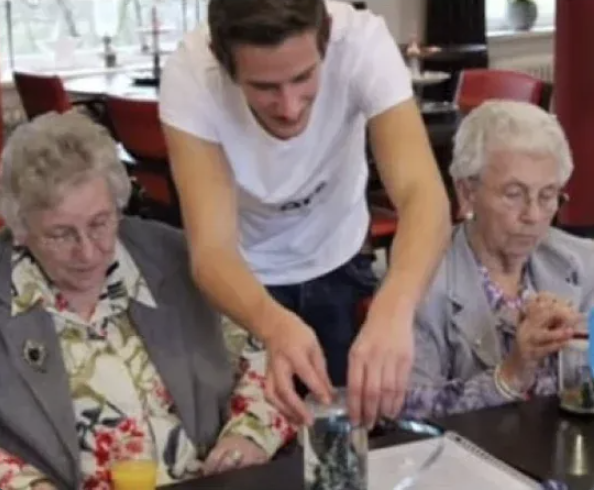
The photograph captures this beautifully: a young male student stands between two elderly female residents, helping them with a meal or activity, his body language showing engagement rather than obligation. The women look content, focused on whatever task they’re sharing, comfortable with his presence in ways that speak to relationship rather than service provision.
Their connections are growing into genuine love. Students who initially signed up for affordable housing find themselves deeply attached to specific residents—checking in beyond their required hours, spending holidays at the nursing home rather than leaving residents alone, grieving when elderly friends pass away. Residents who initially appreciated practical help find themselves invested in students’ academic success, relationship dramas, future plans—becoming surrogate grandparents who care deeply about these young people’s lives.
The halls overflow with laughter, warmth, and constant “I love yous” between generations. This isn’t the quiet, institutionalized atmosphere typical of many nursing homes where residents spend most time in rooms, where interaction is primarily with paid staff, where each day resembles the one before. This is a living, dynamic community where young energy and elderly wisdom intersect constantly, where studying happens alongside stories about decades past, where meal times bring together people separated by sixty years but connected by genuine affection.
The program proves something profound: that the best cure for loneliness is simply people who choose to care. Not professional caregivers following schedules, though they’re essential. Not occasional family visits, though those matter. But daily, consistent presence of people who are there not because they’re paid or obligated by blood, but because they’ve chosen this arrangement and discovered it offers something they didn’t even know they needed.
Students benefit enormously. Free housing solves immediate financial pressure, but the greater gift is the intergenerational relationships they develop. In a world where many young people grow up geographically separated from grandparents, where elderly people exist primarily in age-segregated facilities, these students gain adopted grandparents who offer wisdom, perspective, and unconditional support through the stressful years of academic life.
They learn to value elderly people not as burdens or fading remnants but as fully alive humans with rich histories, maintained personalities, continued capacity for humor and growth and relationship. They learn patience, develop caregiving skills, understand aging in ways that will shape how they treat elderly people throughout their lives. They gain family they didn’t have before—people who genuinely care whether they pass exams, navigate relationship troubles, make good decisions.
Residents benefit equally profoundly. The presence of young people transforms the atmosphere from elderly-waiting-to-die into multigenerational-community-living-actively. Students bring energy, current culture, connection to a world beyond the nursing home. They provide consistent companionship that isn’t contingent on shift schedules or staffing shortages. They offer genuine relationship rather than professional care—the kind of casual, daily interaction that makes life feel normal rather than institutional.
Elderly residents become invested in students’ futures, gaining purpose through supporting young people. They share decades of accumulated wisdom, tell stories that preserve family and cultural history, offer perspectives that only long life provides. They’re needed, valued, connected to future rather than just reminiscing about past.
The thirty hours monthly start as obligation but quickly become insufficient. Students find themselves spending far more time than required because they’ve grown to genuinely love specific residents. The help with tasks becomes secondary to the companionship, the required hours become irrelevant when you’re visiting someone you care about.
This Dutch nursing home has created something remarkable—not through expensive programs or innovative medical care, but through the simple recognition that loneliness is solved by genuine human connection. That young and old need each other in ways modern society has forgotten by segregating generations. That practical arrangements can become profound relationships when people are given opportunity and space to connect authentically.
For thirteen years, students and seniors have formed bonds that prove family isn’t just blood relation. It’s the people who show up consistently, who care about your daily life, who celebrate your successes and comfort your struggles, who see you as fully human regardless of age. The laughter filling the halls, the “I love yous” exchanged between generations, the warmth evident in every interaction—these are the sounds and signs of family created through choice rather than biology.
The best cure for loneliness is simply people who choose to care. Not complicated solutions or expensive interventions, but the daily presence of humans who see each other, value each other, build genuine relationships that transcend age and initial motivations. Students came for free housing and found grandparents. Residents accepted students for practical help and found family. Together, they’ve proven that intergenerational community isn’t nostalgic fantasy—it’s achievable reality when we create structures that bring people together and let relationship develop naturally.