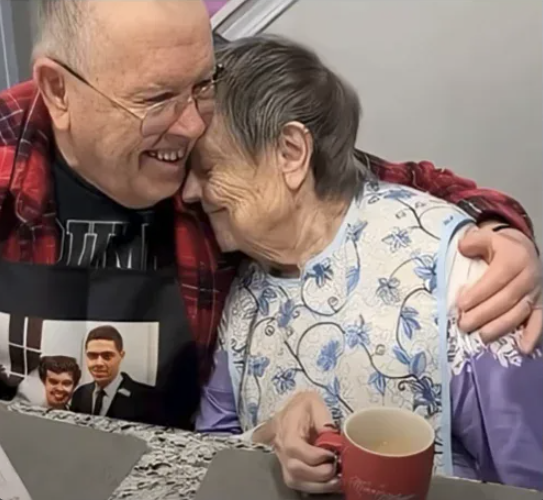
The kitchen fills with the familiar sounds of morning. The coffee maker gurgles. Eggs sizzle in the pan. Toast pops up golden brown. And there, standing at the stove in his apron, is a man wearing a photograph pinned to his chest—a young couple on their wedding day, frozen in black and white, smiling like they had forever.
He does this every single morning.
She sits nearby, watching him with the quiet curiosity of someone observing a kind stranger. Her eyes don’t light up with recognition when he brings her coffee just the way she’s always liked it. She doesn’t remember that he knows she prefers her eggs scrambled soft, not firm. She doesn’t recall the thousand breakfasts they’ve shared at this same table, in this same kitchen, over the decades of their marriage.
Alzheimer’s has taken those memories from her. It’s erased the wedding day captured in that photograph. It’s stolen the years of inside jokes and shared routines, the births of children and the buying of their first home, the arguments and reconciliations that built their life together. She looks at him now and sees only a gentle man who takes care of her, whose face is kind, whose presence feels safe.
So he wears the photograph. Not for himself—he remembers every detail of that day without needing reminders. He wears it for her. A small visual anchor in a world that no longer makes sense. A daily testimony that says: We were married. You wore white. I wore a suit. We promised forever, and I’m still here keeping that promise.
Some mornings she studies the photograph, tracing the outline of the young woman in the wedding dress with her eyes. She might comment on how beautiful the bride looks, not realizing she’s looking at herself. Other mornings she simply accepts the image without question, the way she accepts that this man knows how she likes her coffee, that he speaks to her with tenderness, that he never leaves her side.
The cruelty of this disease is in its specificity. She’s lost him as her husband, but she still knows she’s cared for. She’s forgotten their history, but she still feels safe. The memories are gone, but the love—expressed through action, through presence, through the daily rituals he maintains—that love still reaches her somehow. Not as recognition, but as reassurance.
He could have walked away. Many would have understood. The woman he married exists now only in photographs and in his own memory. The conversations they built their relationship on have been replaced by simpler exchanges. The partnership has become caregiving. The wife has become someone who needs him in entirely different ways than before.
But here’s what that photograph represents beyond a wedding day: the understanding that love isn’t just a feeling that exists in memory. Love is also the choice you make when memory fails. It’s showing up every single day for someone who no longer remembers why you’re there. It’s maintaining the routines that once belonged to two people even when only one person recalls their significance.
He makes breakfast the same way he always has because some part of him believes that consistency matters, that perhaps on some level deeper than conscious memory, she recognizes the rhythm of their shared life. The smell of coffee brewing at seven-thirty. The sound of eggs being whisked. The gentle way he asks if she slept well.
Friends and family see him and wonder how he does it—how he lives with someone who’s forgotten him without bitterness, without visible grief. What they don’t understand is that he’s not living without grief. He’s living through it, every single day, by focusing not on what’s been lost but on what remains. She’s still here. She still smiles when he tells a joke. She still holds his hand when they walk. She still trusts him completely.
The photograph is small against his chest, yellowed with time, showing two people who had no idea what was coming. They couldn’t have known that their vows would be tested in this particular way. That “in sickness and in health” would mean one day she’d look at him like a stranger. That “for better or worse” would include mornings when she asks who he is and evenings when she wonders where her husband went, not understanding that he’s right there beside her.
But they made those vows anyway. And he’s keeping them, with a photograph pinned to his apron, making breakfast in a kitchen full of memories that only he can access now.
This is what devotion looks like when stripped of everything except its essence. Not the romantic gestures or the shared dreams, but the daily choice to remain present for someone even when they can’t remember why you matter. To be the keeper of a love story that only one person can still recall, and to honor that story anyway through every small act of care.
She may not recognize him as her husband. But she knows, on some fundamental level that transcends memory, that she is loved by the man who sits beside her. That she can rest her head on his shoulder, knowing she is safe. That she can trust him, even without understanding why.
And maybe that’s enough. Not what they planned for, not what anyone would choose. But enough to keep showing up, keep making breakfast, keep wearing that photograph. Enough to prove that real love doesn’t end when memory does. It just finds new ways to show itself—quieter ways, simpler ways, but no less true.
Every morning, he pins that photograph to his apron. Every morning, he reminds her without words: You are loved. You have always been loved. And you will be loved for all the mornings we have left.