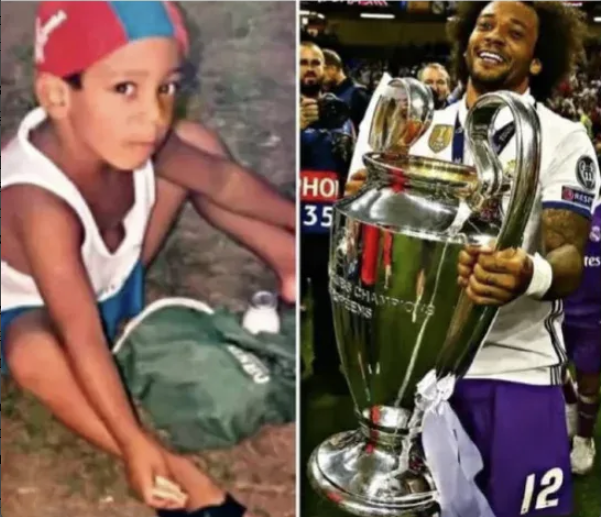
Most 14-year-olds asking for something on credit would be dismissed immediately. Adults don’t extend loans to children based on future earnings, especially not based on dreams as statistically unlikely as becoming a professional athlete. But Marcelinho walked into that store with something more powerful than a business plan—he walked in with absolute certainty.
His mother had already said no. Not because she didn’t believe in him or didn’t want him to have a football, but because the math was simple and unforgiving: they couldn’t afford it. When you’re raising a child in poverty, every purchase is a calculation. Food or football? School supplies or sports equipment? The necessary always wins over the desired, no matter how much the desired matters to your child’s heart.
So Marcelinho went to the store himself. Not to steal, not to beg, but to propose a business arrangement. He found the owner and made his pitch with the kind of confidence that usually comes from having leverage or collateral. He had neither. All he had was a dream and the willingness to stand behind it.
Can you sell me a football? I’ll pay you back when I become a professional player.
The store owner could have laughed. Should have laughed, probably, by any reasonable assessment of how business works. Professional football careers are rare, emerging from Brazilian favelas even rarer. The odds of this particular skinny teenager standing in front of him making it big enough to remember a small debt to a store owner? Astronomical.
But something about the kid’s certainty stopped him. Not arrogance—certainty. There’s a difference. Marcelinho wasn’t promising because he thought he might make it. He was promising because he knew he would. The store owner looked at this 14-year-old and saw something he couldn’t quite name but couldn’t quite dismiss either.
He laughed. But then he said yes.
Hell yes, Marcelo. Just remember to pay.
It wasn’t a sound business decision. It was a leap of faith in a kid who believed in himself with the kind of intensity that bends reality. The store owner handed over the football—a real one, not old or deflated, but the kind that could survive the brutal games played on concrete and dirt, the kind that felt right when you kicked it.
Marcelinho took that ball and practiced like his life depended on it. Because in many ways, it did. Football wasn’t a hobby or a way to pass time. It was the way out, the way up, the thing that would transform his family’s circumstances and prove that his mother’s sacrifices weren’t for nothing. That ball became more than equipment—it became a promise he was keeping to himself and to the store owner who’d believed in him.
Years passed. Thousands of hours of practice. Games played in neighborhoods where talent scouts rarely ventured. Slowly, impossibly, the dream started becoming real. He got noticed. He got chances. He took those chances and turned them into more chances until one day he was signing professional contracts, wearing jerseys that bore his name, playing in stadiums filled with thousands of people chanting for him.
Marcelo Vieira da Silva Júnior—Marcelo—became one of the most successful footballers of his generation. Real Madrid. Brazilian national team. Championships and accolades and a career that would have seemed like fantasy to that 14-year-old asking for credit in a small store.
But he didn’t forget. Years later, established and wealthy and famous, he went back. Not just to the store, but with a purpose that circled back to where it started. He bought balls—not just one, but as many as he could carry. And he took them to the poor kids in his old neighborhood, the ones standing where he’d once stood, dreaming dreams that seemed impossible to everyone except themselves.
The store owner got paid, of course. Probably many times over, in cash and in the satisfaction of having made exactly the right bet. But the real payment was in what Marcelo did with his success—remembering what it felt like to need a football and not be able to afford one, then making sure other kids wouldn’t have to make the same desperate pitch he once did.
There are two photographs that tell this story. One shows a young boy in a favela, skinny and barefoot, holding a football that might have been the one the store owner gave him on credit. The other shows a grown man in a professional jersey, holding a trophy, grinning with the confidence of someone who always knew this was coming.
Between those two images is a story about belief—not just Marcelo’s belief in himself, but a store owner’s belief in a teenager who walked in with nothing but certainty and a promise. It’s a story about how sometimes the most unlikely investments pay off in ways that exceed any monetary return. About how giving someone a chance can change not just their life, but the lives of everyone they’ll go on to help.
Marcelo could have forgotten that debt. He could have decided it didn’t matter, that the store owner wouldn’t remember or care, that it was a small thing from childhood that didn’t require follow-up. But he remembered, because that football represented more than just equipment. It represented someone seeing potential in him when there was no logical reason to. It represented a yes when he should have gotten a no.
And now he’s paying it forward, giving balls to kids who remind him of who he was—full of dreams that adults dismiss as impossible, desperate for just one chance to prove what they already know about themselves. He’s become the store owner for a new generation, the one who says yes when logic says no, the one who sees certainty in young eyes and decides to honor it.
The store owner took a risk on a 14-year-old’s promise. That risk became one of the best investments he ever made—not because he got paid back, but because he helped launch a career that would inspire millions. Because he proved that sometimes believing in impossible dreams is exactly the right business decision, even when all the numbers say otherwise.
Marcelo still has that confidence he walked into the store with at 14. But now it’s backed by accomplishment and softened by gratitude. He knows how easily his story could have gone differently. One different answer from one store owner, and maybe he never gets the practice time that honed his skills. Maybe he loses motivation. Maybe the dream dies not because he lacked talent, but because he lacked equipment.
Instead, a store owner laughed and said yes. A skinny kid took a football and turned it into a career. And years later, a professional athlete remembers where he came from and makes sure other kids get their chance to make impossible promises that might just come true.