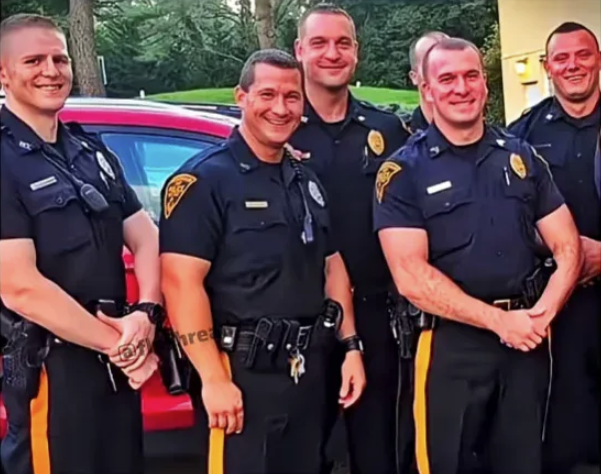
The photo shows five police officers standing together, smiling.
Their uniforms are crisp. Their expressions relaxed. They look like colleagues posing for a department photo—the kind of image that gets filed away in annual reports or posted on social media to show community engagement.
But an hour before this photo was taken, these men weren’t smiling. They were waist-deep in a pond, forming a human chain, fighting to save a child’s life.
An eight-year-old boy had fallen into the water. Whether he’d been playing too close to the edge or slipped on wet ground, the details didn’t matter once he was under. What mattered was that he couldn’t swim, couldn’t reach the surface, couldn’t breathe.
Thompson jumped in first. Didn’t hesitate. Didn’t wait for backup or equipment or someone else to take the risk. Just heard a child was drowning and went.
The others followed immediately, forming a chain—each officer holding the next, creating a lifeline that stretched from shore to where the boy had gone under. They searched through murky water, hands reaching blindly, fighting against time and panic and the terrible knowledge that every second mattered.
They found him. Pulled him up. But he wasn’t breathing.
Martinez started CPR immediately. Compressions. Rescue breaths. The mechanical rhythm that’s supposed to restart what’s stopped. Around him, the other officers held the boy steady, supported Martinez, kept watch, their training taking over even as their hearts raced.
It felt like hours. It was probably minutes. Martinez kept going—compressions, breaths, compressions—until finally, the boy coughed. Sputtered. Started breathing.
His mother, who’d watched in horror from the shore, collapsed in tears. “You gave me back my son.”
Not “you saved him” or “thank you.” But you gave me back my son. Because for those terrible minutes, she’d lost him. Watched him disappear under water. Believed she’d never hold him again.
And these officers—five men who’d never met this child, who had no obligation beyond their duty, who could have waited for specialized rescue teams—had given him back.
An hour later, after the ambulance had left, after the adrenaline had faded, after they’d written their reports and checked their equipment, someone suggested a photo. To document the day. To remember what they’d accomplished together.
They stood together and smiled. Not because what happened was happy—trauma never is. But because they’d won. Because a child who should have died was breathing. Because brotherhood had saved a life.
The caption explained what the photo couldn’t show: that an hour earlier, these smiling officers had been forming a human chain in a pond. That Thompson had jumped in first. That Martinez had done CPR until the boy finally coughed. That this moment of calm camaraderie was the aftermath of crisis, the quiet after the storm.
Not all heroes wear capes… some just show up, risk everything, and go home quietly like nothing happened. Respect to these legends.
The post went viral because people needed the reminder. That police officers do more than what makes the news. That between the headlines about violence and misconduct are thousands of moments like this—officers jumping into ponds, forming human chains, performing CPR, refusing to give up on children they’ve never met.
That heroism isn’t always loud. Sometimes it’s five men standing waist-deep in murky water, holding each other steady while one of them fights to restart a child’s heart.
These officers went home that night to their own families. They probably didn’t talk much about what happened. Didn’t see themselves as heroes. Just did their jobs and moved on to the next call.
But somewhere, a mother tucked her eight-year-old son into bed. Kissed his forehead. Cried tears of gratitude. Because five strangers had formed a human chain and given her back her child.
The photo shows them smiling. What it doesn’t show is the pond. The panic. The CPR. The moment the boy coughed and started breathing again.
What it doesn’t show is that brotherhood—real brotherhood—means jumping into water when someone’s drowning. Means holding the person next to you steady while they fight to save a life. Means showing up, risking everything, and then going home quietly like nothing happened.
This photo is just proof that sometimes, the people smiling beside you are the same ones who’d form a human chain to save your life.
That’s what heroes look like. Not capes.
Just uniforms. And the willingness to jump.