The windstorm hit overnight, the kind that sounds like freight trains passing through your bedroom, that makes you lie awake wondering what you’ll find come morning. When 67-year-old farmer Mark Allen stepped outside at dawn, he found his property littered with branches and debris—the usual aftermath of nature’s fury. But as he surveyed the damage, his eyes traveled beyond his own land to his neighbor’s driveway.
Two massive oak limbs had fallen directly across the gravel path leading to Ruth Collins’ home. Not small branches you could kick aside, but substantial pieces of tree heavy enough to block any vehicle, thick enough to require serious equipment to move. And Ruth, at 84 years old, lived alone.
Mark knew Ruth’s routine. A home aide came each morning to help with medications, meals, and the small tasks that become challenging when you’re in your eighties living independently. But storms disrupt routines. Phone lines go down. Roads become impassable. And suddenly, an elderly woman who relies on regular assistance finds herself cut off from the help she needs.
He didn’t knock on her door to ask permission. Didn’t call to discuss whether she wanted help or could afford to pay someone. He simply walked back to his barn, gathered what he’d need—chainsaw, fuel can, tow strap—and loaded everything onto his tractor. The morning was already warm, humidity thick from the previous night’s rain, but he’d worked in worse conditions.
The chainsaw roared to life, cutting through the quiet morning. Mark worked methodically, sectioning the massive limbs into manageable pieces, each cut calculated to make the wood easier to move without creating new hazards. Sawdust flew, coating his work shirt and mixing with sweat. His muscles, sixty-seven years experienced with physical labor but not immune to age, protested the sustained effort.
He attached the tow strap to the larger sections, using his tractor to drag them off the gravel and onto the grass where they wouldn’t block anything. Back and forth he went, clearing the driveway piece by piece, making sure the path was completely open—not just barely passable, but fully cleared. If Ruth’s aide needed to pull all the way up to the house, she could. If emergency services needed access, they’d have it.
An hour of sustained work in climbing heat. An hour he could have spent clearing his own property, tending his own needs, resting after a storm that had probably interrupted his sleep too. But when you’re a farmer, you understand something about community that suburban living sometimes forgets: your neighbor’s crisis is your crisis. Their vulnerability is your responsibility. The land connects you in ways that go beyond property lines.
When Ruth finally stepped onto her porch, wrapped in a cardigan despite the warmth, she found her driveway completely clear. The massive oak limbs that would have trapped her were gone, dragged aside and stacked neatly where they wouldn’t cause further problems. The gravel was smooth again, ready for vehicles and visitors and the normal rhythms of her day.
She was grateful just to see the road open again. Grateful not to be stranded, not to face the anxiety of wondering when help would come, not to add this crisis to whatever other challenges filled her days. The simple act of an open driveway meant normalcy could resume. Her aide would arrive. Her routine would continue. The storm’s disruption would be temporary, not catastrophic, because someone noticed and acted.
Mark didn’t wait for thanks. Farmers rarely do. The work speaks for itself—problem identified, problem solved, day continues. He drove his tractor back to his barn, put away his equipment, and probably moved on to addressing his own storm damage. Just another morning, just another neighbor, just what you do when you see someone who needs help and you have the tools to provide it.
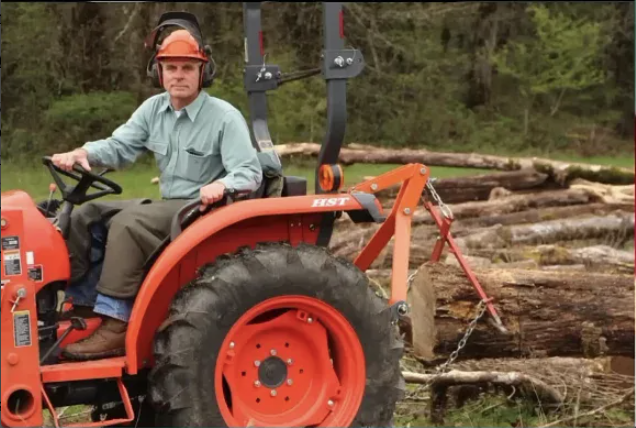
There’s a photograph of Mark on his tractor, chainsaw and equipment visible, the cleared driveway stretching behind him. He’s not smiling for the camera or posing heroically. He just looks like what he is: a farmer doing farm work, someone comfortable with physical labor and solving practical problems. His expression is calm, matter-of-fact, the look of someone who doesn’t consider what he did remarkable.
But it was remarkable, in the way quiet competence always is. He noticed someone else’s problem before fully addressing his own. He spent his physical resources—time, energy, equipment, fuel—without expectation of repayment. He worked in heat and humidity to clear a path for someone who couldn’t clear it herself, someone who might have waited hours or days for help if he hadn’t intervened.
Ruth Collins is 84 and lives alone, relying on a home aide who couldn’t reach her that morning. Without Mark’s intervention, how long would those limbs have blocked her driveway? What appointments would have been missed? What anxiety would have built as the day wore on and help couldn’t arrive? What crisis might have developed if she’d needed emergency services and they couldn’t access her home?
Those questions don’t have answers because Mark made them irrelevant. He saw a problem and eliminated it before it could cascade into something worse. That’s the thing about good neighbors—they prevent crises you never even know threatened you. They create safety and security through actions so quiet you might not notice them happening.
The storm knocked down trees across the county. Thousands of people woke to damage and debris. But Ruth Collins woke to a clear driveway, opened through the effort of a neighbor who could have justifiably focused only on his own property. She stepped onto her porch and saw evidence that she wasn’t alone, that someone was watching out for her, that community still means something tangible.
Mark Allen is 67, still farming, still strong enough to run a chainsaw and operate heavy equipment. But he won’t be 67 forever. Someday he’ll be the one who’s 84, the one who lives alone, the one who needs someone to notice when storms create problems he can’t solve himself. And maybe—probably—he’ll have neighbors who remember this morning, who learned from his example, who understand that community is built through actions like clearing someone’s driveway without being asked.
The oak limbs are stacked on the side now, already beginning the slow process of returning to soil. The gravel driveway is clear and functional. Ruth’s aide arrived that day without incident, her routine unbroken by what could have been a significant disruption. And somewhere, a 67-year-old farmer went about his day, probably never considering that his morning’s work was anything more than what neighbors do.
But it was more. It was a reminder that we’re not meant to face storms alone. That strength is meant to be used in service of those who’ve lost theirs. That the best kind of help is the kind that shows up with a chainsaw and tractor before you even have to ask. That sometimes the most profound acts of love look like an elderly woman stepping onto her porch, wrapped in a cardigan, grateful just to see the road open again.