The migraines started when she was fourteen years old.
Not the occasional headache everyone gets. Hemiplegic migraines—a rare, devastating condition that causes paralysis on one side of the body, along with excruciating pain. The kind of migraines that make you lose feeling, lose function, lose entire days to darkness and agony.
For ten years, she fought them. Saw countless doctors. Tried dozens of medications. Experimented with different diets, therapies, treatments. Nothing worked. The migraines came once a month at first, then became chronic—daily pain, serious neurological symptoms that terrified her family and left her unable to live normally.
For three years, doctors tried everything. New medications. Experimental treatments. Botox injections. Nerve blocks. Nothing could stop them. Eventually, only narcotics could slow the pain down enough for her to function, and even that barely helped.
Then, two or three years ago, doctors suggested something radical: pregnancy.
They predicted that the hormonal changes might stop the migraines completely. That carrying a child could reset whatever was causing her brain to misfire in these catastrophic ways.
She and her husband were leery. Of course they were. They’d been waiting for the migraines to stop before starting a family. They’d spent years in pain, watching her suffer, hoping for a solution that never came. And now doctors were suggesting that pregnancy—the thing they’d been putting off—might be the cure?
But they were running out of options. So they decided to try.
December 23, 2015, the pain stopped. Abruptly. Completely.
She called her friend on her lunch break, confused and almost disbelieving. “I didn’t know what was ‘wrong,'” she said. “I wasn’t in pain. I hadn’t been in pain.”
The pregnancy test later confirmed what the absence of pain had already told her: she was pregnant.
At her first appointment, the doctor delivered another surprise: twins. At seven months pregnant, there was still no headache, no paralysis, no symptoms. Probably because of stress hormones, doctors said. Maybe something else. They didn’t know for sure. But it was working.
On her birthday that year, she underwent a c-section and delivered two healthy, wonderful baby girls. Two months postpartum, and she was still pain-free.
She and her husband started calling their daughters “magical unicorn babies”—creatures of miracle and wonder who’d given her back her life. The migraines that had stolen three years, that had made every day a battle, were gone.
She could finally live again. Could hold her babies without fear of paralysis. Could play with them, care for them, be present in ways the migraines had stolen from her for years.
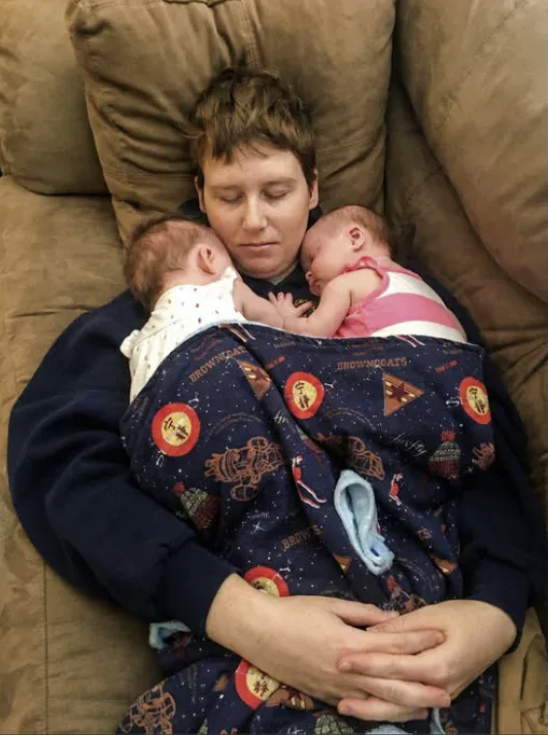
The photo shows her resting on a couch, eyes closed peacefully, holding both infant daughters against her chest. They’re tiny, swaddled, sleeping. And she’s pain-free. Finally. After years of suffering, after trying everything, after almost giving up hope—she’s holding the two miracles who saved her.
The post explained what the photo couldn’t: the decade of suffering. The three years of chronic, daily pain. The medications that didn’t work. The experimental treatments that failed. The decision to try pregnancy as a last resort. And the miracle that followed—two babies and freedom from pain that had defined her life for so long.
At the end, she wrote: At one time I only had thirteen pain free days over the course of three years. Next week I will celebrate three hundred days in a row pain free.
Three hundred days. After years where she’d barely had thirteen.
Her daughters gave her that. Not intentionally—they’re babies, they didn’t choose to be miraculous. But their existence, the hormonal changes that came with carrying them, the biological mystery doctors still don’t fully understand—somehow it all combined to give her back her life.
The magical unicorn babies. Born from suffering. Bringing with them the gift of painlessness.
Sometimes miracles don’t look like we expect. Sometimes they look like two sleeping babies on their mother’s chest. Sometimes they look like three hundred pain-free days after years of agony.
Sometimes they look like hope, finally fulfilled.