Scott left his wedding ring by the sink.
It was a momentary lapse—the kind everyone has. You wash your hands, set the ring down for just a second, get distracted, walk away. You’ll come back for it. Except when Scott came back, the ring was gone.
He searched everywhere. Checked the drain, the counters, the floor. Retraced his steps. Tore apart the bathroom. Nothing. His wedding ring—the symbol of his marriage, the band his wife had placed on his finger years ago—had simply vanished.
A week later, the vet called with news that was both hilarious and horrifying: “Your goat Clover passed a gold band.”
Scott’s wedding ring. Swallowed whole by Clover, one of the goats on his Oregon farm. She’d apparently found it, decided it looked edible, and consumed it in one gulp. The ring had traveled through Clover’s entire digestive system and emerged a week later, still intact but thoroughly… processed.
His wife laughed when he told her. “Even the goats want commitment.”
Because of course they did. Of course Clover—the goat who’d already proven herself capable of eating almost anything—had decided that a gold wedding band was worth trying. Of course Scott’s ring hadn’t just fallen behind the sink or slipped down the drain like a normal lost ring. Of course it had been consumed by livestock.
Scott cleaned the ring thoroughly. Very thoroughly. Then made a decision: he wasn’t risking this again. He bought a chain and started wearing the ring around his neck. Safe. Secure. Inaccessible to goats.
But Clover wasn’t done proving she was a menace.
She ate his tape gun next. Then his shoelaces. Then his lunch, which he’d left sitting on a fence post for thirty seconds while he fixed a gate. Scott built a metal lockbox for valuables and labeled it “Clover-Proof.” Clover chewed the label off within a day.
Eight years later, Scott still checks his pockets twice before heading to the barn. Still wears his wedding ring on a chain because he’s learned his lesson. Still tells people who ask about the necklace: “Living with goats taught me nothing’s really yours.”
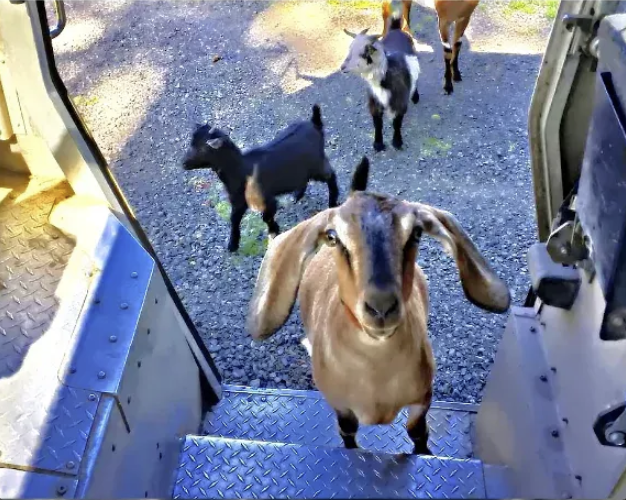
The photo shows Clover and her companions approaching Scott’s work truck, curious and fearless, ready to investigate whatever might be edible. Clover stands front and center, looking directly at the camera with the confident expression of an animal who knows she’s gotten away with everything.
The story went viral because it’s absurd and relatable in equal measure. Everyone’s lost something important. Everyone’s had a pet destroy something valuable. But not everyone can say their wedding ring spent a week inside a goat’s digestive system.
Scott’s wife still jokes about it. “At least we know the goats are committed to this marriage too.” And in a weird way, it’s become their story—the tale they tell at parties, the absurd moment that somehow made their bond stronger because they could laugh about it together.
The ring on the chain has become Scott’s signature. People recognize him by it. Ask about it. He tells the story every time, and every time people laugh. Because it’s ridiculous. Because it’s somehow perfect. Because it says everything about what it means to live on a farm with animals who have no respect for personal property or sentimental value.
Clover is still around, still eating things she shouldn’t. Still testing the limits of what’s actually edible. Still proving that “Clover-Proof” is an aspiration, not a reality.
And Scott still wears his wedding ring on a chain. Not because he wants to. But because he’s learned the hard way that in a battle between a man’s valuables and a determined goat, the goat usually wins.
Eight years. One wedding ring. One very determined goat. And a farmer who now understands that nothing—absolutely nothing—is safe when you live with livestock.
Even your marriage vows, apparently, aren’t safe from being literally consumed.