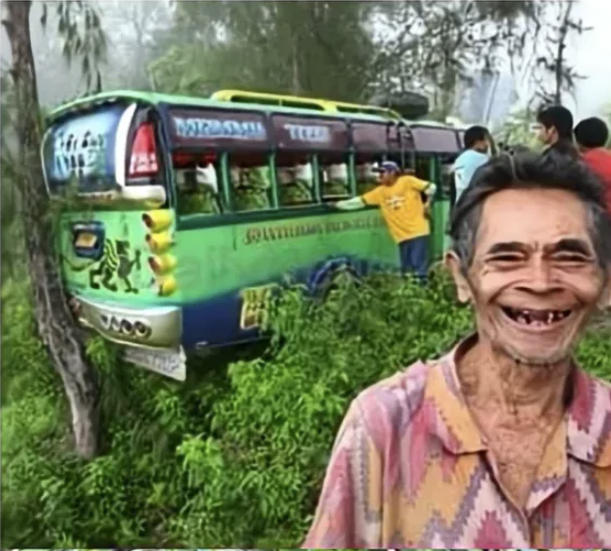
Thirty-five years ago, a man in the Philippines planted a tree. Not for any dramatic reason. Not because he foresaw the future or had a premonition. He just planted a tree. Maybe he liked trees. Maybe he wanted shade. Maybe it was an ordinary act on an ordinary day that he forgot about by the following week.
That tree grew. Slowly, the way trees do. Adding rings year by year. Sinking roots deeper into the hillside. Stretching branches wider. Becoming stronger, more established, more permanent. For thirty-five years, it stood there doing what trees do: growing, existing, occupying space.
And then, decades later, a bus full of people—mostly students—came careening toward a cliff.
Maybe the brakes failed. Maybe the road was wet. Maybe the driver made a split-second error or encountered something unexpected. The reasons matter less than the result: a bus full of thirty-seven people heading toward a drop that would almost certainly kill them all.
The tree stopped it.
Not dramatically. Not cinematically. Just physically. The bus crashed into the tree, and the tree—strong enough after thirty-five years of growth—held. Didn’t snap. Didn’t give way. Just absorbed the impact and kept the bus from going over the edge.
Thirty-seven people walked away from an accident that should have killed them. Most of them students, probably teenagers or young adults. People whose entire lives stretched ahead of them. People with families, dreams, futures that would have been erased in an instant if not for a tree someone planted three and a half decades earlier.
The man who planted it had no way of knowing. Couldn’t have predicted. Wasn’t trying to save anyone when he dug that hole and placed a sapling in the ground. He was just planting a tree. Doing something small that seemed inconsequential at the time.
But thirty-five years later, his small act became the difference between thirty-seven people living and dying.
That’s not coincidence. Or maybe it is, technically. Maybe there’s no grand design, no cosmic plan that connected a man planting a tree in the 1980s with a bus accident decades later. Maybe it’s just random chance that the bus veered off the road at exactly the spot where that particular tree had grown strong enough to stop it.
But it doesn’t feel random. It feels like something else. Like evidence that small acts can have enormous consequences. That things we do without thinking about their future impact can ripple forward in ways we’ll never see. That planting a tree, building something, creating stability—these ordinary acts of cultivation can become extraordinary acts of rescue years after we’ve forgotten about them.
The students on that bus probably had no idea how close they came to dying. They experienced the terror of the crash, the confusion of impact, and then—survival. They walked away shaken but alive. They’ll tell this story for the rest of their lives: the day a tree saved us.
And somewhere, a man looks at a photo of that bus wedged against a tree and realizes that three and a half decades ago, he gave those students their lives. Not intentionally. Not heroically. Just by planting a tree and letting time do its work.
There’s a profound lesson in this about legacy. About the things we create and build and plant without knowing their purpose. We spend a lot of time trying to make an impact, trying to leave our mark, trying to do things that matter. And often those intentional efforts feel frustratingly small or ineffective.
But this man planted a tree. Probably didn’t think about it much afterward. Probably never imagined it would save anyone. And yet, three decades later, it became the most important thing he ever did.
How many other things work this way? How many small acts of cultivation—literal or metaphorical—become foundations for futures we can’t predict? How many trees, systems, relationships, structures do we build without knowing what they’ll eventually support?
That tree spent thirty-five years growing in relative obscurity. No one celebrated it. No one paid attention to it. It was just a tree on a hillside, doing tree things. Existing. Growing. Getting stronger year by year.
And then, when it was needed, it was ready.
There’s something hopeful in that. Something that suggests our small efforts matter even when we can’t see the results. That growth happens slowly but compounds over time. That strength builds in invisibility and reveals itself in crisis.
The man in the photo is smiling. Not a proud smile or a boastful smile. Just a gentle, amazed smile. The smile of someone who planted a tree once and just discovered he saved thirty-seven lives. The smile of someone witnessing an outcome they never anticipated, evidence that something they did casually decades ago turned out to matter profoundly.
Behind him, the bus sits wedged against the tree. Evidence of impact. Evidence of survival. Evidence that sometimes the smallest decisions create the biggest consequences, and we don’t discover which decisions those were until much later.
The thirty-seven people on that bus owe their lives to a tree. And to the man who planted it. And to the three and a half decades of growth that made it strong enough to matter when it was needed.
They probably don’t know his name. Probably never met him. Probably have no way to thank him for something he did before most of them were born. But they’re alive because of him. Because he planted a tree once. Because he did something small that became something enormous.
That’s not just a good story. It’s a reminder. That we don’t always know what we’re building. That small acts of creation can have massive downstream effects. That a tree planted today might save lives decades from now.
And maybe, more broadly: that cultivation matters. That the things we plant—literally or metaphorically—grow in ways we can’t predict. That time compounds small efforts into significant structures. That what feels inconsequential today might turn out to be essential tomorrow.
Thirty-seven people are alive because of a tree. And a tree is there because someone took a few minutes, decades ago, to plant it.
Sometimes that’s all it takes.