He stood outside the cafe, hands shoved deep in his pockets, rehearsing the words in his head.
Asking was always the hardest part. Not because people said no—he’d grown used to that. But because of the way they looked at him when he asked. The quick glance away. The tightened grip on purses and wallets. The unspoken judgment that said, You did this to yourself.
But he was hungry. And desperate. So he walked inside.
The cafe was small, warm, filled with the smell of coffee and fresh bread. People sat at tables, lost in conversation or laptops, living lives that felt impossibly far from his own. He approached the counter, where a woman stood wiping down surfaces, her movements efficient and practiced.
“Excuse me,” he said quietly. “I’m wondering if… I mean, I’m trying to get some money for food. I have felonies on my record, and no one will hire me. If you could spare anything…”
He trailed off, waiting for the usual response. A polite no. A few coins. Maybe nothing at all.
The cafe owner—a woman who’d spent years serving her community, watching people come and go, learning to see past surfaces—looked at him for a long moment. Not the quick dismissive glance he was used to, but a real look. She saw the exhaustion in his eyes. The way his clothes hung loose, like he’d lost weight he couldn’t afford to lose. The dignity he was fighting to maintain even while asking for help.
And then she said something he didn’t expect.
“I’ll hire you.”
He blinked. “What?”
“I said I’ll hire you. I need someone to wash dishes, take out trash, help in the kitchen. You want money? Come work for it.”
He stood there, stunned. Waiting for the catch. The conditions. The reasons why this couldn’t possibly be real.
But she just nodded toward the kitchen. “Start tomorrow. Six a.m.”
He showed up the next morning at 5:45. And the morning after that. And every morning since. For two weeks, he’d been on time, washing dishes until his hands pruned, hauling trash bags that weighed more than they should, scrubbing surfaces until they gleamed. He worked with the intensity of someone who knew this chance might be the only one he’d get.
With his first paycheck, he bought his own food. Not charity. Not handouts. Food he’d earned. And that distinction mattered in ways he couldn’t fully articulate. It wasn’t just about the meal—it was about the dignity of earning it. The proof that someone believed he was worth the risk.
The cafe owner posted about it on social media. Not to brag, but to make a point. Her message was simple: Don’t judge. Some deserve another shot.
Because she understood something most people forget: everyone has a story. The man washing dishes in her kitchen had made mistakes—serious ones, the kind that come with legal consequences and lasting stigma. But mistakes aren’t the whole story. They’re chapters, not endings.
He’d served his time. Paid his legal debt. But society doesn’t let you move on that easily. Felonies follow you. They appear on background checks, close doors, eliminate opportunities before you even get a chance to prove yourself. They become a scarlet letter that never fades.
But this cafe owner saw something else. She saw someone asking for a chance, not a handout. Someone willing to work, if only someone would let him.
So she did.
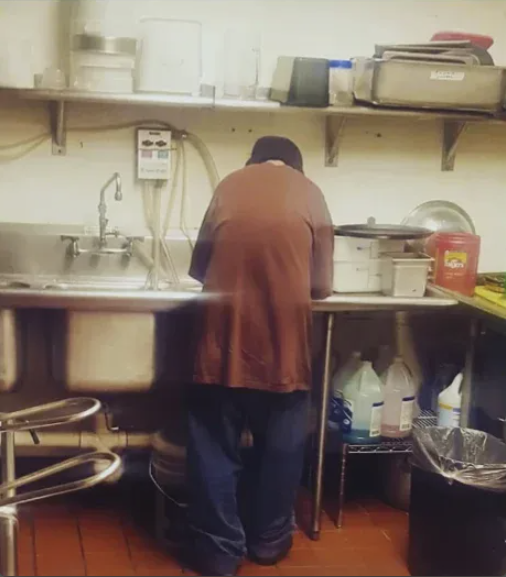
The photo showed him from behind—a man in an orange shirt, standing at an industrial sink, washing dishes in a commercial kitchen. Anonymous. Unremarkable. Just someone doing their job. And maybe that’s what made it so powerful. Because this wasn’t a dramatic transformation story. It was quieter than that. It was just a man showing up, doing the work, proving that second chances aren’t wasted on everyone.
The post went viral. Not because the story was unique—there are thousands of people with felonies who want to work but can’t find anyone willing to hire them. But because it reminded people of something important: we get to choose. We can be the person who says no, who judges, who closes the door. Or we can be the person who says yes, who risks, who opens it.
The cafe owner chose yes. And in doing so, she didn’t just change one man’s life. She reminded an entire community that redemption is possible. That people deserve chances to rebuild. That sometimes, the most powerful thing you can do is look past what someone’s been and see what they’re trying to become.
The man kept showing up. Kept washing dishes. Kept earning his paycheck. And slowly—so slowly—he started to believe that maybe, just maybe, his past didn’t have to define his future.
Because someone had looked at him and seen potential instead of just mistakes. Someone had said, I’ll hire you.
And sometimes, that’s all it takes to change everything.