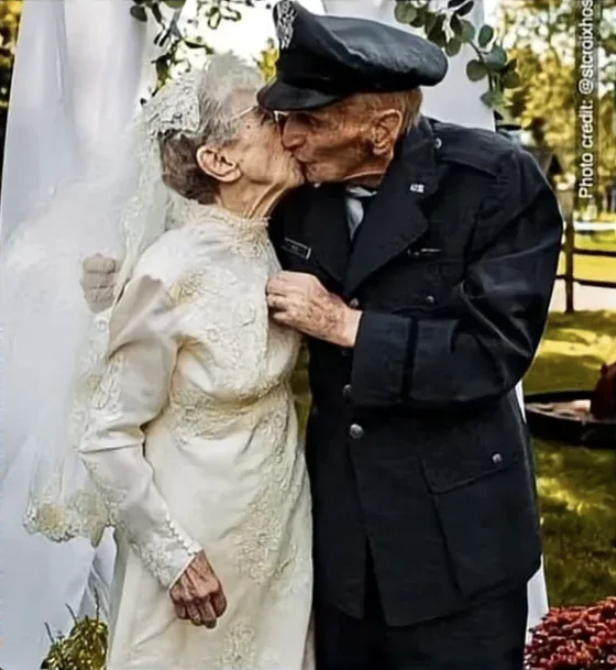
She never had a wedding dress—until she was 97.
That sentence carries seven decades of deferred dreams, of choosing practicality over ceremony, of building a life and family without the traditional markers that signal commitment to the world.
In 1944, Frankie and Royce married during his two-day military leave. No dress, no photos—just love.
World War II created countless rushed wartime marriages. Soldiers with brief leave before deployment, sweethearts choosing to marry immediately rather than wait for uncertain futures, ceremonies conducted hastily without the trappings of peacetime weddings.
Frankie and Royce were one of these couples. They had two days. Not time to plan a proper wedding, buy a dress, arrange photographer and reception. Just time to say vows, make commitment legal, create bond before he left for war.
77 years later, hospice staff heard their story and surprised them with the wedding they never had.
Seven decades of marriage without wedding photos. Without the dress. Without the ceremony that marks the beginning for most couples. They’d built entire lives together — raised children presumably, celebrated anniversaries, weathered all the challenges marriage brings — all without the wedding that most people consider essential beginning.
Hospice staff hearing their story and deciding to create that experience shows remarkable compassion. These weren’t wedding planners or event coordinators. They were end-of-life care providers who recognized that giving this couple their long-deferred ceremony mattered, even at 97 and 98.
Frankie walked the aisle in a white gown.
Finally. At 97 years old, wearing the wedding dress she’d never had as a young bride in 1944. Walking down an aisle, being seen in white, having the moment that most brides experience in their twenties or thirties.
Royce, 98, waited with tears in his eyes.
He’d been her husband for 77 years. They’d lived an entire lifetime together. Yet seeing her walk toward him in a wedding gown moved him to tears — perhaps remembering the young woman he’d married hurriedly in 1944, perhaps grateful for this gift in their final chapter, perhaps overwhelmed by love that had sustained them for nearly eight decades.
This time, every moment was captured.
What 1944 couldn’t provide — photographs documenting the ceremony, images preserving the moment for posterity — 2021 delivered. Someone photographed Frankie walking the aisle, captured Royce’s tears, documented the vows they renewed, created visual record of the wedding they’d never had.
Their daughter turned it into the wedding album they always dreamed of.
This detail reveals generational healing. Their daughter, who’d presumably grown up knowing her parents never had proper wedding, who’d seen other couples’ wedding albums while her parents had none, finally created what they deserved — a collection of images showing her parents in wedding attire, celebrating commitment that had already proven itself through 77 years.
The photograph shows them kissing after the ceremony — Frankie in her white wedding gown with lace details, Royce in what appears to be military-style uniform or formal attire, both of them elderly but full of love. The kiss captures intimacy that 77 years hasn’t diminished, affection that survived war and raising children and all the challenges that test marriages.
This story challenges assumptions about what matters in marriage. Frankie and Royce didn’t have a wedding dress or photos or ceremony in 1944. They built a successful marriage anyway, stayed together for 77 years, created family and life together without the traditional beginning most couples consider necessary.
Yet clearly the absence of that ceremony mattered. Not enough to invalidate their marriage or diminish their commitment, but enough that receiving it at 97 and 98 moved them to tears, enough that their daughter wanted to create the album they’d never had.
Hospice staff arranged this wedding, which means Frankie and/or Royce were in end-of-life care. The ceremony wasn’t just celebration but also closure — giving them this experience before death ended their time together, creating photos their family would have after they were gone.
“If this touched your heart, subscribe. May God bless everyone reading this.” That ending reveals the story’s emotional power, the way it resonates with people who understand that some dreams defer but don’t die, that 77 years of marriage doesn’t erase the wish for proper beginning.
Frankie at 97 finally wearing a wedding dress shows that it’s never too late for some experiences. That even in hospice care, even at the end of life, moments of joy and fulfillment remain possible. That what was missed in youth can sometimes be reclaimed in age.
Royce at 98 waiting with tears shows that seeing your spouse of 77 years in wedding attire can still move you, that recommitting vows after nearly eight decades still carries emotional weight, that love doesn’t diminish with familiarity.
The 1944 wedding was valid without dress or photos. It counted, it created legal marriage, it began their life together. But this 2021 ceremony completed something that had been incomplete, gave them the ritual and recognition and celebration that wartime urgency had prevented.
Their daughter creating the wedding album shows how this ceremony provided healing beyond the couple themselves. She could finally see her parents as bride and groom, could create the family heirloom that should have existed from the beginning, could honor their marriage with the documentation it deserved.
77 years. Most marriages don’t last even half that long. Frankie and Royce proved commitment doesn’t require wedding dresses or photographers. But receiving those things at 97 and 98 proved they still mattered, that ritual and celebration and being seen as bride and groom adds something meaningful even when the marriage already succeeded without them.