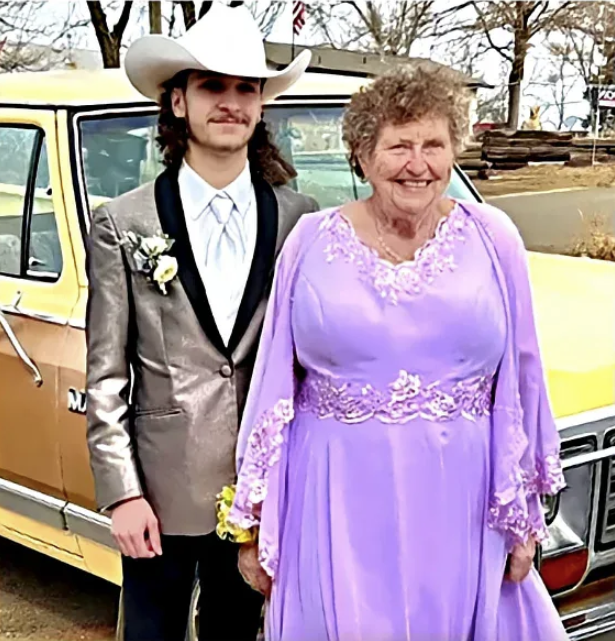
As a teen, Madeline dreamed of prom.
Not just casually hoped for it or thought it might be nice, but genuinely dreamed — the kind of dream teenage girls carry about that one special night, the dress they’ll wear, the person who’ll ask them, the memory they’ll create that lasts forever.
But Madeline was the second oldest of fourteen children. Fourteen siblings meant overwhelming responsibility, endless needs, a household that required constant labor just to function. Her teenage years weren’t about school dances and pretty dresses. They were about survival, about helping raise the younger children, about sacrificing her own adolescence so her siblings could have childhoods.
She left school early to raise her siblings. The dream of prom faded, replaced by the immediate demands of diapers and meals and keeping thirteen brothers and sisters safe and fed and loved.
That dream faded. Not died completely, but faded the way dreams do when reality becomes too demanding to allow space for wishes. She grew up, lived her life, raised her family, became a grandmother and great-grandmother. Seventy-five years passed.
Then, at 92, she opened her door. Her great-grandson Wollan stood there holding flowers and a sign that asked: “Will you go to prom with me? For my last prom and your first?!”
Wollan was finishing high school, facing his final prom. He could have asked any girl his age, could have followed the traditional path of teenage romance and matching corsages with a peer. Instead, he thought about his great-grandmother and the dream she’d sacrificed seventy-five years earlier.
She said yes through tears.
Not polite acceptance or obligatory agreement, but genuine emotional response. Tears that carried seven decades of dormant longing, grief for the teenager she’d been who gave up so much, joy that someone remembered and cared enough to offer what she’d missed.
That night, dressed in lavender with a corsage on her wrist, Madeline finally lived her teenage dream.
The photograph shows them together in their prom finery — Wollan in a tuxedo with a cowboy hat, looking sharp and proud, Madeline in her lavender gown with delicate white lace details, both of them standing before what appears to be a vintage yellow truck. She’s beaming with joy that transcends the decades, looking not like a 92-year-old woman but like the teenager she once was, finally getting her moment.
Some dreams just take a lifetime to come true.
That conclusion carries profound truth. Madeline’s dream didn’t die when she left school at fourteen. It dormant, waiting seventy-five years for circumstances to align, for someone to recognize what she’d sacrificed, for a great-grandson to understand that some gifts matter more than following convention.
Wollan gave up his “normal” prom experience. He could have taken a girlfriend or date his own age, could have had the typical teenage prom night with dancing and photos and romance. Instead, he chose to give his great-grandmother something irreplaceable: the experience she’d missed, the memory she’d never had, the closure on a dream deferred for three-quarters of a century.
That night mattered differently to each of them. For Wollan, it was his last prom — the final time he’d experience this high school tradition, a milestone marking the end of adolescence and the beginning of adulthood.
For Madeline, it was her first prom — the beginning of something she’d never had, the fulfillment of a dream that had waited patient and quiet for seventy-five years.
The corsage on her wrist symbolized more than decoration. It represented all the corsages she’d never worn, all the dances she’d missed, all the moments of carefree teenage joy she’d sacrificed to raise her siblings.
The lavender gown she wore probably required thought and effort to select. At 92, getting dressed for prom involves different logistics than at 17. But she did it, put on the dress and the corsage and became, for one night, the teenage girl who’d dreamed of this moment back when World War II was still being fought, when her whole life stretched before her with possibilities she’d never fully explore.
Her siblings — the thirteen younger brothers and sisters she’d helped raise — probably heard about this night. Perhaps some of them were there, watching their older sister finally get something she’d given up so they could have childhoods. Perhaps they understood, seven decades later, the cost of what she’d sacrificed.
Wollan understood. Young enough to still attend prom, wise enough to recognize that his great-grandmother deserved this moment, generous enough to make it happen even though it meant sacrificing his own conventional experience.
The sign he held asked for her first prom and his last. That framing acknowledged the asymmetry — she was beginning something, he was ending something, but they were doing it together, creating a memory that mattered to both of them in completely different ways.
Some dreams just take a lifetime to come true. Not because they’re impossible, but because circumstances don’t allow them, because sacrifice is required, because other people’s needs take priority, because life happens and dreams get deferred.
But deferred doesn’t mean dead. Madeline waited seventy-five years, raised her siblings and then her children and then watched her grandchildren grow and then her great-grandchildren. She lived a full life without that teenage dream ever materializing.
Until Wollan showed up with flowers and a sign, offering to be her prom date, giving her at 92 what she’d missed at 17.
That night, dressed in lavender with a corsage on her wrist, Madeline finally lived her teenage dream. Seventy-five years late, but no less meaningful. Maybe even more meaningful, because she’d waited so long, because someone loved her enough to make it happen, because dreams that survive three-quarters of a century prove they were worth having all along.