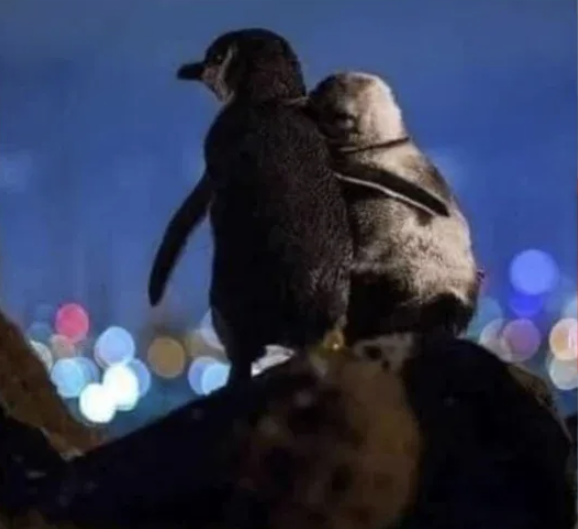
The Melbourne shoreline comes alive at dusk when the city lights begin to shimmer across the water. It’s during these twilight hours that biologists discovered something remarkable—two fairy penguins meeting every night on the same stretch of beach, standing together in silent companionship as darkness settled around them.
At first, researchers simply documented the behavior as an interesting pattern. But as they learned more about these two particular birds, the story revealed itself as something far more profound. The older female had lost her partner earlier that year. The younger male had been widowed two years prior. Both knew the weight of absence, the empty space where their mates used to be.
Night after night, they returned to the shore. Not to hunt or nest or engage in typical penguin activities, but simply to stand together. Sometimes they’d watch the city lights in silence. Other times they’d lean against each other, two small bodies finding comfort in shared presence. They weren’t rebuilding what they’d lost—they were acknowledging it, together.
Photographer Tobias Baumgaertner captured their ritual in an image that would go on to win international recognition. The photograph shows them side by side against the glowing backdrop of Melbourne’s skyline, two silhouettes unified by something humans understand all too well: the need for companionship when grief threatens to swallow us whole.
What strikes deepest about this story isn’t just that animals experience grief—we’ve known that for some time. It’s that these penguins, without language or reasoning, understood something essential about healing: that sometimes the only medicine for loneliness is another lonely soul. That shared silence can be more comforting than empty consolation. That standing beside someone who understands loss is its own form of healing.
The researchers who observed them noted the tenderness of their ritual—hours spent in quiet solidarity, asking nothing of each other except presence. It’s the kind of wisdom that transcends species, the understanding that grief doesn’t need to be fixed or explained. Sometimes it just needs to be witnessed by someone who knows what darkness feels like.
In a world obsessed with productivity and solutions, these two penguins remind us that healing often looks like simply showing up. Like standing beside someone when words fail. Like finding solace not in forgetting the ones we’ve lost, but in remembering them alongside someone who understands that love doesn’t end when life does—it transforms into something we carry forward, together.