In March, Thomas Panek ran the New York City Half Marathon guided by three dogs: his longtime companion Gus, plus Westley and Waffle. Not assisted by human guides holding his arm or running beside him with tethers, but guided entirely by trained dogs who’d learned to lead a blind runner through a complex race course with thousands of other participants.
The team rotated every three to five miles through the 13.1-mile race, each wearing custom running booties while veterinarians monitored their wellbeing. Careful planning to protect the canine athletes—rotating dogs so no single dog had to guide for the entire distance, custom booties to protect their paws from hot pavement and rough surfaces, veterinarians positioned along the course to check on the dogs and ensure they remained healthy and capable of continuing safely.
Panek, president of Guiding Eyes for the Blind, made history as the first person to complete a half marathon guided entirely by dogs rather than humans, crossing the finish line alongside his beloved Gus. The achievement wasn’t just personal but symbolic—demonstrating new possibilities for blind athletes, showcasing the capabilities of guide dogs beyond everyday mobility tasks, proving that the bond between handler and guide dog can extend to athletic pursuits that most people assumed required human assistance.
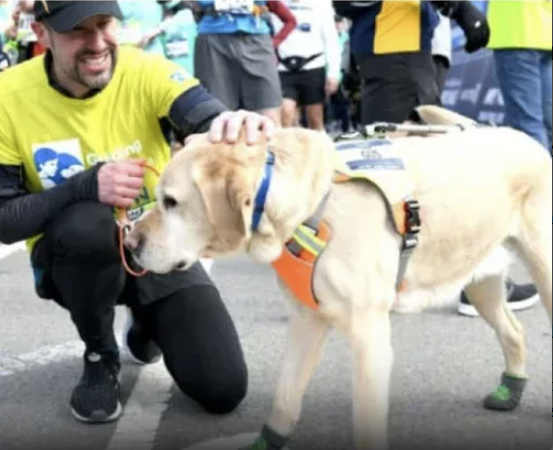
The photograph shows Panek kneeling beside Gus at what appears to be the finish line or post-race celebration. Panek is wearing a yellow running shirt and has a medal around his neck, his face beaming with joy and pride. Gus, a yellow Labrador, wears a blue service vest and colorful running booties on his paws. Both look happy and proud, the bond between them visible in their closeness and mutual accomplishment.
Running a half marathon is challenging for any athlete. 13.1 miles requires training, endurance, mental toughness. For a blind runner, the challenges multiply—you can’t see the course, can’t avoid obstacles visually, can’t navigate turns and route changes, can’t gauge your pace by watching other runners or seeing distance markers.
Traditionally, blind runners have relied on human guides—sighted runners who run beside them connected by a short tether, calling out obstacles and course changes, setting pace, providing the visual information the blind runner needs to complete the race safely. This works but creates dependency on finding willing human guides who are capable runners themselves, whose pace matches the blind runner’s pace, who are available when needed.
Thomas Panek envisioned a different possibility—what if guide dogs, who already help blind people navigate complex urban environments daily, could be trained to guide runners through races? The concept seems logical but presents challenges. Guide dogs are trained for walking pace navigation in predictable patterns. Running is faster, requires different stamina, happens in chaotic race environments with thousands of runners and spectators.
But Panek, as president of Guiding Eyes for the Blind, had resources and expertise to develop this concept. Working with trainers and veterinarians, they developed protocols for training dogs to guide at running pace, for protecting the dogs’ health during longer distances, for managing the unique challenges of race environments.
Three dogs—Gus, Westley, and Waffle—trained for this attempt. Rotating every three to five miles meant each dog ran approximately 4-5 miles, a manageable distance for fit, trained dogs, preventing exhaustion or injury that might come from guiding for the full 13.1 miles.
Each wearing custom running booties addressed the pavement concern. Dogs’ paws can handle running on various surfaces, but 4-5 miles on city pavement, potentially hot or rough, could cause injury. The custom booties protected their paws while allowing them to run naturally.
Veterinarians monitored their wellbeing throughout the race—positioned at the rotation points, checking each dog as they came off the course, ensuring they were healthy and comfortable, providing medical assessment that the dogs could continue or needed to stop. This careful monitoring ensured the dogs’ safety and wellbeing remained paramount throughout the historic attempt.
Panek made history as the first person to complete a half marathon guided entirely by dogs rather than humans. Crossing the finish line alongside Gus—his longtime companion, his primary guide dog, the dog who’d probably run the final segment with him—completing the 13.1 miles and proving that this new approach to blind running is viable, safe, and effective.
The achievement opens possibilities for other blind runners. Demonstrates that guide dogs can extend their service beyond daily mobility into athletic pursuits. Proves that the bond and training between blind handler and guide dog is deep enough and strong enough to work even in the challenging environment of a race with thousands of participants.
For Panek personally, this represented independence in a new sphere. No longer dependent on finding human guides with the right pace and availability. Able to train and run with his own dogs, animals he already trusts and works with daily, extending that partnership into his running hobby.
The photograph captures the joy of that accomplishment—Panek kneeling beside Gus, both wearing medals, both looking proud and happy. The bond between them visible, the achievement shared, the historic nature of what they’ve just accomplished evident in Panek’s expression.
Thomas Panek ran the NYC Half Marathon in March, guided by three dogs who rotated through the 13.1-mile course, each wearing custom running booties while veterinarians monitored their wellbeing. He made history as the first person to complete a half marathon guided entirely by dogs rather than humans, crossing the finish line alongside his beloved Gus. The achievement demonstrates new possibilities for blind athletes and showcases the remarkable capabilities of guide dogs who can extend their service from daily mobility into athletic pursuits, proving that the bond between handler and dog is strong enough to work even in the challenging environment of a half marathon with thousands of participants.