When Queen recorded “The Show Must Go On” in 1990, Freddie Mercury was so ill that Brian May worried he couldn’t handle the demanding high notes. This wasn’t normal recording session concern about vocal performance—this was genuine worry about whether Freddie was physically capable of delivering what the song required.
By 1990, Freddie Mercury was dying. He wouldn’t publicly acknowledge his AIDS diagnosis until the day before his death in November 1991, but his bandmates knew. They’d been watching him deteriorate, watching the disease ravage someone who’d been one of rock’s most dynamic performers. Recording became increasingly difficult as his health failed.
“The Show Must Go On” is a demanding song vocally. It requires power, range, sustained high notes that challenge even healthy singers. For someone as ill as Freddie was at that point, attempting it seemed potentially impossible.
“I don’t know if this is going to be possible to sing,” Brian May told him. Not doubting Freddie’s talent or commitment, but honestly assessing the physical demands against Freddie’s declining health. Worried that pushing for this performance might be asking too much, might fail or worse, might harm Freddie further.
Freddie replied, “I’ll fucking do it, darling,” downed his vodka, and walked into the booth. The response is so perfectly Freddie Mercury—profane and affectionate in the same sentence, determined and defiant, refusing to let illness dictate what he could still accomplish. The vodka probably helped numb pain and calm nerves. And then he walked into the recording booth to attempt something his guitarist thought might be impossible.
Propped against the mixing desk, he delivered one of the most extraordinary performances of his life. Not standing freely as he would have in healthier days, but propped up—needing physical support just to stand long enough to record. His body failing but his voice still capable of extraordinary things when he demanded it.
Brian May says, “When you hear ‘On with the show,’ you’re listening to a man who conquered everything to deliver his finest work.” This isn’t hyperbole or promotional exaggeration. Brian was there, watched it happen, understood what Freddie was conquering just to record that vocal.
Freddie was conquering pain—AIDS in its advanced stages causes significant physical suffering. He was conquering weakness—the disease had left him frail, barely able to stand without support. He was conquering fear—knowing this might be among his final recordings, knowing he was dying, choosing to create anyway.
He was conquering doubt—Brian’s expressed worry that the song might be impossible to sing could have become self-fulfilling if Freddie had accepted it as limitation. Instead, he treated it as challenge to be defeated.
And he was conquering the disease itself—not literally, AIDS was still killing him, but temporarily. For the length of that recording session, for the takes required to capture this vocal performance, Freddie Mercury refused to let illness prevent him from doing what he did best.
The result is extraordinary. “The Show Must Go On” features some of Freddie’s most powerful, emotional vocals. Listening without knowing the backstory, you’d never guess the singer was terminally ill, barely able to stand, recording while propped against furniture for support. The voice is strong, clear, capable of the demanding high notes Brian worried were impossible.
But listening while knowing what it cost to create—that’s when the performance becomes almost unbearably moving. Every note represents triumph over illness. Every sustained high pitch represents Freddie refusing to let dying stop him from singing. The emotional intensity in his voice carries extra weight when you understand he was singing about perseverance while actively persevering through terminal illness.
“The show must go on” as lyrics take on profound meaning when sung by someone who’s dying but refusing to stop performing. The show—Freddie’s career, his artistry, his identity as performer—must go on despite illness, despite pain, despite knowing death is coming soon. He’s singing about what he’s actively doing: continuing, persevering, delivering his finest work while his body fails.
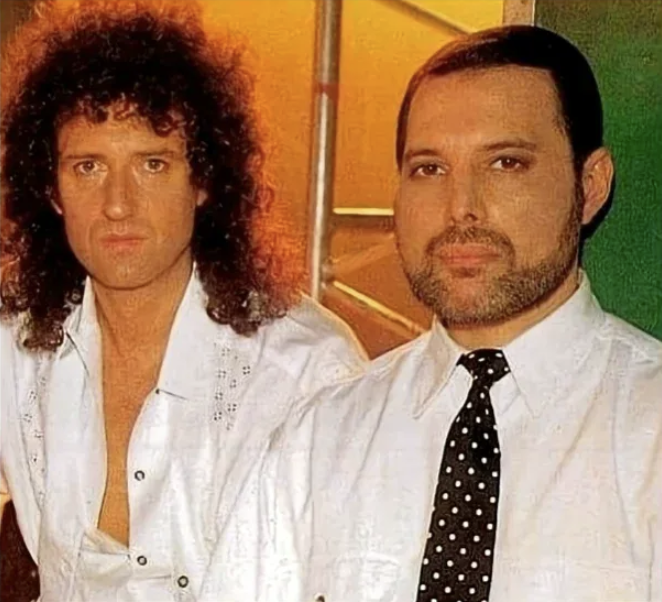
The photograph shows Freddie and Brian together, probably from around this time period based on Freddie’s appearance—thinner than in earlier years, showing the effects of illness, but still present, still creating, still Freddie Mercury despite everything.
Brian May’s tribute to this performance acknowledges what everyone close to Freddie witnessed: that his commitment to his art, his refusal to let illness limit what he could still create, his determination to deliver excellence even when physically failing—all of that culminated in this recording session where he did what seemed impossible.
Propped against the mixing desk because he couldn’t stand unsupported. Downed vodka to manage pain and steady nerves. Walked into the booth despite legitimate concerns about whether his body could handle what the song demanded. And delivered one of the most extraordinary vocal performances of his career.
“When you hear ‘On with the show,’ you’re listening to a man who conquered everything to deliver his finest work.” That line encapsulates what makes this story so powerful. We’re not just listening to a great vocal performance—we’re hearing evidence of human determination triumphing over terminal illness, of an artist refusing to let dying stop him from creating, of Freddie Mercury demanding excellence from himself even when his body was failing.
He’d been performing for audiences for decades by 1990. But this performance wasn’t for an audience—it was for himself, for his bandmates, for his artistic legacy. Proof that even dying, even barely able to stand, even when his guitarist doubted the physical possibility, Freddie Mercury could still deliver extraordinary work.
He died about a year later, in November 1991. “The Show Must Go On” was released on the Innuendo album in 1991, becoming one of Queen’s final singles with Freddie. Listening to it now, knowing what it cost to create, knowing Freddie was dying while recording it, adds layers of meaning to every note.
The show did go on—Queen has continued in various forms, Brian May and Roger Taylor keeping the music alive, celebrating Freddie’s legacy. But that particular show, Freddie Mercury’s performance, ended with his death. This recording captures him near the end, refusing to accept limitation, conquering everything including his own failing body to deliver his finest work.
“I’ll fucking do it, darling,” he said. And he did. Propped against the mixing desk, terminally ill, barely able to stand—Freddie Mercury recorded one of his most powerful vocals, proving that determination and artistry can triumph temporarily even over terminal illness. When you hear “On with the show,” you’re listening to a man who conquered everything to deliver his finest work. That’s Freddie Mercury’s final gift to us—proof that excellence doesn’t require perfect health, that art can triumph over dying, that the show must go on and can go on brilliantly even when the performer is failing.