After retiring from the police force, Wade Milyard saw a need in his Maryland community. Not the kind of need that shows up in crime statistics or emergency calls, but the quieter, more persistent need that exists when people fall through society’s safety nets and end up on the streets without access to basic services that most people take for granted.
One of those basic services is laundry. When you’re experiencing homelessness, clean clothes become nearly impossible to maintain. Laundromats require money you might not have, quarters you can’t spare, time spent in public spaces where you might not feel welcome. Dirty clothes become both a practical problem and a dignity issue—they affect job prospects, social interactions, self-esteem, health, and the way society treats you.
Wade created a solution that restores both cleanliness and dignity. Not through a traditional charity model where people experiencing homelessness have to come to a facility and wait in line and feel like they’re receiving handouts. But through a mobile service that brings the solution directly to people where they are.
He converted a bus into “Fresh Step Laundry.” Took a regular bus—the kind that once transported passengers from place to place—and transformed it into a mobile washing service. Installed commercial washers and dryers, created a functional laundry facility on wheels that could drive through neighborhoods offering services directly to people who need them most.
The bus drives through neighborhoods offering free laundry to people experiencing homelessness. It’s not stationary, requiring people to travel to access services. It comes to them, meeting people where they are, making access as easy as possible by removing transportation barriers and bringing the solution directly to the streets where people are living.
It’s more than just clean clothes—it’s about comfort and respect. This understanding is what separates Wade’s approach from simply providing a service. He gets that offering free laundry isn’t just about removing dirt from fabric. It’s about restoring dignity to people who society often treats as invisible or disposable. It’s about providing comfort—the physical comfort of clean clothes and the emotional comfort of being treated with respect and care.
So far, Wade has washed over two thousand pounds of clothing, one load at a time. That’s not an abstraction—it’s thousands of individual interactions, hundreds of people served, countless moments where someone experiencing homelessness got to wear clean clothes and feel more human, more comfortable, more able to face the day.
One load at a time emphasizes the personal nature of this service. Wade isn’t running an industrial operation processing bulk donations. He’s washing individual people’s actual clothes—the garments they’re wearing, the belongings they carry, the items that matter to them personally. Each load represents a person being served with individual attention and care.
Proving that practical compassion can transform lives. This is Wade’s demonstration that compassion doesn’t have to be abstract or sentimental. Practical compassion—identifying specific needs and creating functional solutions—can have real, measurable impact on people’s lives. Clean clothes might seem like a small thing until you don’t have access to them, and then they become everything.
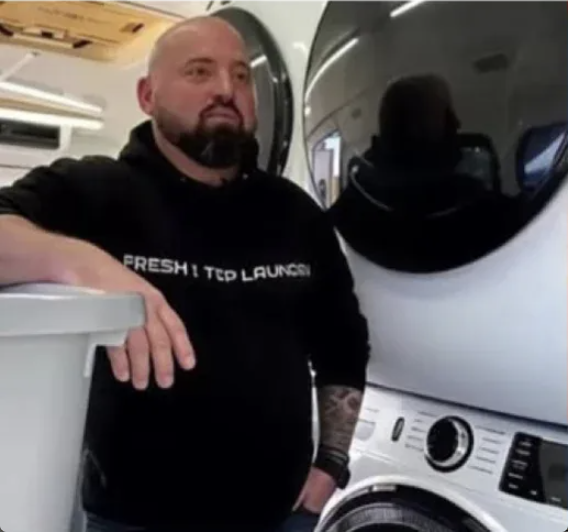
The photograph shows Wade inside his converted bus, standing beside commercial washers and dryers that line the interior. He’s wearing a black “Fresh Step Laundry” shirt, looking directly at the camera with an expression that’s both serious and committed. Behind him, the washers gleam, evidence of a fully functional mobile laundry service that’s actually operating, not just a concept but a reality.
The space is tight—buses aren’t large, and fitting commercial laundry equipment into a mobile space required creative problem-solving. But Wade made it work, creating a functional service that brings dignity and cleanliness directly to people who need it most.
His background in police work probably informs his approach. Officers see homelessness constantly, interact with people experiencing it regularly, understand better than most civilians the complexity of issues that lead to and perpetuate homelessness. Some officers respond with frustration or resignation. Wade responded by creating a practical solution to one specific aspect of the problem.
He couldn’t solve homelessness itself—that requires systemic changes beyond any individual’s capacity. But he could address one concrete need that makes people’s daily lives harder and their path out of homelessness more difficult. Clean clothes help with job interviews, with being treated respectfully in public spaces, with self-esteem and mental health, with simply feeling human.
The mobile aspect is crucial. Stationary laundromats, even free ones, require transportation. Many people experiencing homelessness lack vehicles, can’t afford bus fare, or live in areas poorly served by public transportation. Requiring them to travel to access services creates barriers that prevent help from reaching people who need it most.
By driving through neighborhoods where people experiencing homelessness actually are, Wade eliminates those barriers. The service comes to them. They don’t have to figure out transportation or navigation or whether they’ll be welcome in that neighborhood. Fresh Step Laundry arrives, offers services, treats people with respect, and helps without requiring extraordinary effort from people whose energy is already consumed by survival.
Two thousand pounds of clothing washed represents hundreds of people served. Each person probably received multiple loads over time—Wade’s approach seems designed for ongoing relationship rather than one-time transactions. People can come back, can build trust, can rely on this service being consistently available.
That consistency matters enormously. When you’re experiencing homelessness, so much of life is unpredictable and unreliable. Services close, funding disappears, rules change, help that existed yesterday might not exist today. A mobile laundry service that shows up regularly, that people can count on, that treats them with consistent respect—that reliability itself is a form of dignity restoration.
Wade could have retired from police work and done nothing further for his community. He’d already served for years, already contributed through his career. Nobody would have blamed him for spending retirement focused on his own interests and comfort. Instead, he saw a need and created a solution—converted a bus, installed equipment, developed operations, and started driving through neighborhoods offering free laundry to people society often ignores.
The service is called “Fresh Step Laundry”—a name that suggests both the practical outcome (fresh, clean clothes) and the metaphorical possibility (a fresh step forward, movement toward better circumstances). Wade understands that helping people experiencing homelessness isn’t just about addressing immediate physical needs. It’s about creating conditions where they can take steps forward, where they can maintain the dignity and cleanliness that society requires for employment and social acceptance.
Practical compassion can transform lives. Not through grand gestures or dramatic interventions, but through identifying specific, solvable problems and creating functional solutions. Clean clothes won’t end homelessness, but they make the experience more bearable and the path forward slightly easier. That matters. That helps. That transforms daily life for people who receive the service.
Wade Milyard saw a need in his Maryland community and created Fresh Step Laundry—a converted bus driving through neighborhoods offering free laundry to people experiencing homelessness. Over two thousand pounds of clothing washed, one load at a time, proving that practical compassion can restore both cleanliness and dignity.
It’s more than just clean clothes. It’s about comfort and respect, about treating people experiencing homelessness as humans worthy of care and attention, about bringing services directly to people rather than requiring them to navigate barriers to access help. It’s about a retired police officer who could have done nothing but instead chose to do something—something practical, something sustainable, something that makes real difference in real people’s daily lives.