The man was speeding with his dog in the car when he saw the flashing lights in his rearview mirror. That moment of panic every driver knows—the sudden awareness that you’ve been caught, that consequences are coming, that there’s no way to undo whatever violation brought police attention.
But instead of accepting the inevitable ticket, his brain apparently decided on a different strategy. As soon as he saw the flashing lights, he quickly switched places with his dog, moving to the passenger side while positioning his dog in the driver’s seat.
The plan, presumably, was to claim that the dog had been driving. That he wasn’t the one speeding because he wasn’t in the driver’s seat—his dog was. It’s the kind of absurd excuse that might work in a cartoon but has absolutely no chance of success in reality with actual police officers who’ve seen every excuse imaginable.
When the officer approached the car, the man insisted that it wasn’t him driving, but his dog. Delivered with whatever level of conviction he could muster, trying to sell a story that defied basic logic, biology, and the officer’s own observations. Hoping, perhaps, that sheer audacity would create enough confusion to avoid a ticket.
However, the officers reported that when they got closer, it was clear the dog had been placed in the driver’s seat only after the stop. Not a difficult determination to make—dogs don’t operate vehicles, can’t reach pedals, can’t see over dashboards properly, and certainly don’t position themselves naturally in driver’s seats with paws on steering wheels.
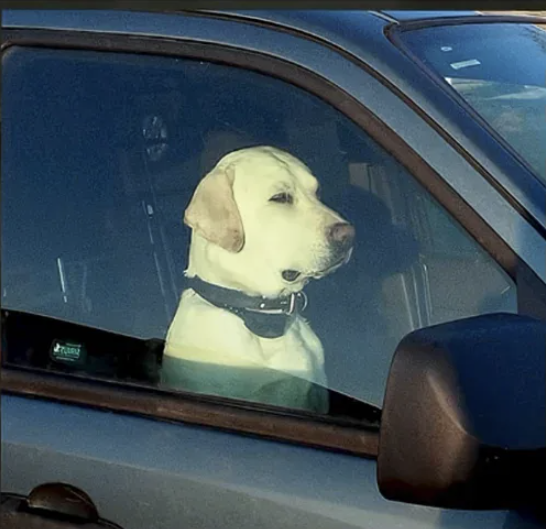
The photograph shows exactly what the officer saw: a yellow Labrador sitting in the driver’s seat, looking out the window with the dignified expression of a dog who had nothing to do with this terrible plan. The dog appears calm, unbothered, completely unaware that his owner just tried to frame him for a traffic violation.
This story is humorous because the plan was so obviously doomed from the start. What was the best-case scenario here? That police would approach, see a dog in the driver’s seat, and think “well, must’ve been the dog speeding then” and leave? That they wouldn’t notice the human who clearly had been driving moments before? That dogs regularly operate motor vehicles and this was a reasonable situation?
The desperation to avoid a speeding ticket led to a decision that probably made everything worse. Instead of getting a standard traffic citation and moving on with his day, this driver now has a much more interesting police report involving attempted deception, false statements to officers, and possibly additional charges beyond simple speeding.
The dog, meanwhile, is entirely innocent. He didn’t ask to be put in the driver’s seat. Didn’t volunteer to take the blame for his owner’s lead foot. Was simply along for a car ride that suddenly got very weird when his owner decided to involve him in a ridiculous scheme to avoid accountability.
There’s something darkly funny about the image of a man frantically switching seats with his dog as police lights flash behind him, believing this plan has any chance of working. The physical comedy of executing the switch—getting an unwilling dog to cooperate with moving to the driver’s seat while the human scrambles to the passenger side, all while pulled over on the roadside with police approaching.
And the commitment to the lie when the officer arrived. “It wasn’t me driving, officer, it was my dog.” Said out loud, to a police officer’s face, as if this was a reasonable statement that might be believed. As if dogs driving cars was common enough that this explanation made sense.
The officer’s response wasn’t recorded, but one imagines it involved a very long pause while processing what they’d just been told, followed by whatever protocol exists for dealing with motorists who try to blame traffic violations on their pets.
The dog in the photograph looks remarkably composed for someone who’s just been framed for a crime. Sitting properly in the driver’s seat, gazing out the window, possibly wondering when the car ride will resume and whether there will be treats later. Completely uninvolved in the human drama happening around him, innocent of all charges except being a good dog who got dragged into his owner’s poor decision-making.
This story joins the long tradition of absurd excuses people give police when caught violating traffic laws. The creativity humans display when trying to avoid accountability is remarkable—from claiming invisible passengers to insisting speed limits don’t apply to them to, apparently, attempting to frame their dogs for speeding.
But police officers have heard everything. They’ve seen every variation of excuse, denial, and attempted deception. They approach hundreds of traffic stops and develop highly calibrated abilities to distinguish truth from fiction, legitimate emergencies from manufactured excuses, and genuine confusion from deliberate lies.
A dog placed in the driver’s seat after the stop is immediately obvious to trained observers. The logistics alone—the time required to execute the switch, the dog’s positioning and body language, the human’s location and demeanor, the physical evidence of who was actually operating the vehicle—all of it tells the true story despite whatever fiction the driver tries to construct.
The man presumably received his speeding ticket. Possibly additional citations for providing false information or whatever charge applies when you try to blame traffic violations on your pet. And definitely a police report that became a memorable story told at the station—remember that guy who tried to claim his dog was driving?
The dog went home unchanged by the experience. Still a good dog. Still innocent. Still unaware that his owner briefly tried to make him a criminal to avoid a ticket. Still ready for the next car ride, hopefully with a human who’s learned that accepting consequences for speeding is much simpler than elaborate schemes involving switching seats with dogs.
The photograph captures the absurdity perfectly—a Labrador sitting in the driver’s seat looking serene and dignified while his owner’s terrible plan falls apart around him. A reminder that when you’re caught speeding, the best strategy is accepting the ticket with grace rather than attempting to convince police that your dog was driving.