South Korea’s cosmetic surgery industry is booming. Drawing waves of Chinese tourists seeking world-class transformations. The country has become globally renowned for advanced surgical techniques that can dramatically alter facial features—jaw reshaping, rhinoplasty, eyelid surgery, facial contouring, comprehensive procedures that fundamentally change how someone looks.
The results are often stunning. Exactly what patients want. Transformative in ways that boost confidence, align appearance with identity, provide the aesthetic changes people have been seeking.
But some patients return home so changed that passport photos no longer match their new faces. Not slightly different—so dramatically altered that border officials can’t confirm the person standing in front of them is the same person in the passport photo.
That’s not a minor inconvenience. That’s a border control crisis. Because passport photos exist specifically to identify travelers, to confirm that the person holding the document is the person the document describes. When cosmetic surgery makes that verification impossible, it creates serious problems.
Confused border officials have no way to confirm identity. Is this person who they claim to be? Is this the valid passport holder? Or is this someone using a stolen or fraudulent document? The officials can’t tell, because the face doesn’t match.
Patients get detained. Questioned extensively. Face delays and complications returning home. Experience the stress of being treated like their identity is fraudulent when they’re just returning from cosmetic surgery.
To solve this, clinics now issue medical certificates with before-and-after photos. Official documentation that says: yes, this person had extensive cosmetic surgery, here’s what they looked like before, here’s what they look like now, this is the same person even though their face has been completely transformed.
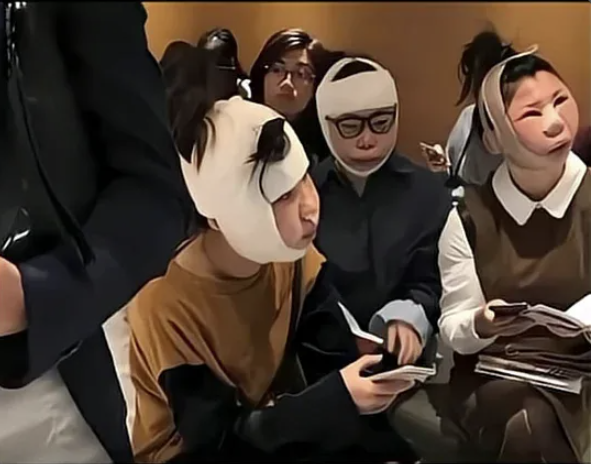
The photo shows several women with their heads wrapped in post-surgical bandages, sitting in what appears to be a waiting area. They’re holding phones or documents, faces obscured by the white bandages that indicate recent extensive facial surgery.
This isn’t a critique of cosmetic surgery. People have every right to modify their appearance, to seek procedures that make them feel more confident or aligned with how they want to look. That’s personal choice, bodily autonomy, individual decision-making about their own faces and bodies.
But this is documentation of a fascinating modern problem: cosmetic surgery technology has advanced to the point where it can change faces so dramatically that identity verification systems break down. Where before-and-after transformations are so complete that the same person looks like different people.
That’s simultaneously impressive (from a surgical technique perspective) and concerning (from an identity verification perspective).
The medical certificates with before-and-after photos are a practical solution. They provide evidence that the person with the dramatically different face is actually the same person who holds the passport. They give border officials the information needed to verify identity despite radical facial changes.
But they also reveal something about modern beauty standards and the extent to which people are willing to modify their appearance. These aren’t minor tweaks. These aren’t subtle enhancements. These are transformations significant enough to make passport photos useless for identification.
The caption notes that modern surgery can “reshape identity and even challenge border control systems.” That’s not exaggeration. Identity verification depends on recognizable facial features. When those features change completely, identity becomes difficult to verify through traditional methods.
This creates interesting questions about how we define identity. Is your face essential to who you are? If you change your face dramatically, are you still the same person legally, officially, in ways that matter for travel documents and border control?
The answer, legally, is yes—you’re the same person regardless of how your face looks. But proving that becomes complicated when the primary verification method (comparing your face to a passport photo) no longer works.
The women in the photo, faces wrapped in bandages, are navigating this exact complication. They’ve undergone procedures that will dramatically change how they look. When those bandages come off, they’ll have new faces—faces that might not be recognizable compared to their passport photos.
They’ll need those medical certificates to get home. To prove that despite looking completely different, they’re the same people who left their home countries seeking cosmetic surgery in South Korea.
This phenomenon says something about global beauty industry, about the extent to which facial features can now be modified, about how far people will go to achieve aesthetic goals. It says something about South Korea’s position as a cosmetic surgery destination, about the skill of surgeons who can create transformations so complete that border officials can’t recognize patients.
It also says something about the limitations of current identification systems. Passport photos assume your face remains relatively consistent. They account for aging, for weight changes, for hair color modifications. But they don’t account for comprehensive facial restructuring that makes you look like a different person.
As cosmetic surgery technology continues advancing, this problem will likely increase. More people will seek dramatic transformations. More will return home with faces that don’t match their passport photos. More will need documentation proving they’re the same person despite looking completely different.
The medical certificates are a practical solution. But they’re also evidence of how extensively modern surgery can reshape not just faces, but identity verification systems, border control processes, and the assumptions underlying how we prove who we are.
The women with bandaged faces will heal. Will see their new faces for the first time. Will experience whatever emotional response comes with radical transformation—excitement, satisfaction, adjustment to looking different than they’ve looked their entire lives.
And then they’ll travel home. With medical certificates proving that despite their dramatically different faces, they’re the same people who left. That cosmetic surgery changed how they look but didn’t change who they are, legally and officially.
Border officials will check the before-and-after photos. Will verify that yes, despite the dramatic transformation, this is the same person. Will allow them through.
And the system will adapt, again, to accommodate what modern medicine makes possible: transformations so complete that you can become unrecognizable even to yourself.