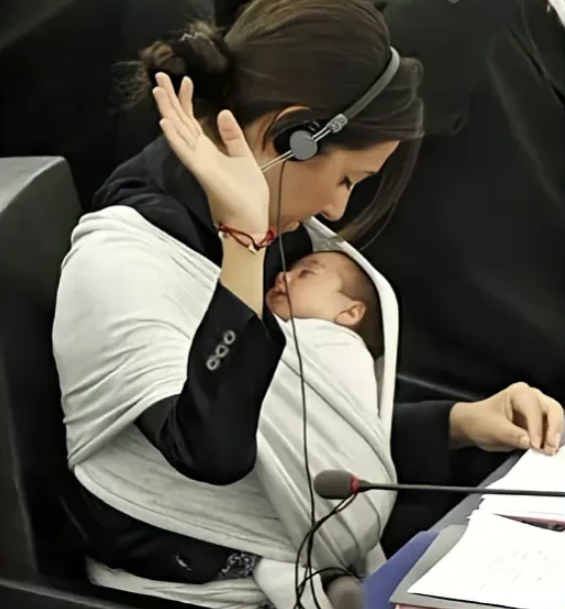
In 2010, Italian politician Licia Ronzulli walked into the European Parliament carrying her forty-four-day-old daughter Vittoria. Not leaving her with childcare. Not apologizing for bringing an infant to a legislative session. Just bringing her daughter to work because that’s what the situation required.
What began as a necessity—a mother who needed to breastfeed and had professional obligations that couldn’t be postponed—became a symbol of women’s rights and work-life balance. Not because Ronzulli intended to make a statement, but because her simple act of bringing her infant to parliament challenged assumptions about where mothers belong and what professional spaces should accommodate.
Over the years, photos captured Vittoria growing up in the chamber. As an infant, sleeping against her mother’s chest during sessions. As a toddler, sitting beside Ronzulli during votes. As a young child, listening and learning while her mother participated in European governance.
These weren’t staged photo opportunities. They were documentation of reality: a mother who had professional responsibilities and parental responsibilities and refused to pretend those two parts of her life existed in separate, incompatible spheres.
The photo shows Ronzulli at her desk in the parliament chamber, wearing headphones for translation, baby Vittoria wrapped against her chest in a carrier, both of them positioned to work. Ronzulli is writing or reviewing documents. Vittoria is sleeping. Both are present in a space that traditionally assumed mothers would leave their children elsewhere.
Ronzulli’s act sparked global conversations about maternity leave and equality. Not through speeches or formal advocacy, but through the simple visibility of a mother doing her job while caring for her infant. Through the evidence that these two roles—legislator and mother—can exist simultaneously if institutions are willing to accommodate them.
Because the problem was never that mothers couldn’t handle both roles. The problem was that professional spaces were designed assuming workers had no caregiving responsibilities, or that those responsibilities would be handled invisibly by someone else.
Ronzulli made caregiving visible. Made it present in one of Europe’s most formal political spaces. Made it impossible to ignore that legislators are whole people with lives that include children, that parenting doesn’t pause during working hours, that accommodation isn’t just possible—it’s necessary if women are going to participate fully in professional and political life.
The fact that Vittoria grew up in the chamber—that there are photos of her at various ages, always present while her mother worked—demonstrates that this wasn’t a one-time publicity stunt. This was Ronzulli’s reality for years. She brought her daughter to parliament regularly, integrated her parenting into her professional life, and in doing so normalized something that should have been normal all along: mothers working while caring for children.
Critics probably objected. Probably said that parliament was no place for an infant. Probably argued that Ronzulli should have arranged childcare like everyone else. Probably suggested that bringing a baby to legislative sessions was unprofessional or distracting or inappropriate.
But Ronzulli’s response was simply to continue doing it. To keep bringing Vittoria. To keep demonstrating that she could fulfill her obligations as a legislator while breastfeeding and caring for an infant. To prove through sustained action that the critics were wrong—that accommodation was not only possible but made her participation in governance possible.
Over time, the photos of Vittoria growing up in the chamber told a different story than critics suggested. They showed a child learning about democracy and governance from the earliest age. They showed a mother successfully balancing responsibilities that society said were incompatible. They showed that the European Parliament could function perfectly well with an infant present.
Ronzulli’s act proved that motherhood and leadership can thrive side by side. That’s the caption’s conclusion, and it’s exactly right. Not “can coexist with difficulty” or “can be juggled with sacrifice.” But can thrive. Can both be excellent. Can both be fulfilled without requiring women to choose between professional advancement and caring for their children.
The global conversations sparked by Ronzulli’s visible mothering in parliament led to policy discussions about maternity leave, about workplace accommodations for nursing mothers, about whether professional spaces need to become more flexible to retain talented women who are also parents.
Some of those conversations resulted in actual change—expanded leave policies, designated nursing spaces, more flexibility for working parents. Some of them are ongoing. But all of them started because Licia Ronzulli walked into the European Parliament with her forty-four-day-old daughter and refused to pretend that her professional self and her maternal self were separate people.
Vittoria is older now. Probably doesn’t attend parliament sessions anymore. Probably has her own school and activities and life separate from her mother’s political career. But for years, she was present—learning, listening, growing up in one of Europe’s most important legislative bodies.
That’s not a burden Ronzulli placed on her daughter. That’s an education. An understanding from the earliest age that women can lead, that mothers can govern, that having children doesn’t disqualify you from professional excellence.
Vittoria grew up watching her mother participate in European governance. Grew up understanding that her presence wasn’t a problem to be solved but a reality to be accommodated. Grew up with a model of motherhood that included professional achievement, not instead of it.
That’s powerful. Not just for Vittoria, but for everyone who saw those photos. For other mothers who felt forced to choose between career advancement and caring for infants. For fathers who needed to see that parenting can be shared and visible. For institutions that needed evidence that accommodation doesn’t destroy professionalism—it expands who gets to be professional.
Licia Ronzulli brought her forty-four-day-old daughter to the European Parliament in 2010. What began as necessity became symbol. What could have been controversy became catalyst for change.
And Vittoria grew up in the chamber—voting, listening, learning beside her mother. Proof that motherhood and leadership don’t just coexist. They thrive side by side.