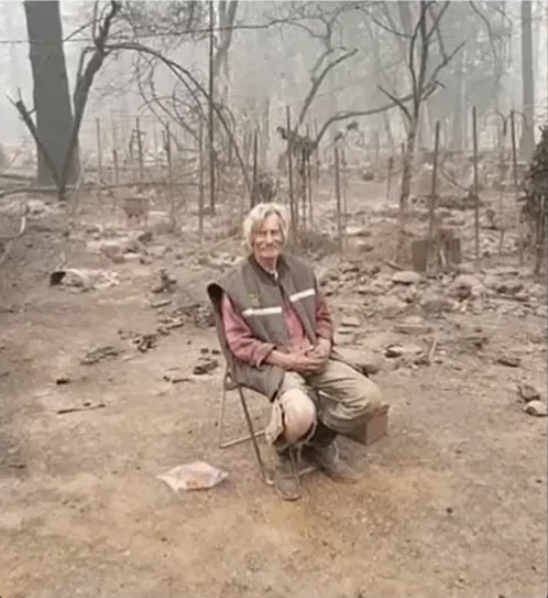
Don Clark sat in a chair that no longer belonged to a home, surrounded by ash and skeletal trees that used to be his Paradise, California neighborhood. Behind him, where his house once stood, there was nothing but gray devastation. The wildfire had consumed everything—walls, memories, the physical evidence of a life built over years. But Don wasn’t focused on what he’d lost.
When the wildfire blocked his escape route, most people would have run anyway, taking whatever path led away from danger. Survival instinct is powerful, and in the face of an inferno, saving yourself isn’t cowardice—it’s nature. But Don made a different calculation. He turned back into the fire.
He managed to rescue one dog and one cat from his property, though another cat remains missing somewhere in the destruction. While his own house burned, he fought to save a neighbor’s home—not because it would benefit him, not because anyone would have blamed him for focusing on his own survival, but because that’s who Don is. When everything is on fire, he’s the kind of person who thinks about what else might be saved.
When deputies finally found him sitting in that chair amid the ruins, they expected to find someone broken by loss, overwhelmed by the magnitude of what the fire had taken. Instead, they found a man who wasn’t dwelling on his destroyed house. He was thinking about the animals still at risk, about the homes he couldn’t reach, about the neighbors who might still need help.
The deputies brought him food and found him, remarkably, still spirited. Not in denial about the devastation, but genuinely more concerned with what could still be done than with what was already gone. There’s a particular kind of strength in that—not the loud, dramatic heroism of movies, but the quiet resilience of someone who’s lost nearly everything and still finds purpose in trying to help others.
Paradise, California, became a landscape of ash and memory that day. Thousands of people lost homes, belongings, entire lifetimes of accumulated possessions. The fire didn’t discriminate—it took everything in its path. But what the fire couldn’t take was the character of people like Don Clark, who face catastrophe and somehow still find room to think beyond themselves.
Sitting in that chair, with nothing but destruction stretching in every direction, Don embodied something essential about human resilience. Not the absence of loss, but the refusal to let loss define you. Not the denial of pain, but the choice to focus on purpose even when everything hurts. Not the illusion that things are okay, but the determination to do what’s right even when nothing is okay.
The deputies who found him saw more than a survivor. They saw someone who’d been tested by the worst kind of disaster and emerged with his values intact—still thinking about saving others, still spirited despite losing everything, still sitting upright in a chair amid the ruins because giving up simply wasn’t in his nature.
We don’t always get to choose what happens to us. Don didn’t choose for his home to burn, for his escape to be blocked, for Paradise to become a graveyard of ash. But he chose to turn back for his animals. He chose to fight for a neighbor’s house. He chose to remain focused on what still mattered rather than drowning in what was lost.
That chair in the ruins became a symbol—not of defeat, but of endurance. Of a man who lost his home but kept his humanity. Who faced fire and chose compassion. Who sat amid destruction and still thought first about others.
Paradise may have burned, but people like Don Clark prove that some things are fireproof: dignity, purpose, the stubborn human insistence on caring about others even when your own world has fallen apart. The house is gone. The neighborhood is destroyed. But the spirit that made Don turn back into danger to save animals and fight for a neighbor’s home—that’s still there, undiminished, sitting upright in a chair where a house used to be.