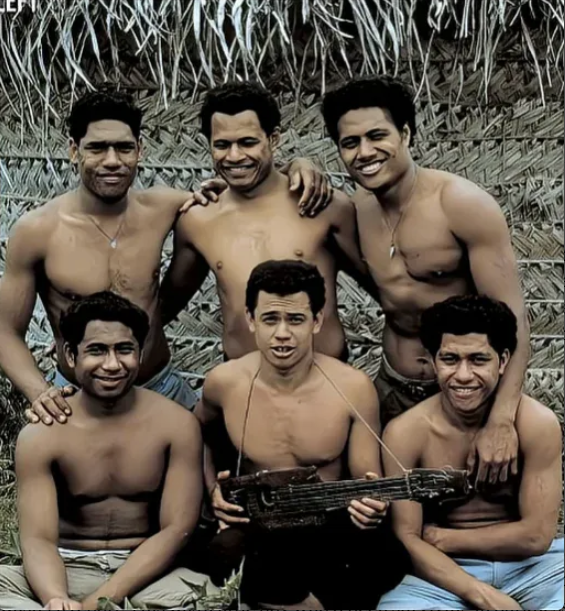
In 1965, six Tongan teenagers made a decision that would change their lives forever. They were tired—tired of school, tired of rules, tired of the predictable path laid out before them. So they did what desperate, dreaming young people sometimes do: they stole a fishing boat and set sail toward Fiji or New Zealand, chasing the vague promise of a better life somewhere beyond the horizon.
They had courage but no real plan. They had hope but limited supplies. And when a Pacific storm tore their vessel apart and left them shipwrecked on uninhabited Ata Island, they had nothing but each other.
Fifteen months. That’s how long they survived on that remote island with no contact with the outside world, no certainty they’d ever be found, no guarantee they’d see their families again. Most groups would have fractured under that pressure. Desperation breeds conflict. Hunger breeds resentment. Fear breeds chaos.
But these six boys chose differently.
They worked together to build a hut that could shelter them from storms. They kept a fire burning continuously for fifteen months, never letting it die, because that flame represented more than warmth—it represented hope, discipline, shared responsibility. They foraged for fish, coconuts, bananas, and papaya, learning which plants could sustain them and which would make them sick. They established routines, assigned tasks, supported each other through injury and illness and the crushing weight of uncertainty.
When arguments arose—and they must have—the boys created a system. If two of them fought, they’d separate to opposite ends of the island until they’d cooled down enough to reconcile. No grudges. No festering resentment. Just space, then reconnection. It was a level of emotional maturity that many adults never achieve.
They didn’t just survive. They built a micro-civilization based on cooperation, mutual respect, and the understanding that their survival depended on unity. Each boy brought different strengths. Each boy needed the others. And rather than let ego or fear destroy them, they chose brotherhood.
When Australian adventurer Peter Warner finally spotted their signal fire and sailed to the island, he expected to find either bodies or broken, desperate survivors. Instead, he found six strong young men who’d maintained their health, their sanity, and their friendship through sheer determination and ingenuity.
Warner was so deeply impressed by their story—by their unity, their resourcefulness, their refusal to give up or turn on each other—that he didn’t just rescue them. He sailed them 1,000 kilometers back home himself, wanting to spend more time with boys who’d accomplished something remarkable not through violence or domination, but through collaboration and care.
The world loves survival stories. But this one matters because it’s not about one hero. It’s about six boys who understood that surviving alone is impossible, but surviving together is achievable. It’s about choosing cooperation over competition when everything is at stake. It’s about young people—often dismissed as reckless or immature—demonstrating wisdom that many adults lack.
They stole a boat looking for a better life. What they found instead was each other. And in those fifteen months on Ata Island, they proved that humanity’s greatest strength isn’t our individual brilliance. It’s our ability to build something stronger together, to hold each other up when the world falls apart, to keep the fire burning even when hope seems distant.
Those six teenagers returned home as men. Not because they’d survived, but because they’d learned what matters most: that we are stronger together, that unity is a choice we make daily, and that sometimes the greatest adventures teach us not how to conquer the world, but how to rely on each other within it.
Their story isn’t about escaping to a better life. It’s about creating one, right where you are, with the people beside you.