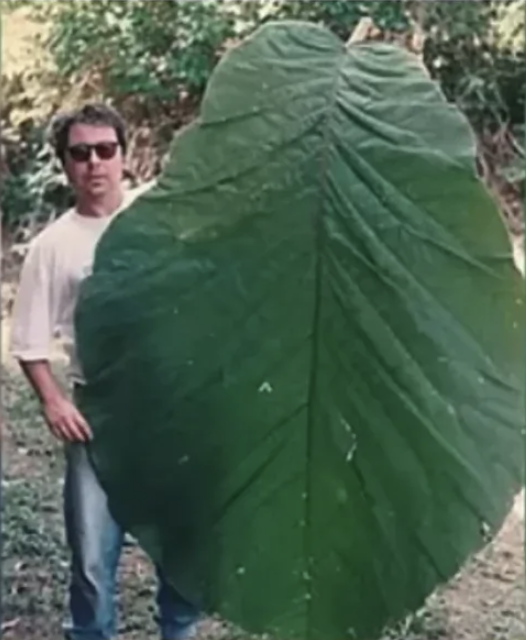
Deep in the Amazon rainforest, scientists had seen the tree before. Massive, with leaves the size of a person—so enormous they seemed almost mythical, like something from a fairy tale rather than botanical reality. The researchers documented it, took notes, marked its location. But they didn’t have what they needed to study it properly. They couldn’t identify the species without seeing it bloom.
So in 2005, they planted seeds and waited.
Thirteen years. That’s how long it took for just one tree to bloom and finally give them the proof they needed. Thirteen years of waiting, watching, tending, hoping that eventually nature would reveal its secrets on its own timeline, not theirs.
When it finally bloomed, the scientists confirmed what they’d suspected: this was officially a new species. A tree with person-sized leaves that had been growing in the Amazon for who knows how long, undiscovered by science until someone had the patience to wait more than a decade for a single flower.
Think about that. Thirteen years. Most research grants last three to five years. PhD programs take five to seven. Careers are built and shifted in thirteen years. But these scientists planted seeds and waited, understanding that some knowledge can’t be rushed, some mysteries reveal themselves only to those willing to be patient.
The discovery makes you wonder: what else is the Amazon hiding, still waiting to be found?
The rainforest is vast beyond comprehension—millions of acres of dense canopy where sunlight barely reaches the forest floor, where new species might live their entire existence without ever being seen by human eyes. Scientists estimate we’ve identified maybe 10% of the species living there. Maybe less. The rest remain hidden, waiting for the right combination of curiosity, patience, and luck to bring them into human awareness.
There could be trees even larger than this one. Plants with medicinal properties that could revolutionize healthcare. Insects that have evolved specialized adaptations science hasn’t imagined yet. Animals that have learned to thrive in micro-ecosystems we don’t even know exist. Fungi creating vast underground networks that communicate in ways we’re only beginning to understand.
All of it hidden. All of it waiting. Some of it might be found in our lifetimes. Some of it might remain undiscovered for centuries. Some of it might disappear before we ever know it existed, lost to deforestation or climate change or the hundred ways human activity reshapes ecosystems faster than science can document them.
The tree with person-sized leaves is a reminder of how little we actually know. We’ve mapped the surface of Mars and sent probes to the edge of our solar system, but we still don’t know all the species living in Earth’s rainforests. We can sequence genomes and edit genes, but we had to wait thirteen years for a tree to bloom so we could confirm it was new to science.
There’s something humbling about that. Something that puts human knowledge in perspective. We’re smart and capable, armed with technology and determination. But nature operates on its own timeline, reveals its secrets when it’s ready, not when we demand answers. Some trees take thirteen years to bloom. Some species hide for centuries. Some mysteries require patience we’re not always willing to give.
The scientists who planted those seeds in 2005 understood this. They knew they might wait a decade or more. They knew the tree might never bloom, might die before revealing what they needed to know. But they planted anyway, because that’s what scientific curiosity requires sometimes—faith that eventually, if you pay attention long enough, nature will show you something remarkable.
And it did. Thirteen years later, one tree bloomed. The scientists got their proof. The species was officially confirmed. And humanity’s understanding of biodiversity expanded by one more data point in the vast catalog of life on Earth.
But the real story isn’t just about this one tree. It’s about what this discovery represents—the vastness of what we don’t know, the patience required to learn it, and the reality that even in 2025, with all our technology and knowledge, Earth still holds mysteries we’re only beginning to uncover.
What else is the Amazon hiding? What other species are waiting to be found? What plants might hold cures for diseases we can’t yet treat? What animals have adaptations we haven’t imagined? What ecosystems function in ways we don’t understand?
We don’t know. And that’s both frustrating and magnificent. Frustrating because every year we lose rainforest to development, potentially destroying species before we’ve documented them. Magnificent because it means Earth still holds wonder, still surprises us, still proves that for all our knowledge, we’re students of a world much older and more complex than our understanding of it.
The tree that took thirteen years to bloom teaches us patience. It teaches us humility. It reminds us that some answers can’t be rushed, some knowledge requires waiting, and some mysteries reveal themselves only when we’re willing to plant seeds and tend them faithfully, even when we don’t know if we’ll ever see results.
So don’t forget to wonder. Don’t forget that the Amazon still hides trees with person-sized leaves that took thirteen years to bloom. Don’t forget that science sometimes requires patience measured in decades. Don’t forget that Earth, despite everything humans have explored and cataloged and claimed to understand, still holds secrets waiting to be found.