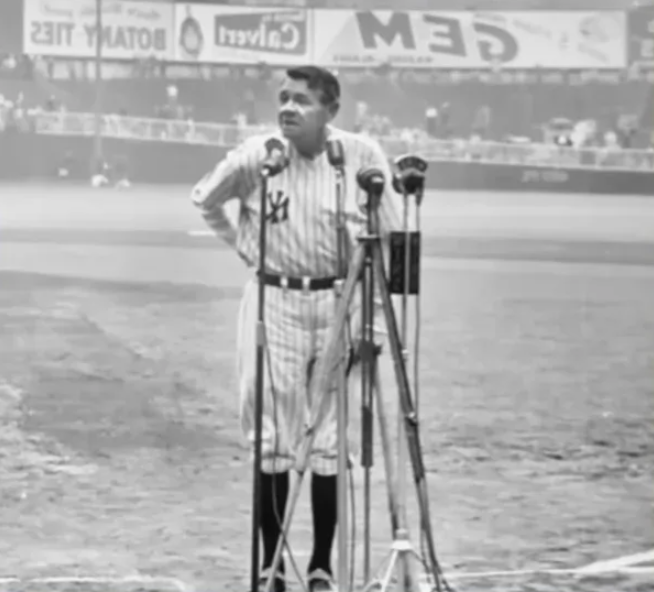
June 13, 1948. Yankee Stadium turned twenty-five, but the celebration belonged to someone else. The fans didn’t come for fireworks or festivities. They came to see a ghost.
Babe Ruth shuffled toward home plate, his pinstriped jersey hanging loose on a frame that cancer had ravaged. The man who once hit baseballs into legend could barely hold himself upright. His wife had dressed him that morning, her hands trembling as she buttoned his uniform—the same number 3 that had become synonymous with greatness. He’d protested coming at all. I look terrible, he’d said. But baseball called, and Babe Ruth always answered.
The microphones stood like metal crutches. He gripped them not as a speaker addressing a crowd, but as a sick man trying not to fall. Throat cancer had stolen his booming voice, the one that used to bellow across locker rooms and charm reporters. What remained was rough as sandpaper, a rasp that hurt to hear. But fifty thousand people leaned forward to catch every syllable.
Thank you… the boys… baseball…
The words came slowly, painfully. He couldn’t finish sentences. His breath gave out too quickly. Yet everyone understood. This wasn’t a speech—it was a goodbye. The Bambino, the Sultan of Swat, the man who had built this very stadium with his legend, stood at home plate one last time, not as a hero, but as a dying man giving everything he had left.
The roar that followed sounded like summer itself had come back to life. Fifty thousand people rose to their feet, and the sound filled every corner of the stadium. It wasn’t applause—it was gratitude. For the called shot. For the countless home runs. For making a generation believe that anything was possible if you swung hard enough. For giving them something to cheer about during the hardest years of their lives.
Ruth lifted his cap with a shaking hand. The gesture was small, almost fragile, but it carried the weight of everything he’d been. In that moment, he wasn’t thin or weakened or dying. He was still unmistakably Babe—the kid from Baltimore who’d changed baseball forever, who’d made legends seem real, who’d taught America that heroes could be flawed and beloved all at once.
Two months later, he was gone. The headlines mourned. The world paused. But Yankee Stadium—the House that Ruth Built—continued to stand. And it still does, carrying the echo of that final roar, that last tip of the cap, that rasp of a voice saying thank you one more time.
We build stadiums and monuments to remember greatness. But Babe Ruth’s final appearance wasn’t about statistics or records. It was about a man facing his mortality with courage, showing up even when showing up meant exposing his frailty. It was about a community honoring someone who’d given them joy, even as grief waited just beyond the outfield walls.
That day wasn’t a speech. It was a final swing of the heart—a rasp, a breath, a moment that filled the stadium one last time. And in the way that only sports can do, it reminded everyone watching that legends don’t just live in record books. They live in the echoes of cheers, in the memories of summer days, in the way we stand and roar when someone gives everything they have left.
The House that Ruth Built still holds the echo of that final roar.