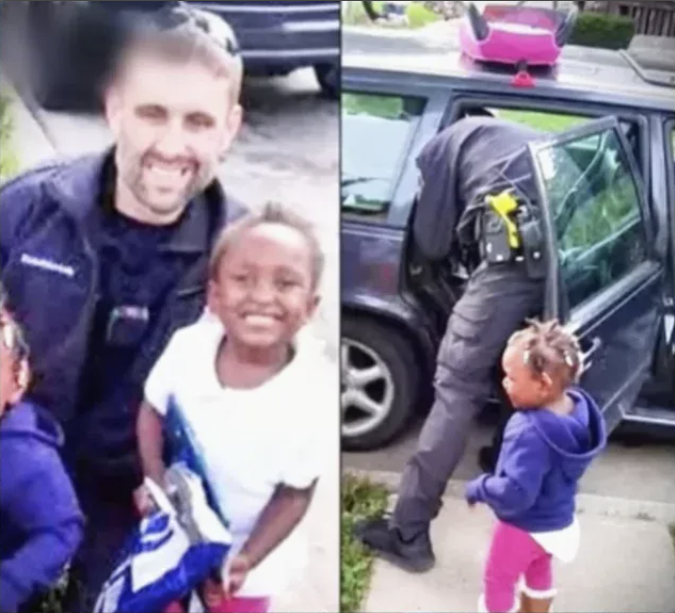
Three-year-old Amaya was small enough to disappear into the backseat. When Officer Zimmerman walked up to the car, he noticed her immediately—not because of the missing car seat, but because of her eyes. Wide. Terrified. Brimming with tears.
Her mother’s hands gripped the steering wheel. She’d been pulled over for a routine traffic stop, but there was nothing routine about the fear coursing through that car. No car seat. A three-hundred-dollar fine she couldn’t afford. Amaya whispered from the back, her tiny voice breaking: Are we going to jail?
Officer Zimmerman heard it. That small, trembling question that no child should have to ask.
Amaya’s mom worked five-dollar-an-hour shifts, stringing together just enough to keep food on the table and gas in the tank. A car seat cost more than half a week’s wages. She’d been praying every single day for her daughter’s safety, driving as carefully as she could, hoping nothing would happen before she could save enough. Now an officer stood at her window, and her worst fear seemed about to come true.
Zimmerman looked at the citation in his hand. He looked at the mother’s face—exhausted, ashamed, afraid. He looked at Amaya, shrinking in the backseat, tears streaming down her cheeks. And he made a choice.
Stay right here, sweetheart, he said softly, crouching down to meet Amaya’s eyes through the window. He smiled at her—not the polite smile of an officer doing his job, but the warm smile of someone who saw a scared little girl and wanted to fix it.
Minutes later, he returned. Not with a ticket. With a brand-new car seat.
He opened the back door and installed it himself, adjusting straps and buckles with the same care a father would. Amaya watched, her fear melting into confusion, then wonder. When he finished, he lifted her gently into the seat and buckled her in. She fit perfectly. Safe. Secure.
He saved me, Mama! Amaya beamed, her earlier terror replaced with pure joy. Her giggles filled the car—the sound of relief, of innocence restored.
Officer Zimmerman didn’t see a violation that day. He saw a mother doing her best in impossible circumstances. He saw a little girl who deserved to feel safe, not scared. He saw an opportunity to be more than an enforcer of rules—to be a protector in the truest sense.
That car seat cost money. But what it gave Amaya was priceless: the knowledge that not all uniforms mean danger, that sometimes help comes when you least expect it, and that the world still holds people who care. Her mother cried, but this time from gratitude. She’d been carrying the weight of that worry for so long, and in one act of kindness, it was lifted.
We talk about community policing, about building trust, about officers who go beyond the call of duty. But sometimes it’s simpler than that. Sometimes it’s about seeing a three-year-old’s tears and deciding they matter more than a fine. Sometimes it’s about recognizing that safety isn’t just about laws—it’s about compassion.
Amaya rode home that day buckled safely in her new car seat, giggling and telling her mom the story over and over. Officer Zimmerman went back to his shift. And somewhere in that city, trust between a community and its protectors grew a little stronger.
Some heroes protect the smallest passengers with the biggest hearts.