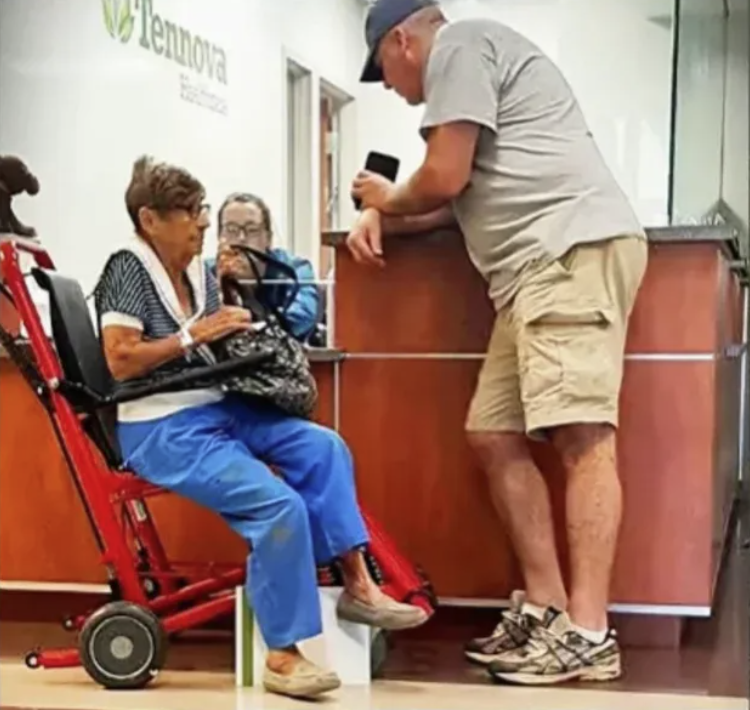
Margaret sat alone in her wheelchair in the hospital waiting room, staring at the forms in her lap. Eighty-seven years old, recently released after surgery, and facing a question she couldn’t answer: Emergency contact? Next of kin? She left both lines blank. There was no one to call. Her husband had died last month. Her only son, three years earlier in Afghanistan. She was the last one left.
“I have no family,” she whispered to the nurse. “No way home.” The words came out flat, defeated—the voice of someone who’d accepted that they’d been forgotten.
Across the room, Jeffery stood in his Army uniform, waiting for his own appointment. He was a Fort Campbell soldier, young, strong, capable. But when he heard Margaret’s words, something inside him cracked. Because Jeffery knew exactly what she was feeling. Six months ago, he’d sat in a different hospital, watching his mother die alone in a bed. She’d been sick for weeks, and he’d been deployed. By the time he got leave and rushed back, she was already gone. He’d arrived too late to say goodbye, too late to hold her hand, too late to tell her she wasn’t alone.
He walked over to Margaret’s wheelchair and knelt down. “Ma’am,” he said softly. “I’ll take you home.”
Margaret looked up, confused. “You don’t know me.” Jeffery nodded. “I know. But I know what it feels like to be alone. And I know my mom would have wanted someone to help her when I couldn’t be there.” His voice caught on the last words. “So I’m here for you. If you’ll let me.”
Margaret’s eyes filled with tears. “Your mother raised you well.” Jeffery’s throat tightened. “She died alone in a hospital bed while I was overseas,” he said quietly. “I can’t change that. But I can make sure you don’t have to be alone today.”
They drove in silence at first—Margaret in the passenger seat, Jeffery behind the wheel. But slowly, she started talking. About her son, who’d been brave and kind and had died serving his country. About her husband, who’d never recovered from losing their boy. About the house she was going home to that would be empty for the first time in sixty years. Jeffery listened, his hands steady on the wheel, his eyes focused on the road, but his heart breaking with every word.
When they pulled up to her house, Jeffery didn’t just help her inside. He stayed. He checked that she had groceries. He wrote down his phone number. “If you need anything—anything at all—you call me,” he said. Margaret took his hand. “Thank you for not letting me die forgotten,” she whispered. Jeffery shook his head, tears in his eyes. “You’re not forgotten. Not anymore.”
Over the following months, Jeffery checked in regularly. He brought groceries. He fixed things around her house. He sat with her on holidays. And Margaret—who thought she’d lost everyone—found herself with an unexpected family. Not blood. But something deeper: a bond forged in shared loss and the understanding that loneliness is something no one should face alone.
“Some angels wear uniforms,” Margaret tells people now, “and understand loneliness by heart.” And Jeffery—who couldn’t save his mother—found a way to honor her memory by making sure another mother would never feel abandoned. Because that’s what love does. It doesn’t die with the people we’ve lost. It transforms. It extends. It finds new ways to show up, even when showing up means kneeling beside a stranger in a hospital and saying two simple words: “I’ll stay.”