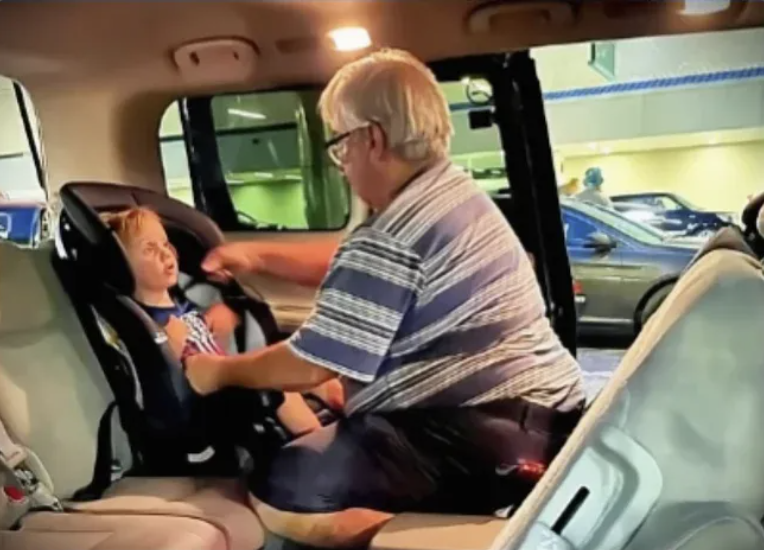
Tim’s hands moved with practiced precision, threading the seat belt through the car seat base, checking the angle, pulling the strap tight. The young mother stood beside him, her infant son sleeping peacefully in her arms. “I had no idea it was this complicated,” she admitted. Tim smiled gently. “Most people don’t. That’s why I’m here.”
What she didn’t know was why Tim was really there—why he spent his weekends in parking lots teaching strangers how to install car seats, why he’d become certified as a technician, why his hands never stopped moving through the straps and buckles with an urgency that went beyond simple helpfulness.
Three years ago, Tim’s four-year-old grandson died in a car accident. The impact itself wasn’t fatal. But the car seat had been installed incorrectly—at the wrong angle, with the straps too loose. In the collision, the seat failed. And Tim’s grandson, the little boy who called him “Papa” and insisted on wearing his grandfather’s too-big baseball cap everywhere, was gone.
Tim had installed that car seat himself. He’d thought he’d done it right. He’d pulled the straps, checked the base, felt confident. But he’d missed something—a small detail that meant everything. When the police officer explained what had gone wrong, Tim felt his world collapse. He’d failed to protect the one person he loved most. And that failure had cost his grandson his life.
For months, Tim couldn’t forgive himself. He’d wake up in the middle of the night, replaying the installation in his mind, wondering which strap he’d missed, which angle he’d gotten wrong. His wife found him in the garage one night, sitting in their car, staring at the empty backseat. “I should have known,” he kept saying. “I should have learned.”
It was a grief counselor who suggested that Tim’s guilt might transform into purpose. “What if you learned now?” she asked gently. “What if you made sure other grandparents, other parents, never made the same mistake?”
Tim enrolled in “Grandpa School”—a car seat safety certification program. He studied crash test data, installation techniques, the physics of impact. He learned that 73% of car seats are installed incorrectly, that most parents and grandparents don’t know about critical safety angles and weight limits. He learned that what happened to his grandson wasn’t rare—it was preventable.
Now, Tim sets up in parking lots, community centers, hospitals—anywhere new parents might be. He’s installed more than 50 car seats. Each one takes him 20 to 30 minutes. He doesn’t rush. He explains every step, points out common mistakes, answers every question. And when he’s done, he places his hand on the car seat and says the same thing every time: “Your baby is safe now.”
The young mother in front of him today watched as Tim finished the installation. “Thank you so much,” she said. “You didn’t have to spend this much time.” Tim looked at her baby—peaceful, protected, secured properly. “Yes, I did,” he said quietly. Then, after a pause: “I learned this in grandpa school. Now I’m making sure everyone else knows what I didn’t.”
She didn’t ask what he meant. But as Tim walked back to his car, he felt the familiar ache in his chest—the one that never fully goes away but feels a little lighter every time he secures another child safely in place. He couldn’t change the past. He couldn’t bring his grandson back. But he could change someone’s future. One buckle, one strap, one properly installed car seat at a time.
“We can’t change the past,” Tim tells people who ask why he does this. “But we can change someone’s future.” And in that mission—in every child he helps keep safe—his grandson’s memory becomes something more than loss. It becomes a legacy that saves lives.